Clear Sky Science · en
Curvature-induced effects on the vortex domain wall properties in bent nanotubes
Why the Shape of Tiny Tubes Matters
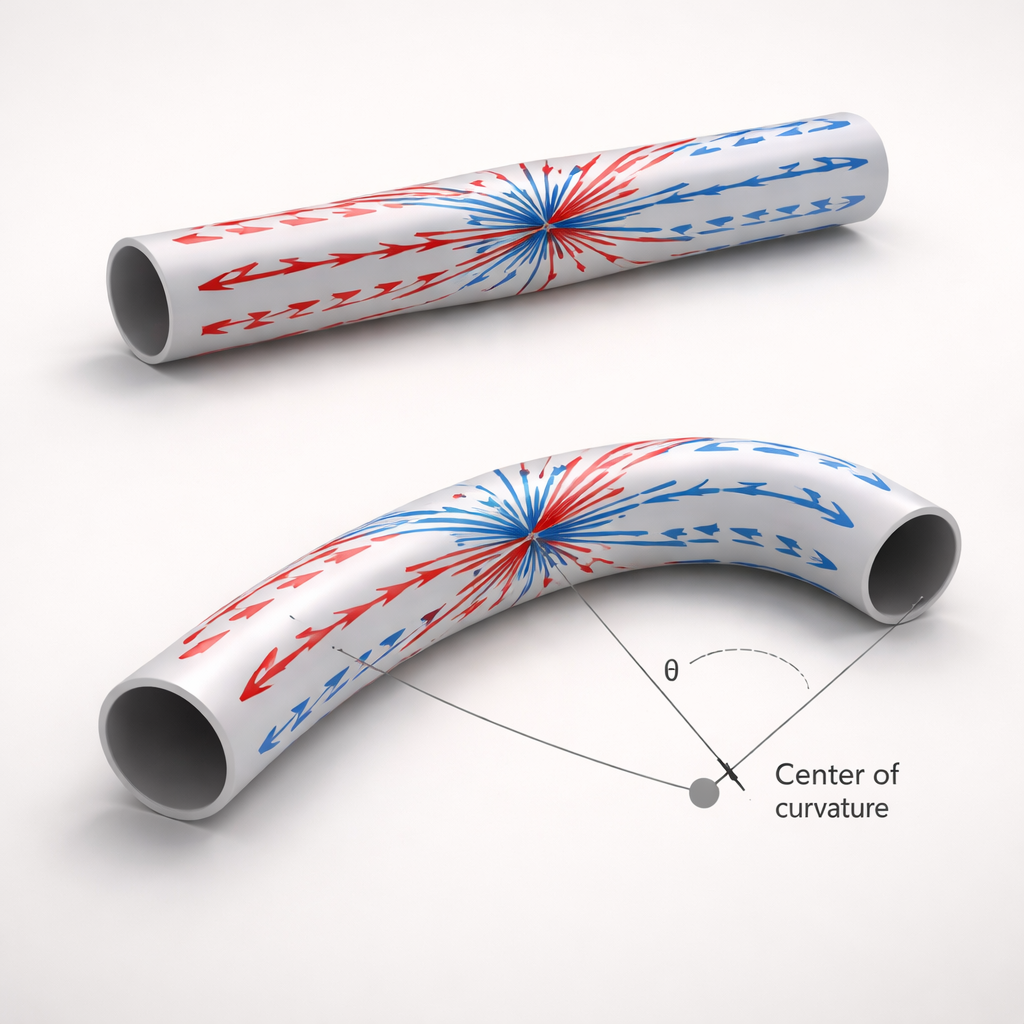
Inside future computers, information may be stored and moved not by electric charges but by tiny magnetic regions racing along microscopic tracks. This study asks a deceptively simple question with big technological implications: if you bend those magnetic tracks into gentle arcs instead of keeping them straight, does their performance change? By carefully modeling how a special kind of magnetic pattern, called a vortex domain wall, behaves in bent nanotubes, the authors show that geometry alone can speed up or slow down magnetic signals and even change how they prefer to move.
Bending Magnetic Race Tracks
Modern spintronics aims to use the spin of electrons—their tiny magnetic moment—to process and store information more efficiently than conventional electronics. One promising building block is the magnetic nanotube: a hollow cylinder only tens of billionths of a meter across. In these tubes, information can be encoded in the positions of domain walls, the narrow regions separating areas magnetized in opposite directions. The authors focus on vortex domain walls, where the magnetization curls around the tube like stripes on a candy cane, avoiding singular points that would otherwise be unstable. As fabrication methods improve, it is becoming feasible to make nanotubes that are not straight but gracefully curved or even fully three‑dimensional, raising the question of how such shapes influence magnetic behavior.
How Curvature Reshapes the Wall
Using large-scale computer simulations supported by an analytical model, the researchers examine nanotubes that are identical in size and material but differ in how much they are bent. They find that as the tube curvature increases, the vortex domain wall becomes wider, meaning the transition region between oppositely magnetized sections spreads out. At the same time, a small portion of the magnetization in the wall center tilts slightly away from the tube surface. This tilt reflects a subtle tug-of-war: by leaning out of the surface, the spins can reduce one kind of energy associated with neighboring spins wanting to align smoothly, but they pay a cost in magnetic “charge” at the surface. Bending the tube shifts this balance, so curvature acts like an additional, geometry-induced interaction that favors a different wall shape. The total magnetic energy of the wall rises with curvature, revealing that bending is not just a gentle deformation but a genuine way to tune the energetic landscape.
Curved Tubes Change How Fast Information Travels
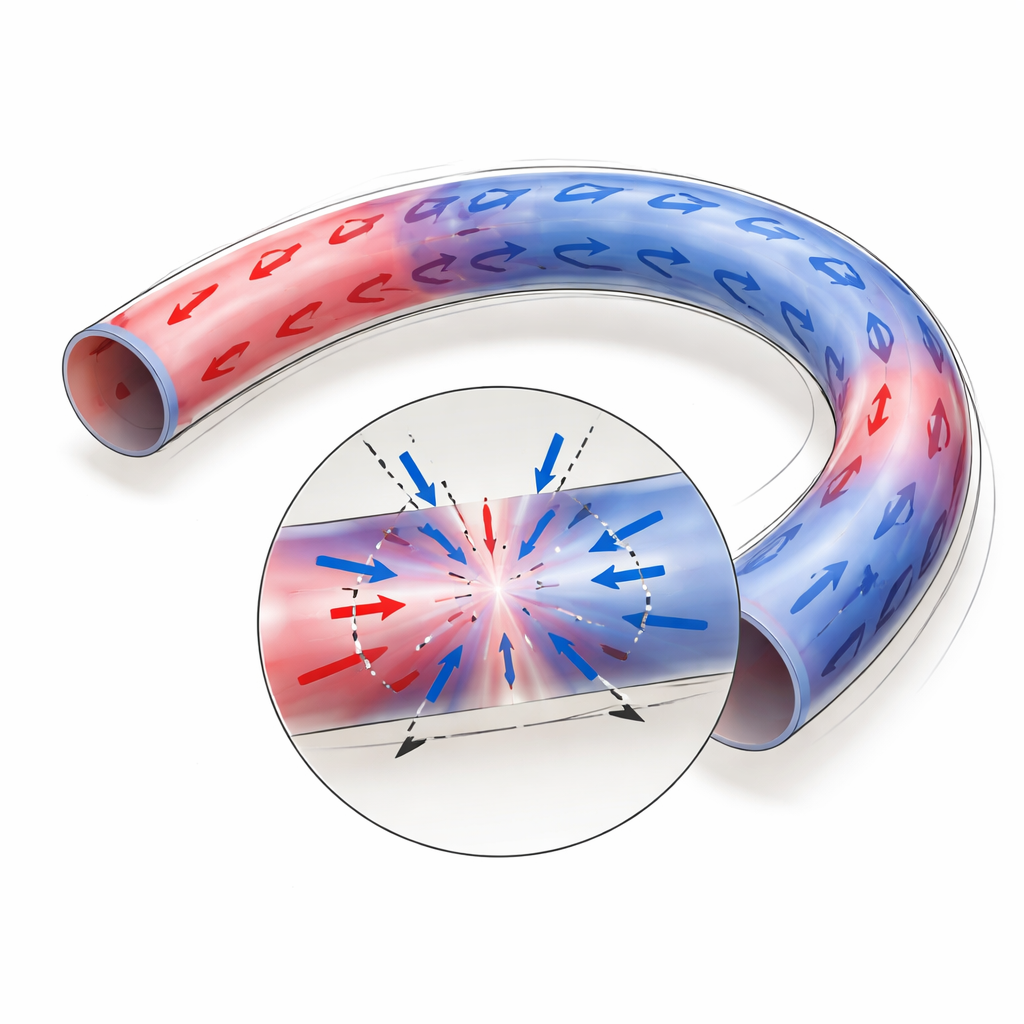
The team then studies what happens when an external magnetic field drives the vortex domain wall along the tube, mimicking how data might be moved in a device. In straight nanotubes, previous work showed a striking asymmetry: walls move faster in one direction than the other, depending on how their internal magnetization curls, a form of chiral symmetry breaking. The new simulations reveal two key changes when the tube is bent. First, the average speed of the wall increases with curvature, so a more strongly bent tube can shuttle information more quickly under the same field. Second, the difference in speeds between the two opposite directions steadily shrinks as curvature grows. In other words, bending not only boosts the wall’s mobility but also makes its motion more symmetric, partially canceling the directional preference seen in straight tubes.
Designing Better Magnetic Devices with Shape
These findings suggest that curvature is a powerful design knob for future spintronic technologies. On one hand, strongly bent nanotubes could be used where fast, efficient motion of domain walls is desired, such as in next‑generation “racetrack” memories that shift bits of data along nanoscopic loops. On the other hand, the same curvature tends to suppress direction‑dependent effects that some devices might want to exploit, such as non‑reciprocal elements that treat signals differently depending on which way they travel. By carefully choosing how much to bend these tiny tubes, engineers may be able to strike a balance between speed and directional control, using geometry itself as a quiet but precise way to program the behavior of magnetic information carriers.
Citation: Nunes, J.V., Castillo-Sepulveda, S., Costilla, J.I. et al. Curvature-induced effects on the vortex domain wall properties in bent nanotubes. npj Spintronics 4, 7 (2026). https://doi.org/10.1038/s44306-026-00127-1
Keywords: magnetic nanotubes, domain walls, spintronics, curvature effects, racetrack memory