Clear Sky Science · en
Antiferromagnetic domain wall in ferrimagnetic bilayers controlled by magnetic spin Hall effect
Magnetism That Shrugs Off External Fields
Modern electronics store and move information by shuttling electric charge. Spintronics aims to go further by using the tiny magnetic “spins” of electrons, promising faster, cooler, and more compact devices. A big obstacle, however, is that many of the most attractive magnetic states are stubbornly hard to control. This study shows how to tame one such state—antiferromagnetic order—using cleverly designed magnetic materials and an unusual spin current, opening doors to robust, field-proof memory technologies.
Why Antiferromagnets Are So Tempting—and So Tricky
In ordinary magnets, many spins line up in the same direction, creating a net magnetic field that can be nudged around by external magnets. In antiferromagnets, neighboring spins point in opposite directions, canceling out the overall field. This makes them almost invisible to external magnetic fields, which is ideal for densely packed memory elements that do not disturb one another. But that same insensitivity makes them very difficult to steer or switch. Researchers therefore look to ferrimagnets—materials where two kinds of magnetic atoms are anti-aligned but not perfectly balanced—as a more manageable stand-in that can imitate antiferromagnets while still responding to fields and currents.
Building a Hidden Magnetic Boundary
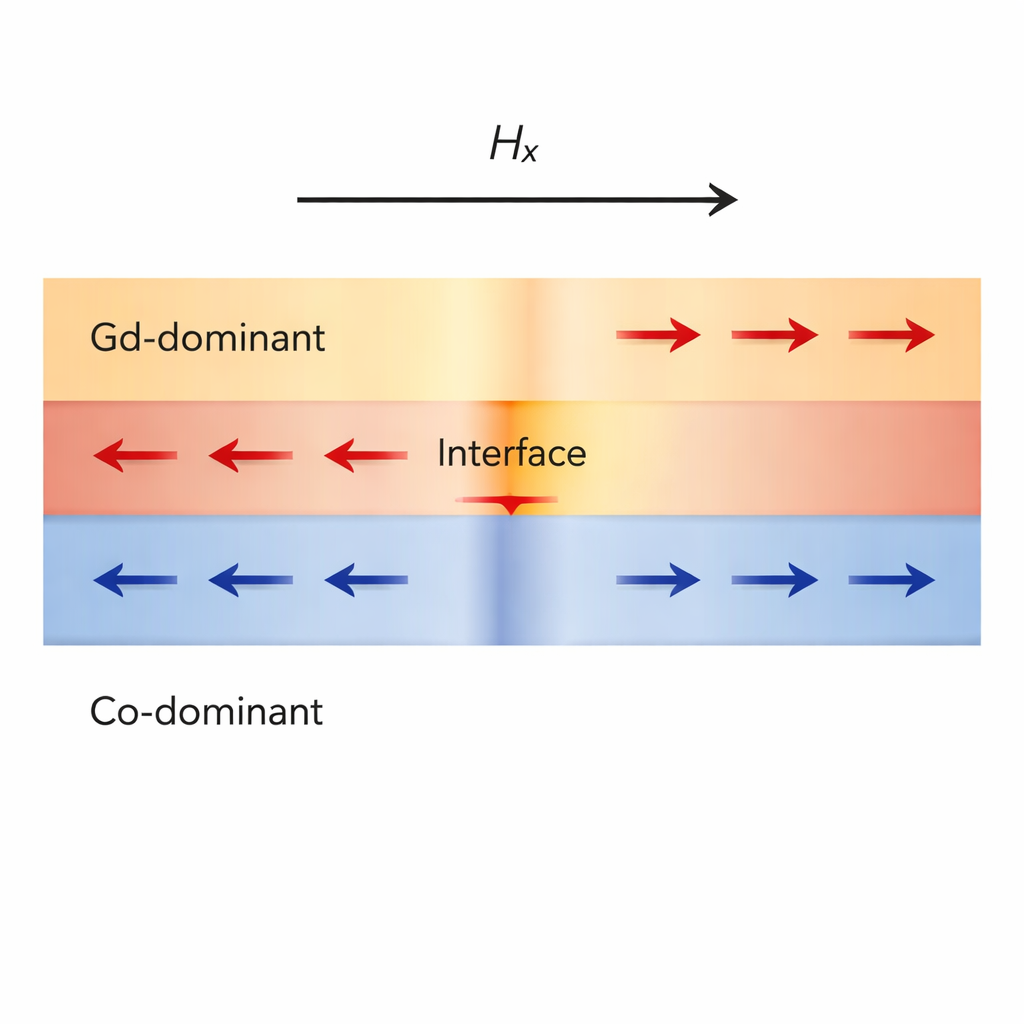
The authors use a ferrimagnetic alloy made of gadolinium (Gd) and cobalt (Co), where Gd and Co moments point in opposite directions. By slightly changing the composition of Gd and Co in different layers, they stack an upper layer that is Gd‑dominant on top of a lower layer that is Co‑dominant. Because atoms mix a little at the interface, there is a smooth transition from one composition to the other. Right in the middle of this transition, the net magnetization nearly vanishes even though the Gd and Co sub‑moments remain opposed. This region naturally forms what is called a domain wall with antiferromagnetic character, acting like a razor‑thin, field‑immune boundary between two magnetic states.
Harnessing a New Kind of Spin Current
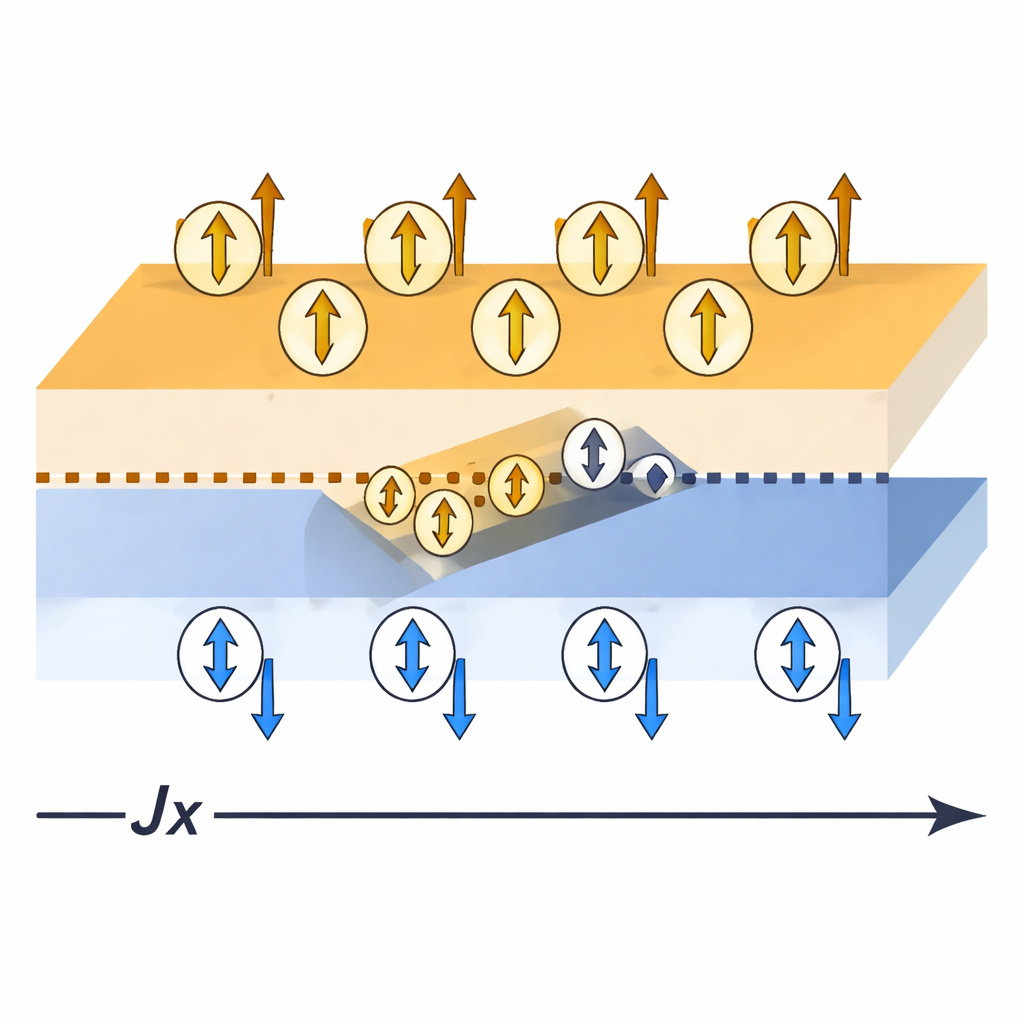
To manipulate this hidden boundary, the team turns to the magnetic spin Hall effect, a cousin of the better known spin Hall effect in which an electric current generates a flow of spins. In the usual version, the spin direction is fixed by the crystal and does not care about the magnetization, so the contributions from the two layers tend to cancel at the interface. In the magnetic spin Hall effect, by contrast, spin‑orbit coupling works together with the magnetization so that the direction of the spin current depends on how the moments are oriented. In their GdCo bilayer, the conduction electrons mainly follow the Co moments. Because the Co spins in the two layers point in opposite directions, the resulting spin currents at the interface add up instead of canceling, producing a strong flow of spins pointing out of the plane.
Seeing and Steering the Invisible Wall
This out‑of‑plane spin current acts like a localized magnetic “push” on the interfacial domain wall, tilting a tiny part of its magnetization slightly out of the film. Although the overall magnetization is nearly zero, this small tilt can be detected through the anomalous Hall effect, an electrical signal that tracks out‑of‑plane magnetic components. By measuring this Hall resistance while sweeping magnetic fields and temperatures, the researchers confirm that the signal truly comes from the interfacial wall and that the wall itself behaves in an antiferromagnetic, field‑immune way. Crucially, when they change the direction or strength of the electric current, the Hall signal changes linearly, showing that the magnetic spin Hall effect can reliably twist the wall’s internal structure and even reverse its handedness—its microscopic “chirality.”
From Fundamental Physics to Future Memory
In simple terms, the study demonstrates a recipe for creating a tiny, robust magnetic boundary that ignores external magnetic fields yet remains highly sensitive to spin currents generated inside the material. By carefully engineering ferrimagnetic bilayers and exploiting the magnetic spin Hall effect, the authors achieve electrical control over an antiferromagnetic‑like domain wall in an amorphous alloy. This combination of stability and tunability could be a building block for future three‑dimensional spintronic memories, where information is stored in stacks of such walls that can be moved or reoriented by modest electric currents rather than by bulky magnetic fields.
Citation: Ko, S., Kim, H., Han, D. et al. Antiferromagnetic domain wall in ferrimagnetic bilayers controlled by magnetic spin Hall effect. npj Spintronics 4, 6 (2026). https://doi.org/10.1038/s44306-026-00126-2
Keywords: spintronics, antiferromagnet, ferrimagnet, spin Hall effect, magnetic memory