Clear Sky Science · en
Microscopic origin of the magnetic interactions and their experimental signatures in altermagnetic La2O3Mn2Se2
Why hidden magnetism matters
Inside many of today’s technologies—from computer hard drives to proposed quantum devices—magnetism quietly does the heavy lifting. But not all magnets behave like the familiar bar magnet on a fridge. This paper explores an unconventional type of magnetism, called altermagnetism, in a crystalline compound named La2O3Mn2Se2. Understanding how its atoms and electrons cooperate to produce this unusual behavior could open doors to faster, more efficient electronics that manipulate electron spin without generating stray magnetic fields.
A new kind of order in a quiet magnet
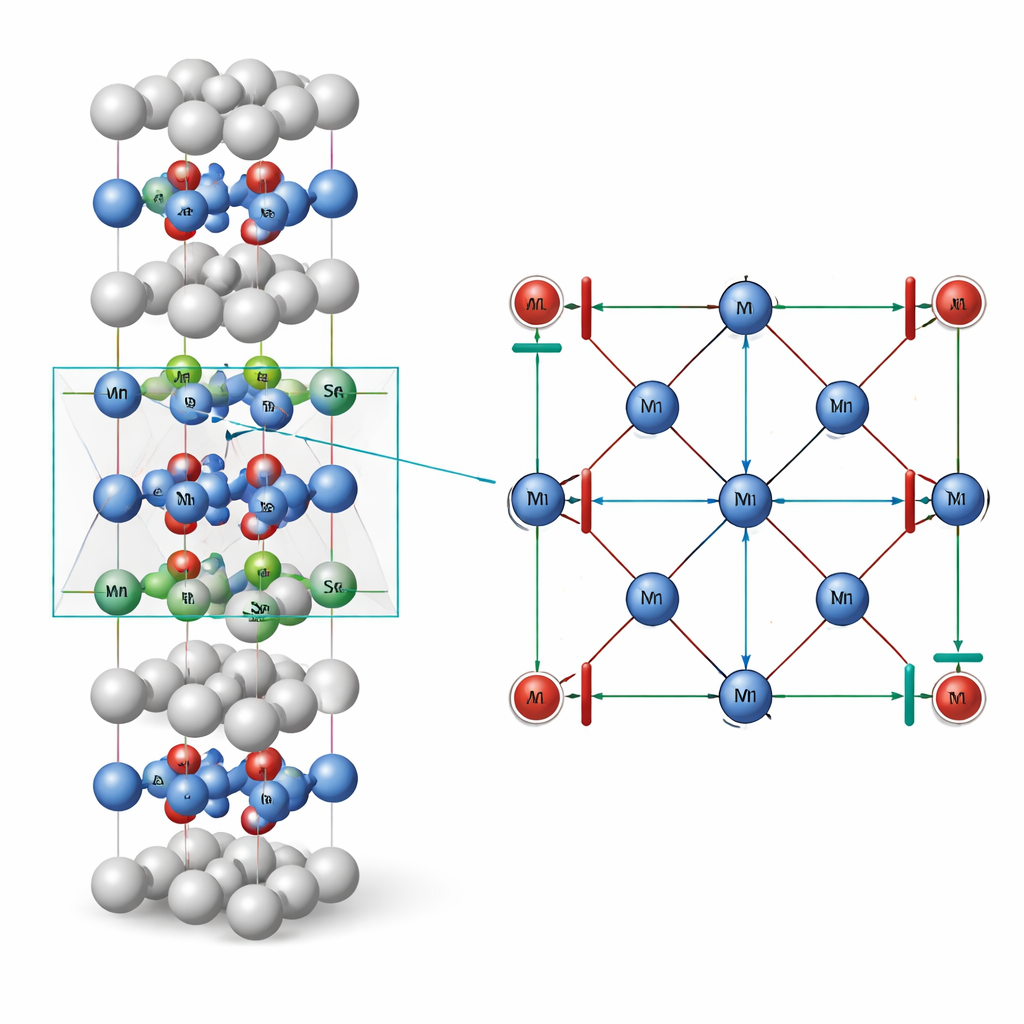
Traditional magnets fall into two main camps. Ferromagnets have spins that line up and create a strong overall magnetization. Antiferromagnets have neighboring spins that point in opposite directions so their magnetization cancels out. Altermagnets sit intriguingly between these two: their spins still cancel overall, but moving electrons “see” a splitting similar to that in ferromagnets, which can be very useful for spin-based electronics. La2O3Mn2Se2 fits into this new category because its manganese atoms form what is known as an inverse Lieb lattice—a repeating pattern that naturally hosts two intertwined magnetic sublattices with opposite spin directions yet preserves a simple, undoubled unit cell in space.
How the atomic scaffold shapes magnetism
The authors begin by examining the crystal structure in detail. Layers made of manganese (Mn), oxygen (O), and selenium (Se) form a two-dimensional network, with lanthanum (La) sheets acting as spacers. Within each magnetic layer, two manganese sublattices sit in slightly different positions, while oxygen and selenium atoms occupy the corners and edges of the square-like pattern. This geometry allows neighboring manganese atoms to interact either directly or through “superexchange” paths that run Mn–O–Mn or Mn–Se–Mn. Crucially, the nearest-neighbor interactions link opposite sublattices, while next-nearest neighbors connect atoms on the same sublattice. This subtle distinction is what enables altermagnetism to emerge.
Untangling the competing magnetic forces
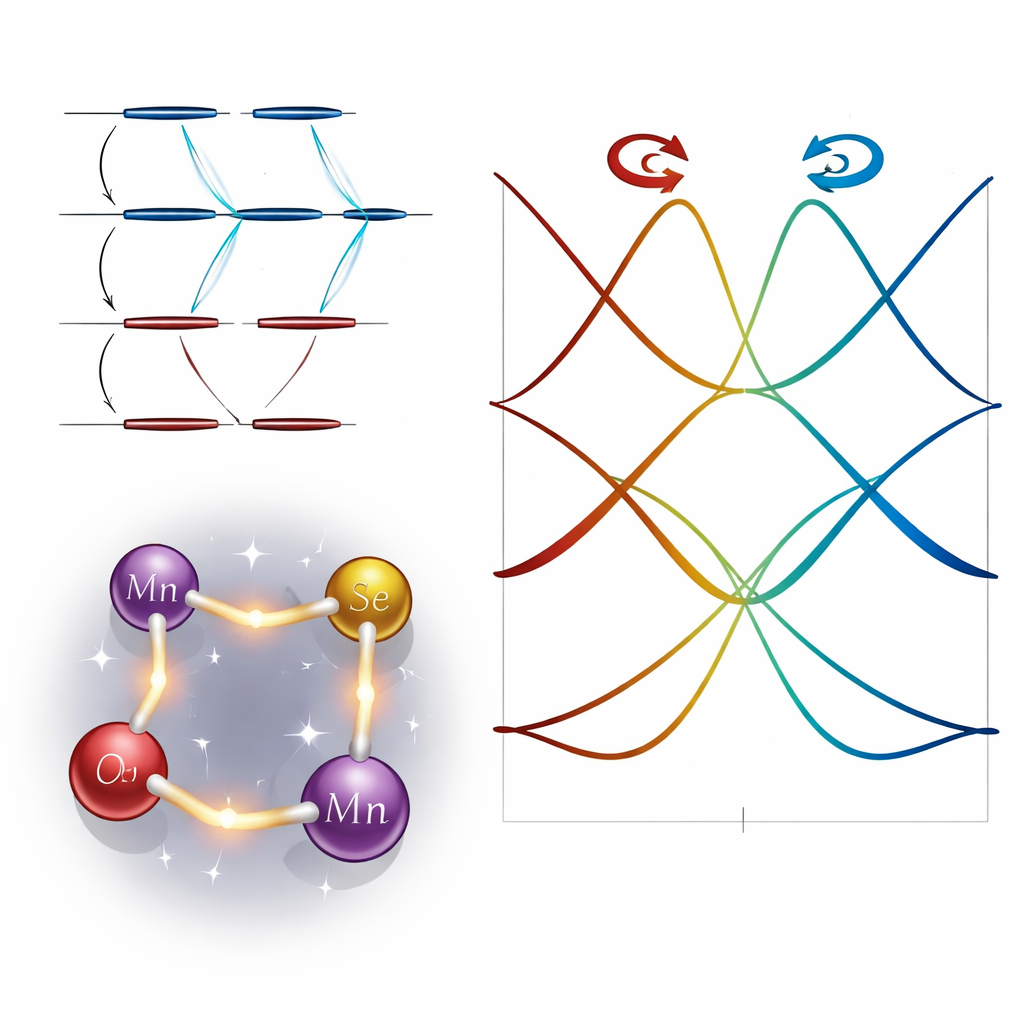
To find out which interactions dominate, the researchers carried out state-of-the-art electronic structure calculations and then translated those results into a simpler magnetic model. They discovered that the strongest interaction between manganese atoms is antiferromagnetic and occurs between nearest neighbors. Weaker—but still antiferromagnetic—interactions occur between next-nearest neighbors on the same sublattice. At first glance, this seems to contradict well-known Goodenough–Kanamori–Anderson rules, which often predict different signs of coupling for the 90-degree and 180-degree bond angles present here. By dissecting the electron hopping processes in terms of atomic orbitals, the team shows that the full set of manganese d orbitals and their detailed overlaps with oxygen and selenium orbitals overturn the naive rules and favor antiferromagnetism throughout.
Watching collective spin waves reveal the pattern
Magnetically ordered materials do not just have static spins; they support ripples of spin known as magnons, which can be probed in neutron scattering experiments. The authors calculated these magnon bands for La2O3Mn2Se2 using linear spin-wave theory. Because the two next-nearest-neighbor couplings are similar but not identical, the magnon spectrum shows small, characteristic splittings at particular points in momentum space. These splittings are “chiral,” meaning that the associated magnons carry a handedness related to the direction of spin precession. The size and position of these splittings provide direct fingerprints of the underlying exchange interactions and offer experimentalists a roadmap for measuring them.
From microscopic detail to practical clues
Altogether, the study explains how a seemingly ordinary manganese compound realizes a sophisticated altermagnetic state. The authors show that a combination of strong direct overlap between certain manganese orbitals and carefully tuned superexchange paths through oxygen and selenium stabilizes robust antiferromagnetic couplings while still producing the band splittings useful for spintronics. Although La2O3Mn2Se2 itself shows only modest chiral magnon effects, closely related materials in the same structural family are likely to exhibit much stronger signatures. For non-specialists, the takeaway is that by reading and engineering the fine details of atomic geometry and orbital overlap, researchers can design “hidden” magnets that quietly control electron spins—potentially enabling low-power, high-speed devices without the disruptive stray fields of conventional magnets.
Citation: Garcia-Gassull, L., Razpopov, A., Stavropoulos, P.P. et al. Microscopic origin of the magnetic interactions and their experimental signatures in altermagnetic La2O3Mn2Se2. npj Spintronics 4, 9 (2026). https://doi.org/10.1038/s44306-025-00125-9
Keywords: altermagnetism, spintronics, magnon spectrum, exchange interactions, La2O3Mn2Se2