Clear Sky Science · en
Megafires in Mediterranean Europe: the compound role of fire weather and drought
Why These Giant Fires Matter
In recent summers, vast wildfires have swept across parts of Portugal, Spain, Italy, Greece, and other Mediterranean countries, sometimes burning tens of thousands of hectares and overwhelming firefighters. This study asks a simple but urgent question: why do a few fires explode into landscape‑scale “megafires” while most stay relatively small, and can we see those runaway events coming before they unfold?
From Ordinary Fires to Rare Giants
The researchers examined 11,403 summer wildfires across Mediterranean Europe between 2008 and 2022, each larger than 30 hectares. They grouped them into four size classes: medium, large, very large, and megafires, the last category starting at 10,000 hectares. Most fires were medium or large and together made up over 90 percent of all events. Yet a tiny fraction—just 0.4 percent of fires—qualified as megafires, and these rare giants alone accounted for nearly one fifth of all burned area. The team found that very large fires occur across the region, but megafires are particularly clustered in Portugal and north‑western Spain, with additional hotspots in Sardinia, Greece, and western Turkey, where landscapes offer continuous fuels and challenging terrain.
Weather, Drought, and Fuel Working Together
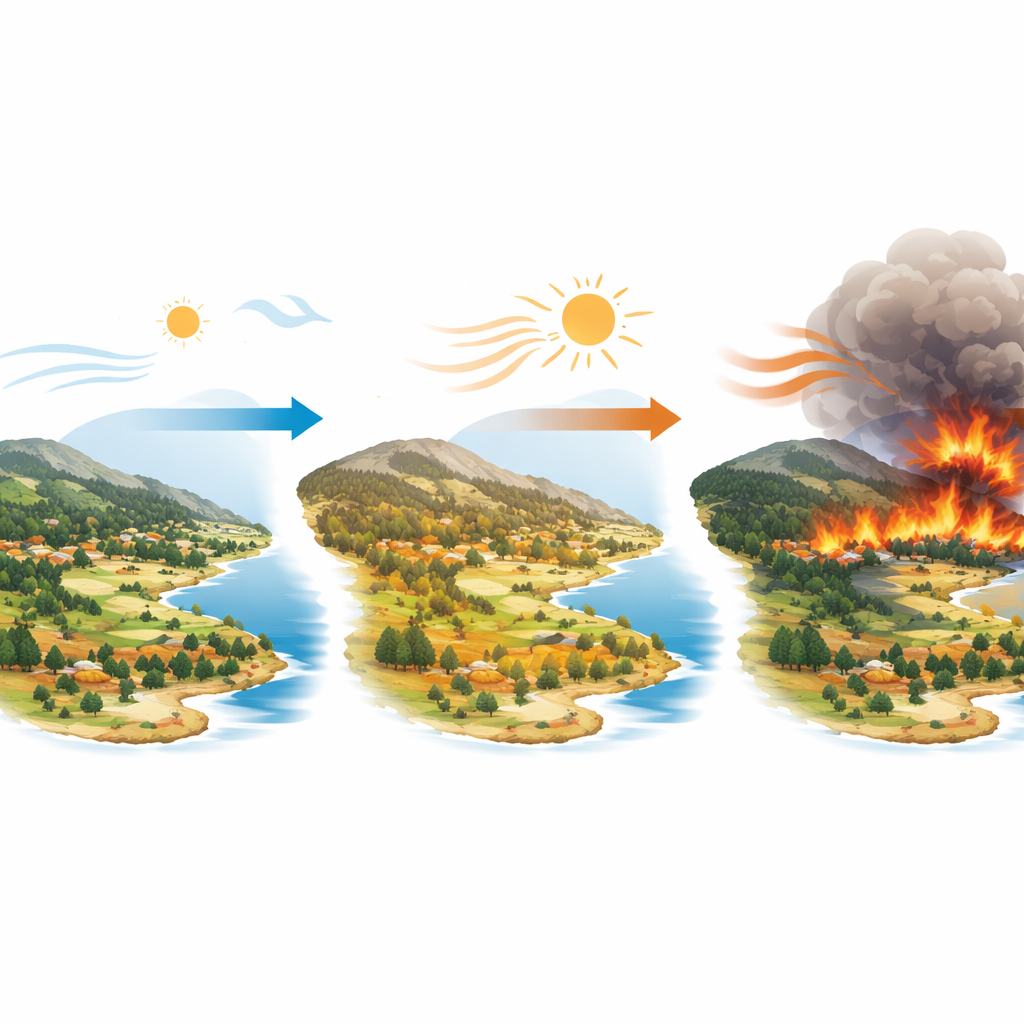
To uncover what pushes a fire from one size class to the next, the authors combined detailed fire perimeter maps with a high‑resolution environmental “datacube.” This dataset tracks day‑to‑day weather, land‑surface temperatures, vegetation, soil moisture, and multi‑month drought indicators across the Mediterranean. They distinguished between fast‑reacting variables, such as daily heat, humidity, wind, and rainfall near the time of ignition, and slow‑reacting variables, such as long‑term drought and fuel dryness that build up over weeks to months. Their analysis shows a clear pattern: as fires get larger, they are increasingly associated with hotter conditions, drier air and soils, stronger winds, and multi‑month drought. These background conditions act like a preloaded spring, making vegetation more flammable and helping initial ignitions escape early control.
What Makes a Megafire Different
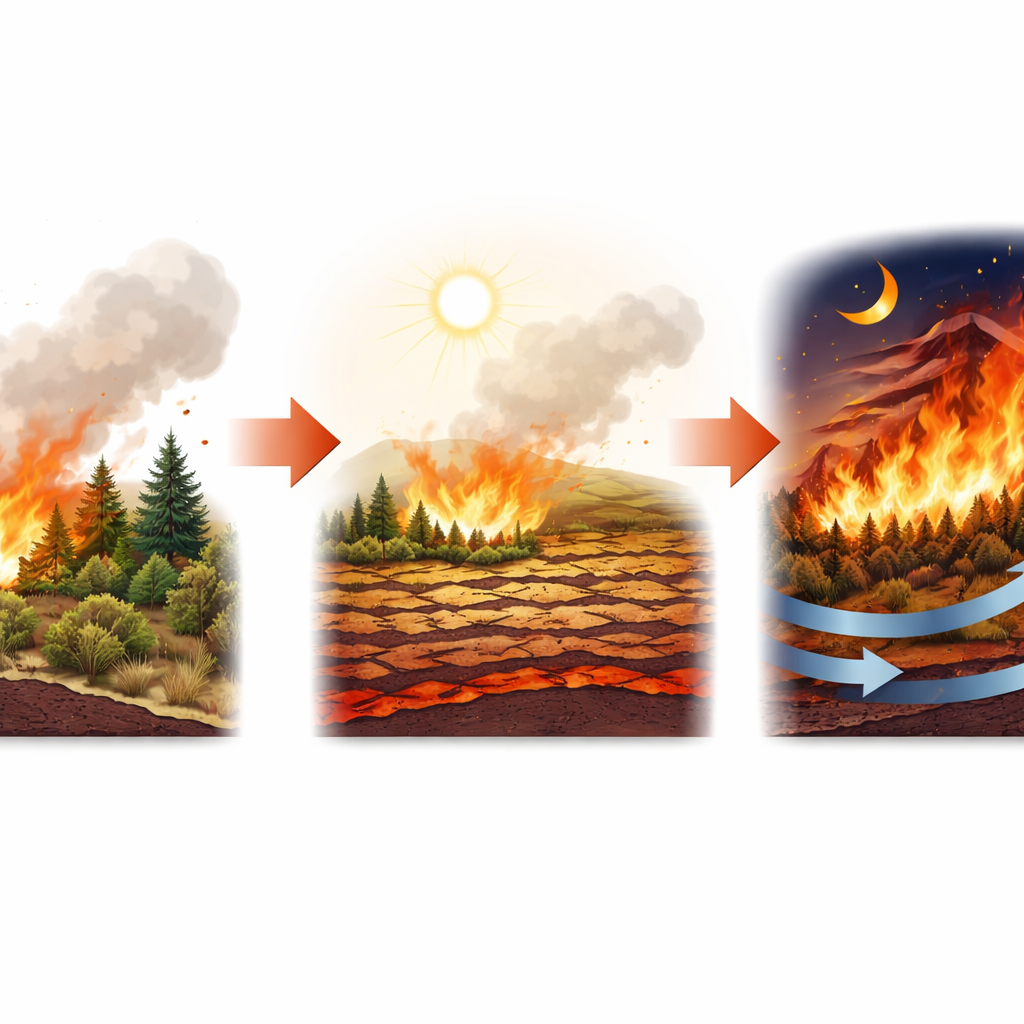
Strikingly, the jump from already very large fires to true megafires does not hinge on ever‑worse drought or visibly sparser vegetation. Instead, it is tied to an additional boost in short‑term fire weather, especially unusually warm nights and strong winds around the time the fire starts. Using machine‑learning models and logistic regression, the authors found that nighttime land‑surface temperature and wind speed consistently emerge as the most powerful predictors of fires crossing into bigger classes, including the mega category. A key insight is that hotter nights mean fuels do not recover moisture after sunset, and the traditional “night shift” window when firefighters can safely and effectively attack a blaze is shrinking. When continuous dry fuels, multi‑month drought, warm nights, and strong winds align, fires are far more likely to grow beyond what suppression teams can contain.
How Predictable Are These Escalations?
Because megafires are rare, it is challenging to build reliable statistical models. Even so, the authors showed that with just a handful of variables—chiefly nighttime land‑surface temperature, wind speed, and a three‑month drought index—models can correctly identify a majority of the largest fires in independent tests. The predictability improves with fire size: transitions toward bigger classes, especially those involving megafires, are less random and more strongly governed by systematic weather and fuel conditions. Smaller fires, by contrast, are more affected by chance ignitions and immediate suppression success. Robust checks suggest that the key findings do not depend on any single extreme event, and that the nighttime temperature signal reflects real environmental warmth rather than the glow of the fire itself.
Living with Fire in a Warming Mediterranean
For a lay reader, the take‑home message is that megafires in Mediterranean Europe arise when long‑lasting drought and abundant fuels line up with short bursts of exceptional weather, especially hot, dry, windy days that no longer cool off at night. These conditions are becoming more frequent as the climate warms and heatwaves intensify. While we cannot control the weather, we can influence how much and how continuously the landscape can burn. The study argues that reducing fuel loads and breaking up continuous forests and shrublands—through strategic land management, targeted fuel treatments, and careful planning of where people live and build—can make it harder for extreme weather to translate into uncontrollable megafires.
Citation: Ghasemiazma, F., Tonini, M., Fiorucci, P. et al. Megafires in Mediterranean Europe: the compound role of fire weather and drought. npj Nat. Hazards 3, 33 (2026). https://doi.org/10.1038/s44304-026-00197-5
Keywords: megafires, Mediterranean wildfires, drought and heat, fire weather, climate change impacts