Clear Sky Science · en
Assessment of ground-motion prediction equations using observations and information theory: application to the Northeastern Tibetan Plateau
Why this matters for people and places
Earthquakes do not just shake the ground; they test the safety of cities, dams, and lifelines that millions of people depend on. In the northeastern Tibetan Plateau, a rugged region crisscrossed by active faults, engineers must estimate how hard the ground will shake during future quakes even though only a few modern events have been well recorded. This study explores how to judge which mathematical recipes for predicting shaking are most trustworthy in such data-poor but high‑risk areas.
A restless corner of Asia
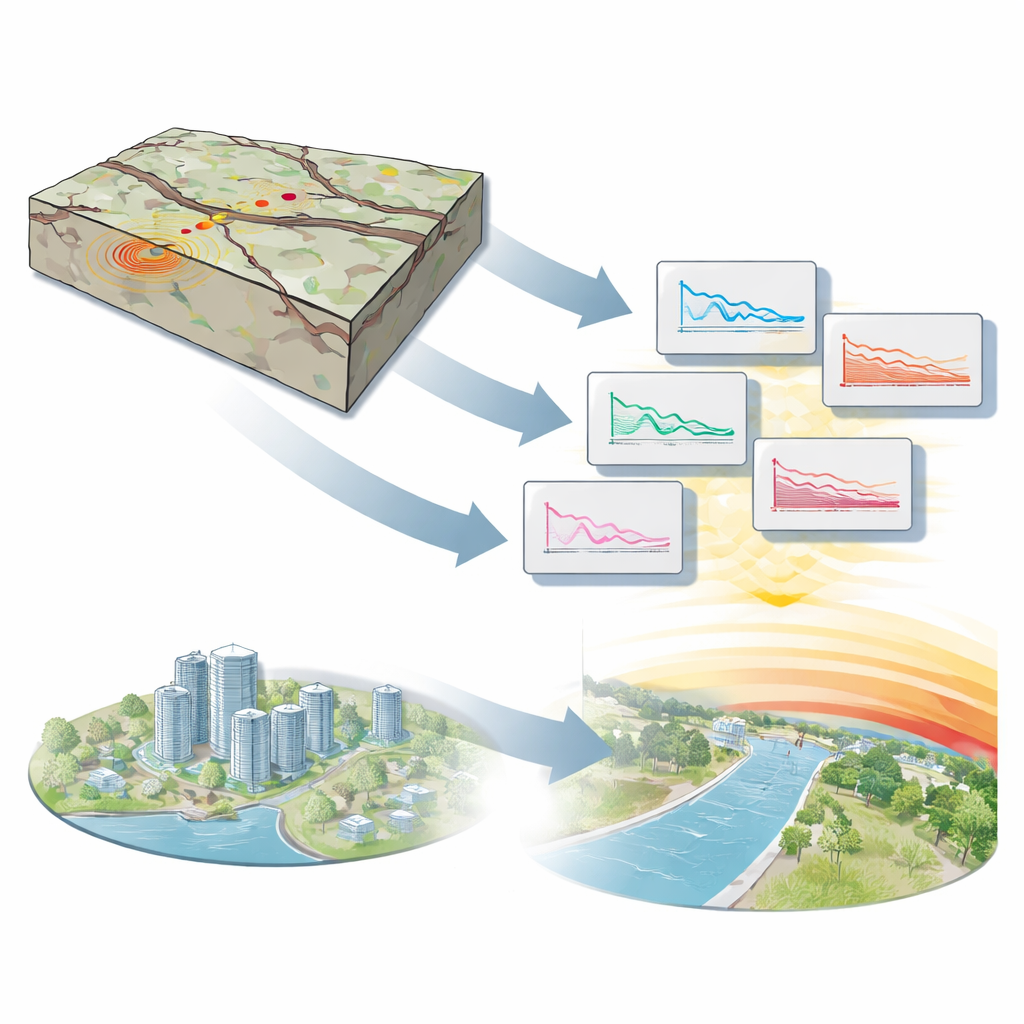
The northeastern Tibetan Plateau sits at the meeting point of several crustal blocks where India continues to grind into Eurasia. The area is cut by a web of major faults and has produced dozens of moderate to great earthquakes, including some of the strongest in China over the past century. Critical infrastructure, such as a chain of large hydropower dams that supplies a significant share of China’s electricity, lies directly in harm’s way. To design and retrofit such structures, planners rely on ground‑motion prediction equations—formulas that convert earthquake size, distance, fault type, and soil conditions into estimates of shaking strength. Yet almost no strong‑motion instruments were in place for most past earthquakes here, so it has been unclear which existing formulas actually work best for this complicated terrain.
How scientists usually judge shaking formulas
When enough recordings are available, researchers test prediction formulas in a straightforward way: they compare the shaking each model predicts with what instruments actually measured. Differences between observed and predicted values are summarized with error statistics, a family of measures often called residual analysis. Using new datasets from two recent events—the 2022 Menyuan strike‑slip earthquake and the 2023 Jishishan thrust earthquake—the authors applied this approach to five widely used formulas tailored to China and nearby regions. For Menyuan, all five captured the overall level of shaking, but one model developed specifically for the region showed the tightest match. For Jishishan, however, every model struggled, especially for the strongest shaking, and a different formula emerged as the top performer. The rankings shifted from one event to the other, revealing that success for one type of quake does not guarantee success for another.
Using information hidden in the models themselves
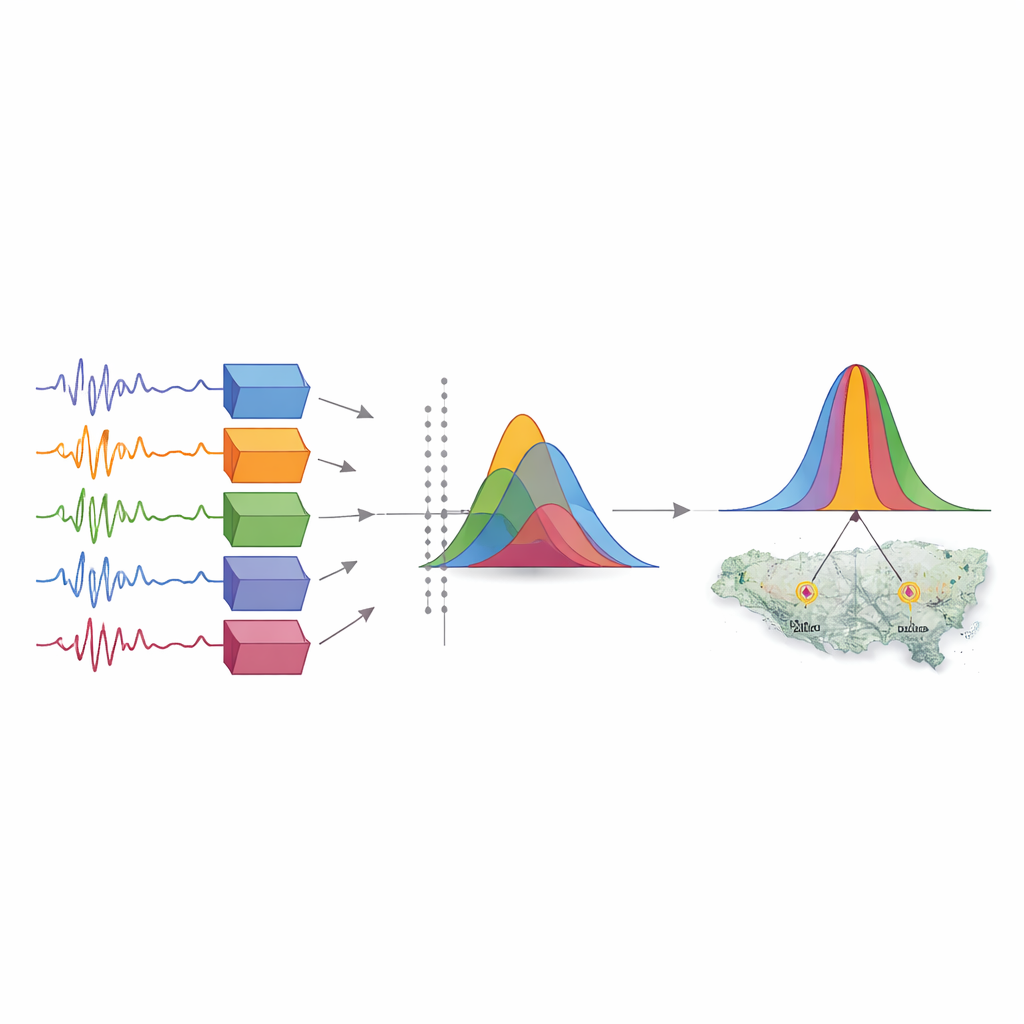
Because large, well‑recorded earthquakes are rare in this region, the study also turned to an approach rooted in information theory. Instead of relying on direct comparisons to data at each recording station, this method looks at the broader statistical patterns of shaking that each formula produces over a wide area around an earthquake. By treating those patterns as probability distributions, the authors quantified how much information would be lost by favoring one model over another and converted this into weights—numbers that say how much trust to place in each formula. They first tested this framework on the same two modern earthquakes to check that the results broadly agreed with the residual analysis, then extended it to two great historical events from 1920 and 1927, for which no instrumental records exist.
What the two lenses reveal together
Viewed through the information‑theory lens, some patterns became clearer. Across the four earthquakes, one region‑specific formula consistently received the highest weight, with two others providing meaningful but smaller contributions, while the remaining two were repeatedly down‑weighted. These rankings remained stable even for the historical events, suggesting that the method can identify robust performers when direct observations are scarce. At the same time, the classic residual analysis highlighted how strongly a model’s success depends on details such as whether a rupture is mostly sideways or mostly upward, how the fault tears through the crust, and how thick soft surface layers like loess are in different parts of the plateau. In other words, residuals illuminate event‑by‑event quirks, whereas information theory emphasizes long‑term reliability.
What this means for future safety
For non‑specialists, the main message is that there is no single magic formula for earthquake shaking—especially in a geologically tangled region with few modern records. By combining two different ways of judging the models, the authors outline a practical recipe: use residuals where data are rich to see how each formula behaves for specific earthquakes, and use information‑theory‑based weights to blend the better‑performing formulas into a composite prediction that is more stable across many possible scenarios. This dual strategy can guide seismic hazard estimates for the northeastern Tibetan Plateau today and can be adapted to other earthquake‑prone regions where the ground keeps moving but the data remain sparse.
Citation: Yang, Y., Ismail-Zadeh, A. & Wu, J. Assessment of ground-motion prediction equations using observations and information theory: application to the Northeastern Tibetan Plateau. npj Nat. Hazards 3, 32 (2026). https://doi.org/10.1038/s44304-026-00196-6
Keywords: earthquake hazard, ground motion prediction, Tibetan Plateau, seismic risk, information theory