Clear Sky Science · en
Population exposure predicts flood losses in Sweden
Why Floods Matter for Everyday Life
Across the world, floods are becoming more frequent and costly, and Sweden is no exception. Beyond dramatic news footage of overflowing rivers and soaked neighborhoods lie hard questions: where are people most at risk, how bad could it get in an extreme event, and which simple numbers actually tell us where damage will occur? This study looks at all of Sweden to answer a surprisingly practical question: when it comes to flood losses, is it more useful to count buildings in harm’s way or people in harm’s way?
Looking at a Whole Country at Once
The researchers combined several nationwide data sources: detailed outlines of every building, a fine grid showing where people live, and government maps that estimate how far water would spread in two kinds of river floods. One is the well known “100-year flood,” a serious but moderately rare event. The other is an extreme scenario called the “highest possible flood,” roughly akin to a once-in-10,000-years situation. By laying these maps on top of each other, they counted how many buildings and how many people would end up inside the flooded areas, and then grouped these totals by county and by municipality. 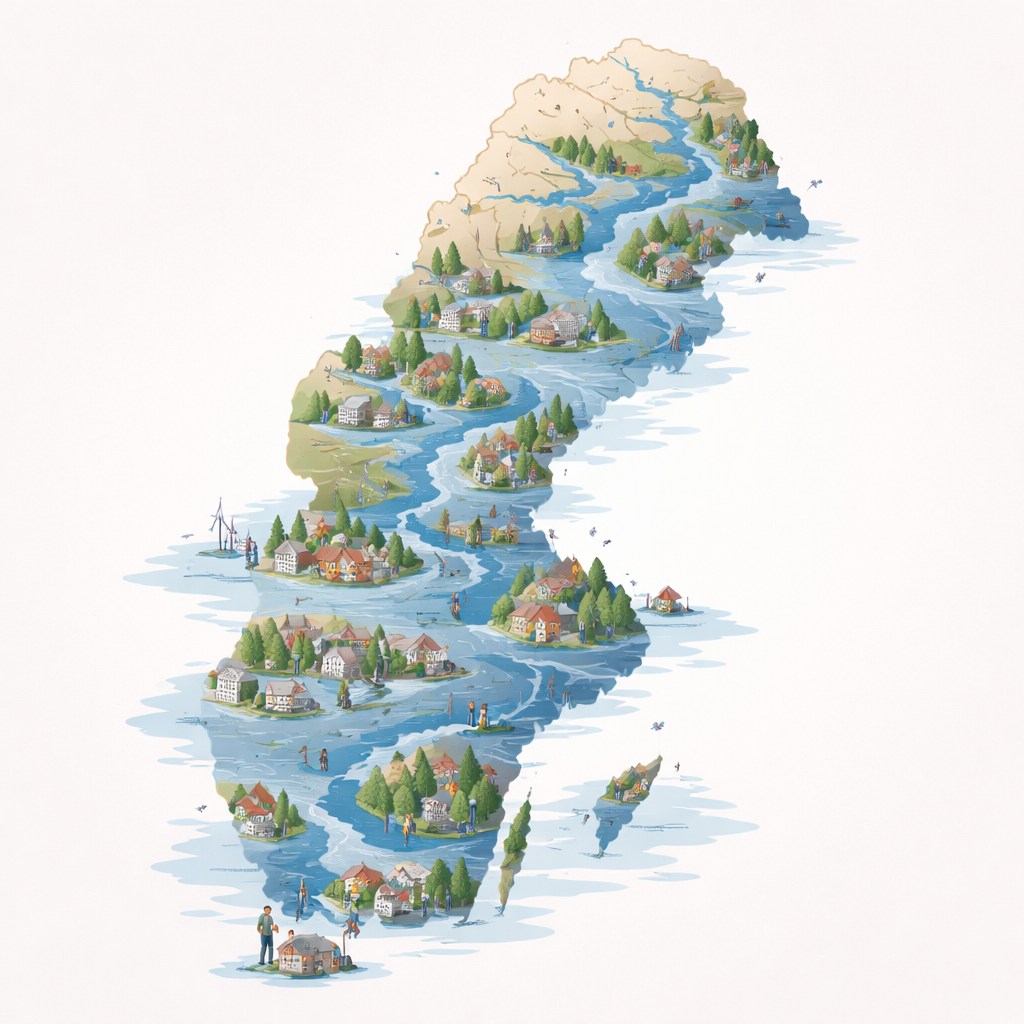
How Much Worse Do Extreme Floods Become?
The jump from the 100-year flood to the extreme scenario was dramatic. Under the 100-year flood, about 69,000 buildings and 226,000 people in Sweden fell inside the modelled flood zones. Under the highest possible flood, more than 207,000 buildings and roughly 462,000 people were exposed. In other words, building exposure tripled, while the number of exposed people roughly doubled. This means that as floods get bigger, they reach many more structures built along river plains and low-lying areas, even while the population remains relatively concentrated in key towns and cities.
Where the Water Meets People and Homes
Exposure is not spread evenly across the country. At the county level, northern regions such as Norrbotten and Västerbotten stand out for high numbers of exposed buildings in both flood scenarios, creating a clear north–south contrast. Central counties like Dalarna, Värmland and Örebro see some of the strongest increases in building exposure under the extreme flood, showing how sensitive river-side settlements can be to even small expansions of flood extent. Population exposure shows a different pattern: it is relatively average across most counties in the moderate scenario but becomes tightly concentrated in central Sweden under the extreme scenario, especially around Örebro and Värmland. At the finer municipal level, differences sharpen further, with certain northern communities hosting many exposed buildings, while central municipalities host more exposed people. 
Following the Money: Insurance Claims
To see whether these exposure numbers really match what happens in the real world, the authors turned to insurance data. They examined more than 7,000 water-related insurance claims filed in Sweden between 2015 and 2023, looking at both how many claims were made and how much money was paid out in compensation, again at county and municipal scales. At the county scale, the link was striking: areas with more flood-exposed people tended to have more insurance claims and higher payouts. In statistical terms, the relationship between population exposure and insurance losses was strong, especially for the extreme flood scenario. Counts of exposed buildings, however, were noticeably less predictive of where high losses occurred.
Why People Count More Than Buildings
The study argues that simply counting buildings in the floodplain misses much of what drives damage. Population exposure serves as a shorthand for several hidden factors: how dense the housing is, how valuable the surrounding assets are, and how likely people are to notice damage and file insurance claims. Places with more residents usually have more homes, more belongings and more local infrastructure packed into the same space, which raises the odds that a flood will generate numerous and costly claims. At smaller municipal scales, the neat relationship between exposure and losses weakens as local details come into play, such as building style, income, insurance coverage, and the depth and duration of individual floods. Even so, at the broader county level, population-based indicators remain a reliable bridge between “where water goes” and “where money is lost.”
What This Means for Future Flood Planning
For decision-makers, the message is straightforward: if you want to know where floods are most likely to cause financial harm, start with where people live, not just where buildings sit. National flood risk maps that highlight population exposure under both moderate and extreme scenarios can give a clearer picture of which regions deserve priority for defenses, land-use planning, and emergency preparation. While more detailed studies still need to account for building quality, social vulnerability, and changing climate conditions, this work shows that counting people in the floodplain is one of the most powerful and accessible tools for understanding—and ultimately reducing—future flood losses.
Citation: Karagiorgos, K., Nyberg, L. & Grahn, T. Population exposure predicts flood losses in Sweden. npj Nat. Hazards 3, 27 (2026). https://doi.org/10.1038/s44304-026-00194-8
Keywords: flood risk, population exposure, insurance losses, Sweden floods, natural hazards