Clear Sky Science · en
Substantial increases in the likelihood of extreme fire weather events for fire-prone ecosystems in Australia
Why future bushfire weather matters to everyone
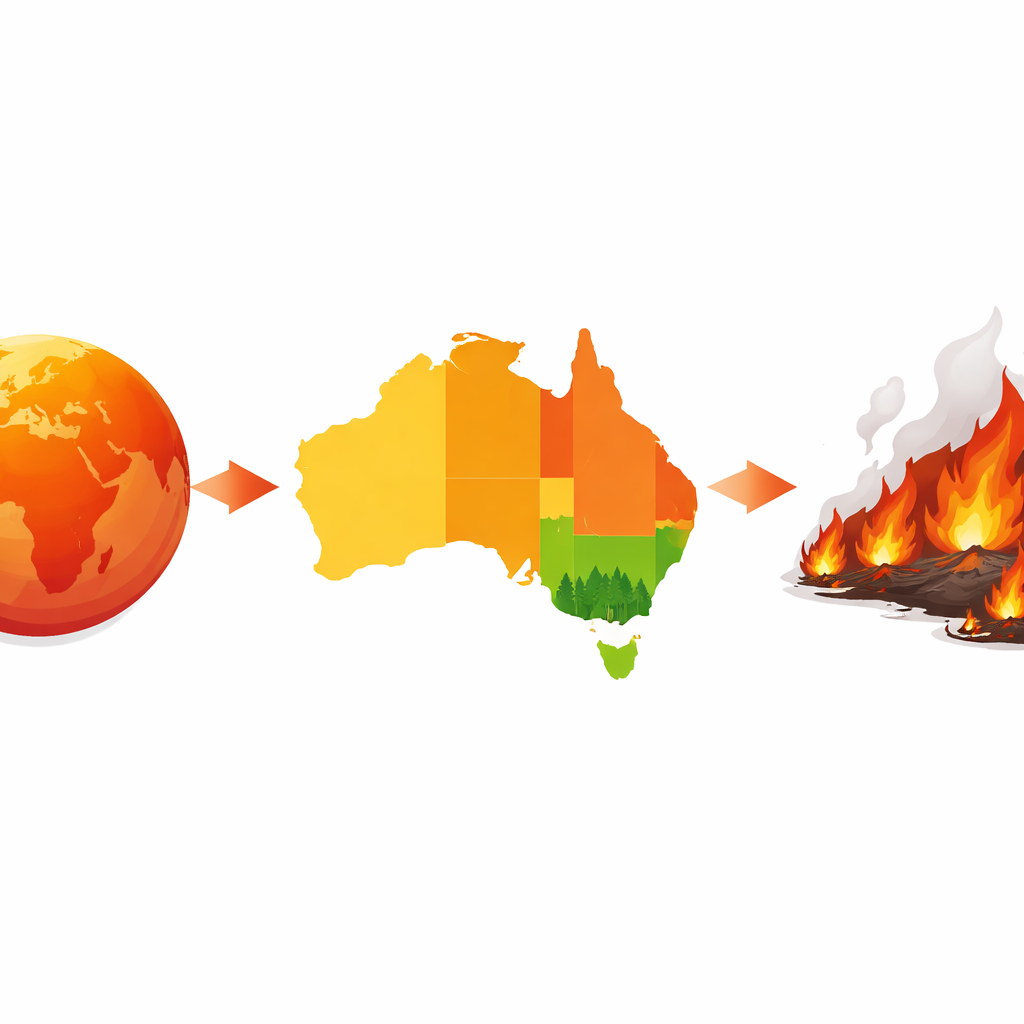
Australians already live with bushfire as a fact of life, from smoky summer skies to tragic seasons like the 2019–20 “Black Summer.” This study asks a pressing question: as the planet warms, how much more often will the kind of dangerous fire weather that drives mega‑fires occur, especially in the forests where people live, work, and holiday? Using the latest generation of climate simulations, the authors show that extreme fire‑favouring weather is set to become far more frequent and intense across much of Australia, with particularly sharp increases in the eucalyptus forests of the southeast and Tasmania.
How scientists measure dangerous fire days
Fire needs fuel, a spark, and the right weather. While fuel and ignition are complex and local, weather can be summed up with a single indicator that combines temperature, humidity, wind, and recent rain. In Australia, one widely used measure is the Forest Fire Danger Index, which rises on hot, dry, windy days after dry spells. High index values line up closely with past disasters and large burned areas, so they provide a practical shorthand for how “fire friendly” the atmosphere is. To look ahead, the researchers used an ensemble of global climate models that were run at high resolution over Australia, then carefully adjusted to better match real‑world weather records.
Sharpening the climate picture over Australia
Global climate models normally see the world in grid boxes hundreds of kilometres wide, which smooths over mountains, coastlines, and other features that shape local fire weather. This study uses a technique called downscaling to translate those coarse global projections into a roughly 10‑kilometre grid over Australia, capturing sharper regional detail. Even so, the raw model output carries systematic quirks—for example, tending to be too hot or too dry in some regions. The team compared two detailed weather reanalyses and found that an Australia‑focused product called BARRA2 best matched actual station observations for the temperature, humidity and wind conditions that matter most for fires. They then used a quantile‑matching technique to nudge each model’s variables month by month so that their statistical behaviour aligned with BARRA2 during recent decades, and recalculated the fire danger index from these corrected fields.
More severe fire days and a longer season
With bias‑corrected data in hand, the authors examined how often different categories of fire weather occur under various levels of global warming, measured relative to pre‑industrial times. Conditions classed as “Severe” or worse become more common across large parts of Australia as warming climbs to 3–4 °C, especially in north‑western and central regions. Days in the “Very High” range also increase in the tropical north and the more densely populated south. Importantly, these rises are strongest not only in summer but also in spring, autumn and even winter in some areas, signalling a longer fire season and narrower windows for hazard reduction burns and other preparations.
Extreme fire weather in southeast eucalyptus forests
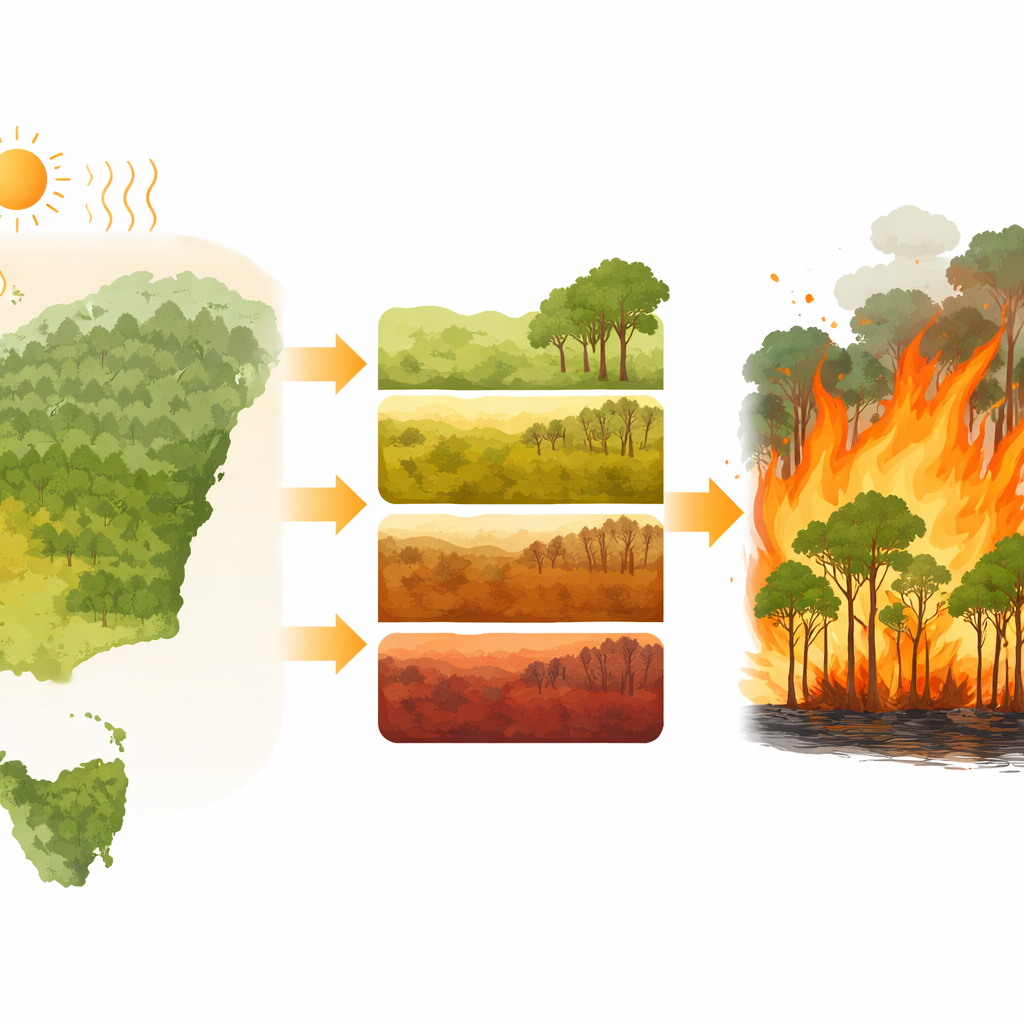
For communities, the most dangerous days are not just hot and windy—they are unusually extreme compared with local history. To capture this, the study analysed multi‑day peaks in the fire danger index and estimated how often events that used to occur once in 20 or 50 years will happen in future. Across all of Australia, a 20‑year, week‑long extreme event becomes about 1.7 times more likely at 2 °C of global warming, and 2.7 times more likely at 3 °C. Focusing in on the dense eucalyptus forests of southeast Australia tells an even starker story. In these forests overall, such 20‑ and 50‑year extremes become roughly 2.1 and 2.5 times more likely at 3 °C. Tasmania stands out: there, 20‑ and 50‑year week‑long extremes are projected to be about 3.2 and 4.1 times more likely at 3 °C, with the intensity of those events also rising by more than 20 percent.
Why Tasmania and different regions respond differently
The study links these patterns to shifts in the underlying weather ingredients on very high fire‑danger days. In southeast Australia, rising maximum temperatures are the main driver, but other factors either amplify or soften the effect. In Tasmania and southern mainland forests, spring becomes markedly drier and fuels more parched, pushing a drought factor used in the index sharply upward, while humidity tends to drop. This combination primes forests for explosive fire behaviour. Further north in Queensland and northern New South Wales, humidity on extreme days is projected to increase slightly, likely reflecting changes in large‑scale wind patterns that bring fewer bursts of hot, dry inland air to the coast; this tempers, but does not erase, the impact of higher temperatures. Uncertainties remain greatest for the very rarest events and for lower warming levels, yet the overall trend toward heightened fire‑friendly weather is consistent across models and methods.
What this means for people and landscapes
To a layperson, the message is clear: if the world continues to warm, the kind of fire weather that underpinned Black Summer will no longer be a once‑in‑a‑lifetime outlier, especially in Tasmania and other southeastern forests. The study does not forecast specific fires, because actual risk also depends on how fuels, land use and firefighting practices evolve. But it does show that the atmospheric conditions that allow big fires to ignite and spread are becoming more frequent, more intense, and more season‑spanning. That knowledge can help planners, emergency services, communities and conservation managers prepare for a future where extreme fire weather is less exceptional, and where protecting lives and unique ecosystems will demand earlier warnings, stronger building standards and carefully managed landscapes.
Citation: McGloin, R., Trancoso, R., Syktus, J. et al. Substantial increases in the likelihood of extreme fire weather events for fire-prone ecosystems in Australia. npj Nat. Hazards 3, 28 (2026). https://doi.org/10.1038/s44304-026-00193-9
Keywords: bushfire weather, climate change, eucalyptus forests, Tasmania wildfires, extreme fire danger