Clear Sky Science · en
Obstacle-induced dissipation of tsunami waves: linking solitary-wave and N-wave formulations
Why trees and poles can tame giant waves
Tsunamis are often shown as unstoppable walls of water racing toward coastlines. Yet in many real disasters, villages shielded by mangrove forests or dense structures have suffered less damage than nearby bare shores. This paper explains, in physically consistent terms, how bands of vegetation and other obstacles sap energy from long tsunami-like waves, and how to predict that protection more reliably for hazard planning.
How coastal obstacles blunt a tsunami's force
As a tsunami travels in deep water it loses very little energy, but near the coast it encounters shallow depths and, in many places, belts of trees, wetlands, or man-made installations such as mussel farms and wind-farm pylons. These act like forests of rigid poles that the water must weave around. Each pole creates drag and swirling wakes that convert organized wave motion into turbulence and heat, steadily shrinking the wave. Past studies have described this damping in many different ways, often mixing how the incoming wave is represented with how the energy loss is calculated. That patchwork has made it hard to transfer laboratory results to real coastlines in a consistent way. 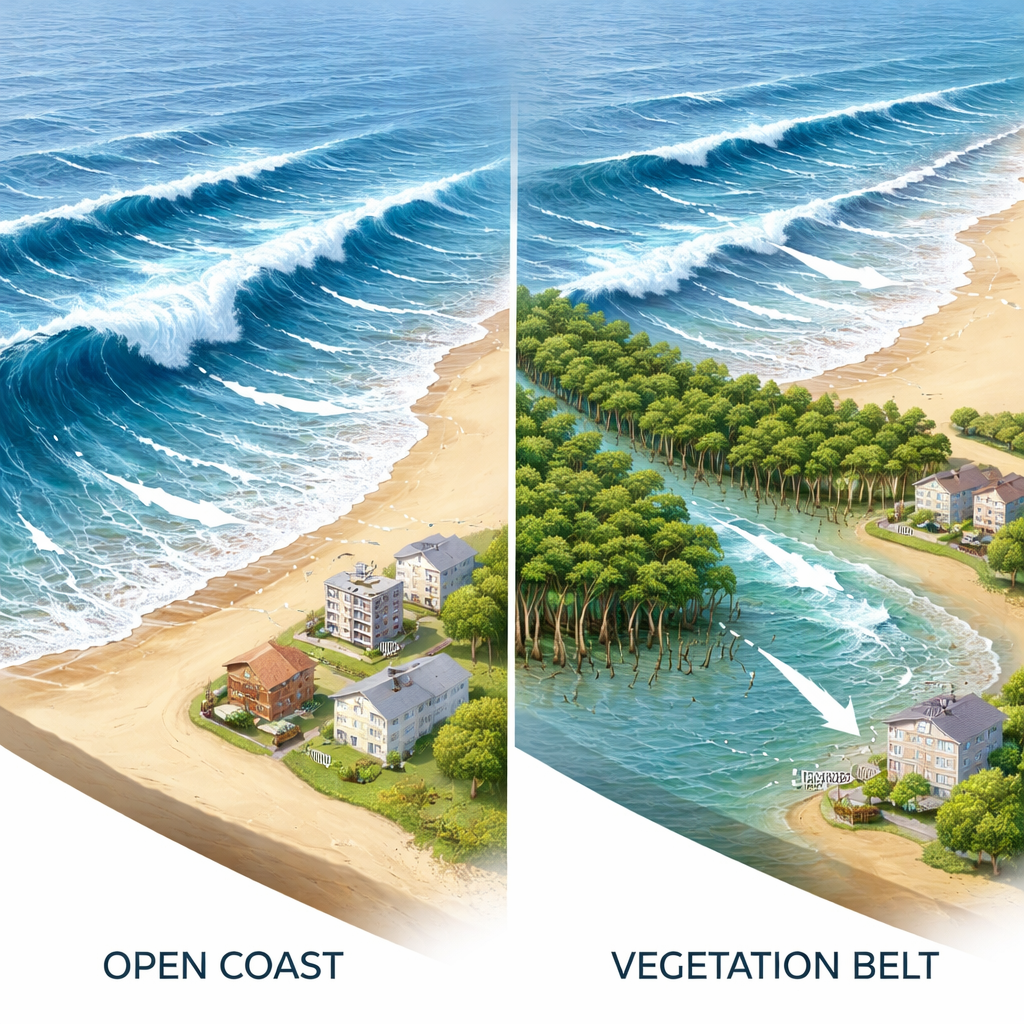
Two ideal waves, one shared pattern
The author focuses on two simplified but widely used shapes for long waves. The first is the solitary wave: a single hump of water that travels without changing form and is easy to generate in laboratory flumes. The second is the so-called N-wave, which better mimics real tsunamis created by seafloor movements and has a rise of water followed by a dip, with no overall change in water volume. Working within shallow-water theory, the study tracks how much mechanical energy such a pulse carries and how that energy is drained by drag from vegetation or poles. A key result is that, once this is done carefully, solitary waves and N-waves obey the same basic attenuation rule: their height falls in a hyperbolic way along the vegetated zone. The only difference between them is contained in a single coefficient that depends on wave shape, not on any change in the underlying drag physics.
Why common formulas can misjudge protection
Many practical tsunami models simplify vegetation drag by treating it as a constant linear resistance, which leads to an exponential decline of wave height with distance. This is convenient for long, nearly repeating waves but is not faithful to a finite pulse that weakens as it travels. In such models the local damping rate does not decrease as the wave shrinks, so they tend to predict too much attenuation. The paper contrasts three options that all start from the same physical drag on the same obstacle field: an energy-based pulse model for N-waves, the traditional constant-rate exponential model, and a modified “pulse-consistent” linear model that updates the representative velocity as the wave decays. With identical obstacle properties, the predicted remaining wave height differs mainly because of the chosen closure, highlighting that the mathematical form of the damping law can matter more than fine-tuning drag coefficients.
What the laboratory flume reveals
To anchor the theory, the study reuses detailed experiments in a 25-meter flume where solitary waves ran through arrays of thin steel cylinders mimicking stems. Wave gauges measured how the crest height declined along the six-meter vegetated section for three different stem densities, with and without a background current. By fitting the energy-based solitary-wave model to these measurements, the author obtained bulk drag coefficients that summarize the combined effect of stem geometry and spacing. Wall friction was shown to be minor compared with stem drag. These calibrated drag parameters were then held fixed and plugged into the alternative models to ask a hypothetical question: if a tsunami-like N-wave crossed the same obstacle field, how much would each formulation say it is reduced?
What this means for coastal safety
The comparisons show that, for realistic vegetation densities, energy-consistent models and the pulse-consistent linear variant predict a slower, hyperbolic decline of wave height, while the common constant-rate exponential approach can overstate the protection afforded by the same forest or obstacle field. The analysis also explains why drag coefficients reported in the literature often disagree: many reflect differences in the assumed damping law rather than true changes in plant or structure properties. For planners and modelers, the message is that solitary-wave experiments remain valuable tools, but they must be coupled with pulse-aware attenuation formulas when translated to tsunami scenarios. Doing so should yield more reliable estimates of how much coastal vegetation, wetlands, and engineered arrays can really reduce tsunami impact, helping design nature-based defenses and interpret field data more safely. 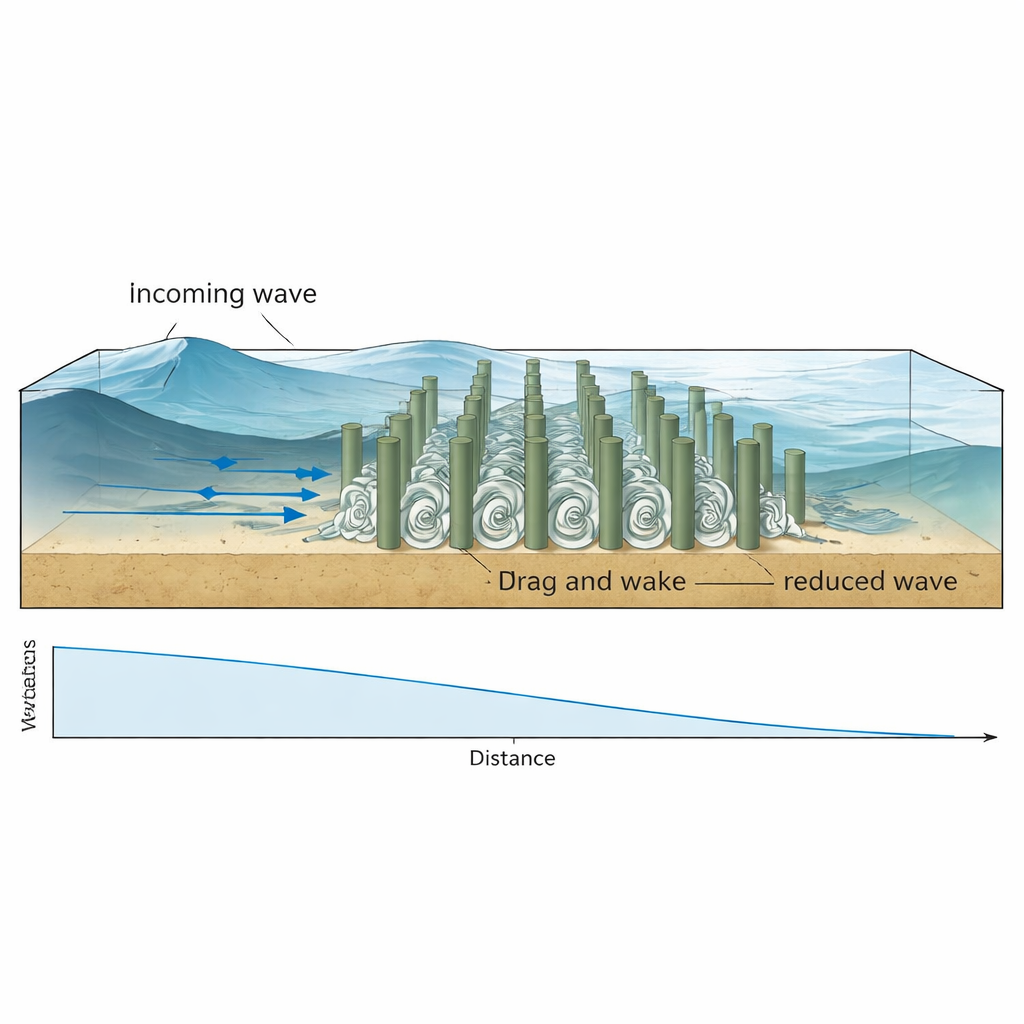
Citation: Mossa, M. Obstacle-induced dissipation of tsunami waves: linking solitary-wave and N-wave formulations. npj Nat. Hazards 3, 26 (2026). https://doi.org/10.1038/s44304-026-00192-w
Keywords: tsunami attenuation, coastal vegetation, wave energy dissipation, solitary and N-waves, nature-based coastal protection