Clear Sky Science · en
Urbanization and Local-scale storm characteristics dominate spatially divergent tropical cyclone rainfall trends in South China
Why city storms are changing
Tropical cyclones—called typhoons in East Asia—are already some of the most dangerous storms on Earth. They bring fierce winds, huge waves, and, most of all, torrential rain. But not every place hit by these storms is getting wetter in the same way. This study looks at South China and asks a down-to-earth question with global relevance: as the climate warms and cities grow, where exactly is cyclone rain getting heavier, where is it easing off, and why should people living in coastal cities care?
Uneven rains along a crowded coast
By analyzing 366 tropical cyclones that affected South China between 1979 and 2018, the authors find that overall, these storms now drop more rain on land and produce heavier downpours. However, this average picture hides a striking patchwork. The Pearl River Delta megacity—home to Guangzhou, Shenzhen, and neighboring cities—and the western parts of South China have seen tropical‑cyclone rainfall rise by about 20–35 percent when comparing the late period (1999–2018) to the earlier decades. In contrast, some eastern coastal areas have actually become drier during cyclones, with rainfall decreasing by 10–20 percent. 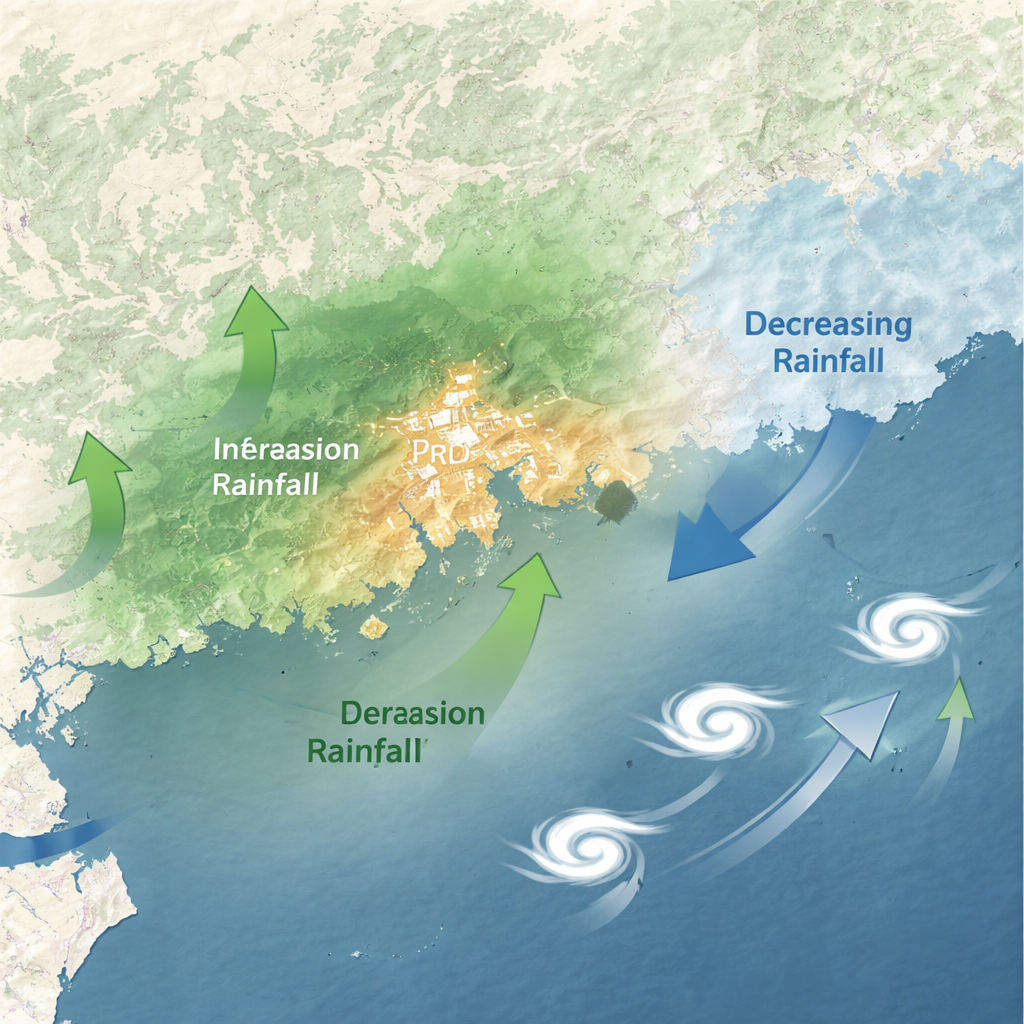
Storm paths and staying power
One key reason for these changes lies in how storms move and how long they linger near particular places. The study shows that, around South China as a whole, cyclones are lasting longer and traveling farther over the region, even though their overall speed has not changed much. Their tracks have become more twisted and meandering instead of straight. When the researchers zoom in to smaller scales—about a 150‑kilometer radius around each location—they find an even clearer pattern: areas where storms are spending more time, passing more often, and arriving with stronger winds are the same areas where rainfall has increased the most. Western South China and the Pearl River Delta fall into this category, while eastern Guangdong has fewer and weaker local storm passages, helping to explain its decreasing cyclone rainfall.
When cities rewrite the rulebook
Storm behavior is only half the story; the other half is how the land underneath has been transformed. The Pearl River Delta has urbanized at breakneck speed over the past four decades. Expanding concrete and asphalt surfaces, taller buildings, and waste heat from human activities create a strong urban heat island, which warms the air over the city and changes how air flows and clouds form. The authors find that in rapidly urbanizing areas, cyclone rainfall has been increasing much faster than in rural surroundings. In fact, in countryside regions, changes in rainfall still follow changes in storm characteristics fairly closely. Inside the megacity, those links weaken or even reverse, meaning that the city itself is reshaping rainfall patterns and partly breaking the usual connection between a storm’s intensity or duration and how much rain it delivers locally.
The surprising second wave after the storm
Perhaps the most worrying discovery is what happens after the cyclone has moved on. By examining the 48 to 96 hours following each storm’s closest approach, the researchers find that most coastal areas see little change or even slight declines in post‑storm rainfall. The Pearl River Delta is a dramatic exception: there, rainfall and especially extreme downpours increase sharply in this so‑called post‑passage period. 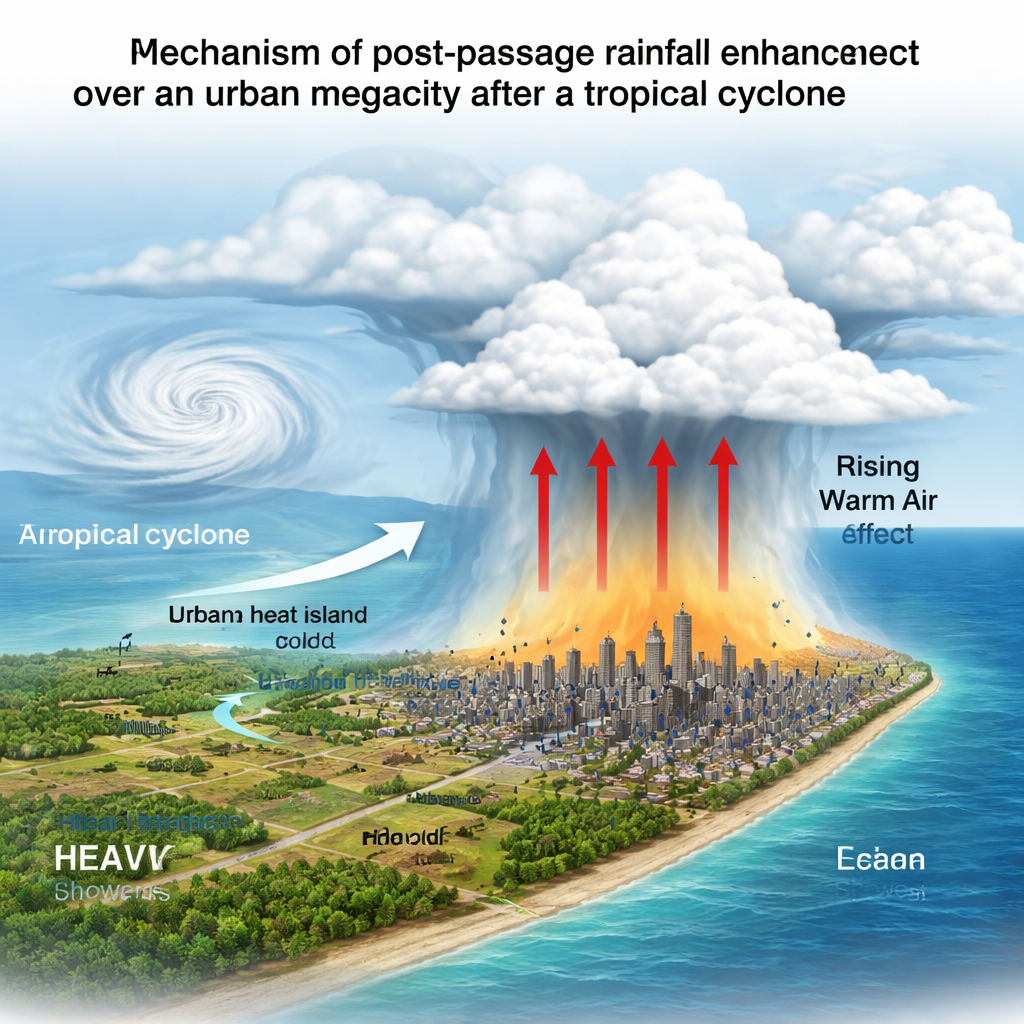
What this means for people and planners
For residents and decision‑makers, the study’s message is straightforward but sobering. It is not enough to know that climate change is likely to make tropical cyclones wetter overall. What really matters is how those changes play out at the scale of individual cities and regions—tens, not thousands, of kilometers. In South China, local storm tracks and the rapid growth of the Pearl River Delta jointly explain more than half of the variation in how cyclone rainfall has changed from place to place, and they create a new kind of compound hazard: stronger rains both during storms and in the days after. As coastal megacities worldwide continue to grow, they may experience similar “hidden” hotspots of cyclone‑related rain. Adapting will mean designing drainage, warning systems, and emergency plans that account not only for the peak of the storm, but also for the unexpected, urban‑driven second act that can follow.
Citation: Hu, C., Tam, CY., Sui, X. et al. Urbanization and Local-scale storm characteristics dominate spatially divergent tropical cyclone rainfall trends in South China. npj Nat. Hazards 3, 25 (2026). https://doi.org/10.1038/s44304-026-00189-5
Keywords: tropical cyclone rainfall, urbanization, Pearl River Delta, coastal megacities, climate change impacts