Clear Sky Science · en
Severe rapid indian monsoon weakening due to emissions from extreme Canadian wildfires
When Faraway Fires Change a Distant Monsoon
In late summer 2023, India experienced its driest August since national records began in 1901, with rainfall down by more than a third from normal. At nearly the same time, unprecedented wildfires in Canada burned an area of forest seven times larger than the country’s usual annual loss and released record-setting amounts of smoke. This study asks a surprising question with big implications: could fires in North America have helped shut down rains half a world away in South Asia?
Two Extreme Events, One Curious Connection
August is usually one of India’s wettest months, as the summer monsoon brings moist ocean air inland to feed crops, refill reservoirs, and cool the land. Yet August 2023 was marked by searing heat and a 36% shortfall in rainfall across the country. Meteorologists pointed to shifts in well-known natural climate patterns—such as El Niño in the Pacific and a tropical wave known as the Madden–Julian Oscillation—as likely culprits. At the same time, Canada’s massive wildfires sent thick plumes of smoke across the Northern Hemisphere, rivaling the annual fossil fuel emissions of major industrial nations. Because the Indian monsoon is highly sensitive to particles in the air, especially in the Northern Hemisphere, the authors set out to test whether the Canadian smoke might have been an overlooked factor.
Testing the Idea with a Global Climate Model
To explore this link, the researchers used a sophisticated Earth system model called EC-Earth3, which simulates the atmosphere, oceans, and the chemical reactions of gases and particles. They ran two sets of experiments for the 2023 monsoon season: one that included realistic estimates of smoke emissions from the Canadian fires (the “FIRE” case) and another identical set without those emissions (“noFIRE”). By comparing the two ensembles, each made up of ten slightly different runs, they could isolate the impact of wildfire smoke from the background jumble of natural weather ups and downs. The team then compared the model’s response to real-world data from reanalysis products, weather balloons, satellites, and surface observations.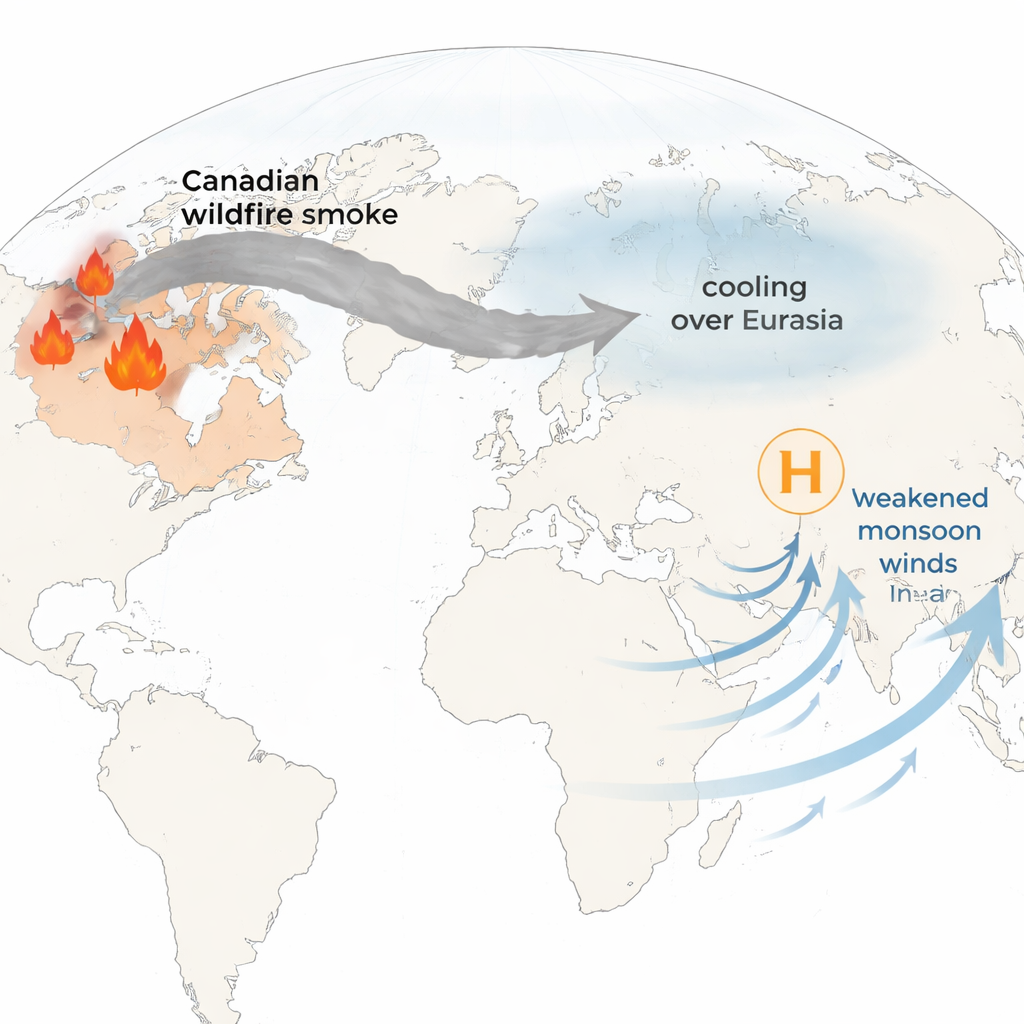
How Smoke Coolled One Region and Dried Out Another
The simulations showed that including Canadian smoke produced a strong dry anomaly over India, similar in size and shape to what was observed in August 2023. Both the model and observations revealed daily rainfall reductions exceeding 5 millimeters across much of the country, with localized hotspots of far greater deficits. The model also reproduced a marked drop in cloud cover over western India and a pattern of surface temperature changes: cooling across much of Eurasia and the northern Arabian Sea, but warming over the Indian peninsula itself. This warming over India arose partly because fewer clouds allowed more sunlight to reach the ground, and partly because less rain meant less evaporation to provide natural air conditioning. Observed temperatures matched this picture, with August 2023 registering India’s highest average maximum and mean temperatures on record for that month.
The Pressure Build-Up That Slowed the Monsoon Winds
The key to the proposed mechanism lies over the northern Arabian Sea. According to the model, smoke particles from the Canadian fires increased the haziness of the air and modified cloudiness over Eurasia and nearby seas, reducing the amount of sunlight reaching the surface and leading to broad cooling. Cooler surfaces, in turn, raised surface air pressure over the northern Arabian Sea. This high-pressure area weakened the usual low-level westerly winds that blow moist air from the Arabian Sea toward India during the monsoon. Instead, easterly wind anomalies developed over the central Arabian Sea, pushing back against the normal flow. Independent reanalysis data showed a similar high-pressure region and weakened westerlies, and weather-balloon observations from cities like Mumbai (Bombay) and Kochi confirmed unusually low wind speeds at the crucial 850‑hectopascal level during July and August 2023.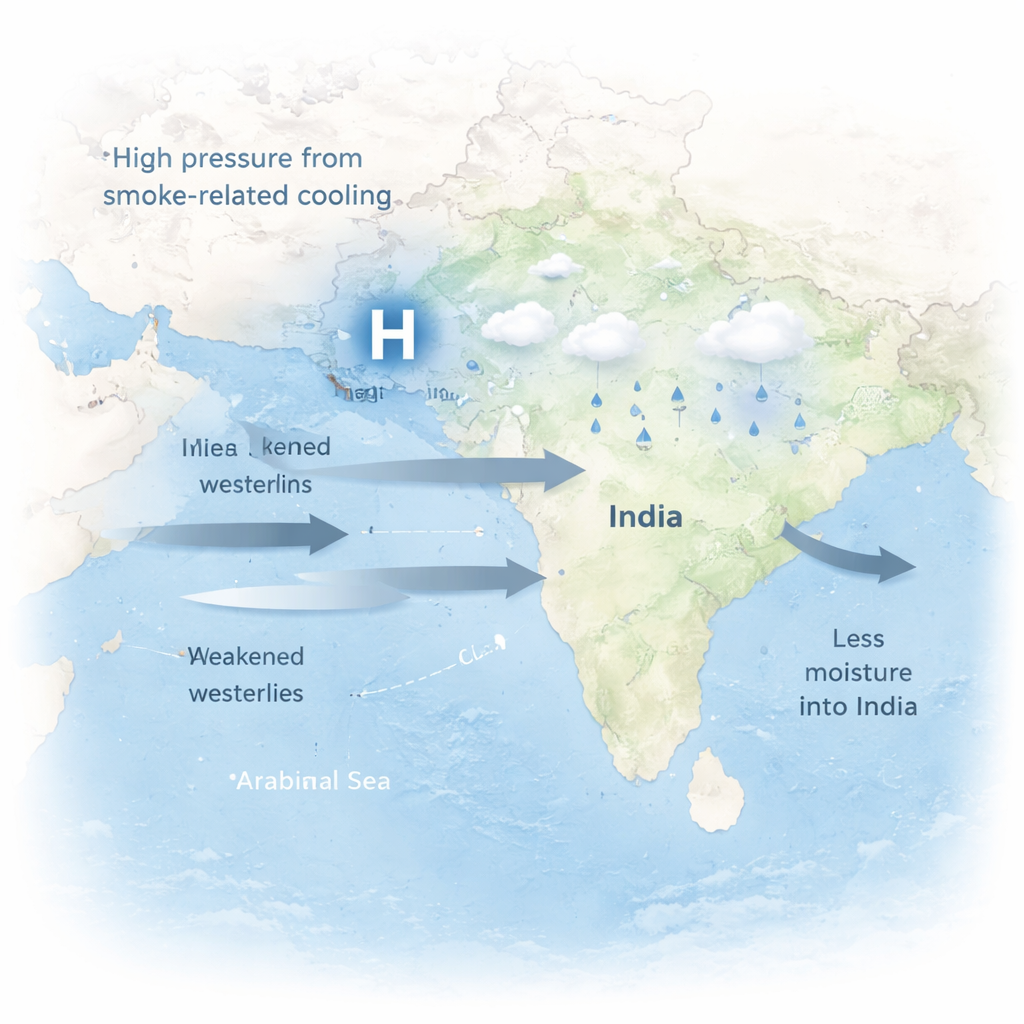
Moisture Pathways Rerouted Away from India
When the team examined the model’s total-column moisture transport, they found that the weakened westerlies led to a net export of moisture away from India and into surrounding regions. Over the areas with the largest rainfall deficits, the model showed strong divergence of moisture, indicating that the main supply of humid ocean air feeding the monsoon had been throttled. These values matched what would be expected for an aerosol-driven weakening of the monsoon and contrasted with patterns seen in years when the monsoon is unusually strong. The authors also considered other possible routes by which the smoke might have influenced the monsoon, such as changes in the timing of tropical disturbances (like the Madden–Julian Oscillation and its summer counterpart, the boreal summer intraseasonal oscillation). While their model hints that smoke-related pressure changes may have nudged these systems into phases less favorable for Indian rainfall, this role appears secondary to the direct effect on winds and moisture transport.
What This Means for a Warmer, Fire-Prone World
For non-specialists, the takeaway is that huge fires in one part of the world can do more than foul local air—they can subtly reshape weather patterns thousands of kilometers away. In this case, the study shows that smoke from Canada’s 2023 wildfires could plausibly have helped produce a record-breaking dry spell over India by cooling parts of Eurasia, building up high pressure over the northern Arabian Sea, and slowing the moisture-laden winds that usually drive the monsoon. While the exact timing in the model does not perfectly match observations, the strong agreement in patterns of rainfall, winds, clouds, and temperature suggests a real physical link. As climate change makes extreme wildfires more common, especially at high northern latitudes, understanding these far-reaching knock-on effects will be crucial for anticipating risks to water security, agriculture, and millions of people who depend on the reliability of the monsoon.
Citation: Roșu, IA., Mourgela, RN., Kasoar, M. et al. Severe rapid indian monsoon weakening due to emissions from extreme Canadian wildfires. npj Nat. Hazards 3, 19 (2026). https://doi.org/10.1038/s44304-026-00184-w
Keywords: Indian monsoon, Canadian wildfires, wildfire smoke, aerosols and climate, remote climate impacts