Clear Sky Science · en
Monitoring landslide disturbances using distributed acoustic sensing under extreme weather conditions
Why watching hills during storms matters
Landslides triggered by powerful storms can bury roads, cut off towns, and destroy homes with little warning. Around the world, typhoon- and rain-driven landslides cause billions of dollars in damage and many deaths each year. This study explores a new way to "listen" to unstable slopes during extreme weather, using ordinary fiber‑optic cables already buried in the ground. By turning these cables into thousands of tiny vibration sensors, scientists show how we might spot dangerous ground movements earlier, even in the middle of a super typhoon.
Listening through everyday cables
The researchers use a technology called distributed acoustic sensing, or DAS, which sends laser pulses down fiber‑optic cables and measures tiny changes in the light that bounces back. These changes reveal how the ground is stretching or vibrating along the cable, effectively converting each meter of cable into a virtual sensor. In Zhejiang Province, China, a 50‑kilometer stretch of fiber originally installed to monitor oil and gas pipelines happened to cross rugged hills and city neighborhoods. When Super Typhoon Muifa struck in September 2022, the team captured round‑the‑clock records of how the ground responded, at a resolution of tens of meters in space and one second in time. 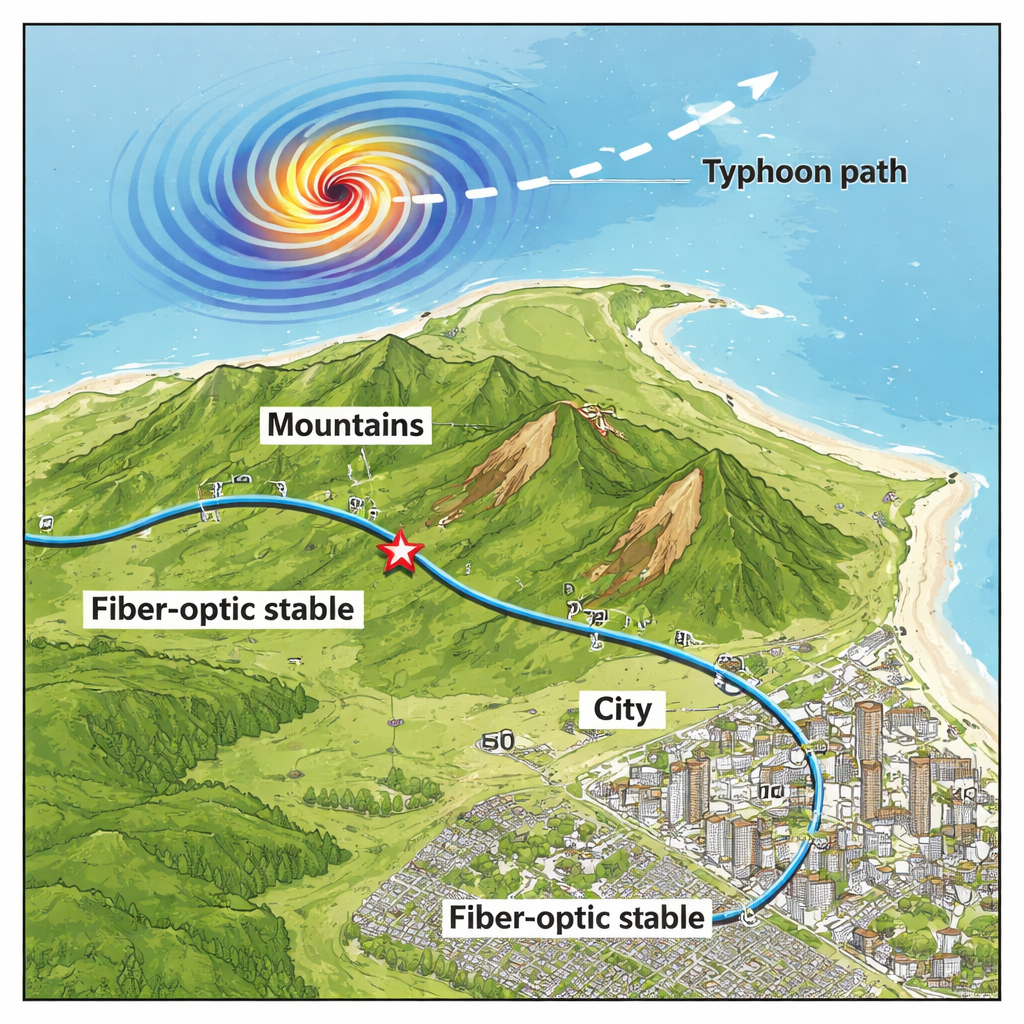
Storm, slopes, and hidden motions
As the typhoon swept over the mountains and into the plains, the buried cable picked up a rich mix of signals: traffic, flowing water, wind, and—most importantly—subtle ground shifts on unstable slopes. Two landslides near the ends of the monitored section were later confirmed by local authorities. In those areas, the DAS data showed sudden jumps in vibration energy and distinctive patterns in very low frequencies that are linked to slow bending and cracking of soil and rock. In some places the system recorded long‑lasting, choppy vibrations that hinted at slopes gradually giving way; in others it saw short, sharp bursts tied to rapid sliding. Because all of this information is laid out along the cable, scientists can see not just when the ground moves, but where along the hillsides those movements start and how they spread.
Turning raw noise into clear warning signs
Raw DAS measurements are extremely data‑heavy and full of "noise" from harmless everyday activity. To separate dangerous behavior from normal background shaking, the team created a new evaluation framework built on three simple ideas: how strong the signal is, how long it lasts, and how far it spreads. They calculated a spectrum intensity gradient to flag sudden jumps in vibration strength, a duration measure to find signals that persist rather than flash and fade, and a radiation range to see whether disturbances remain local or spill over into neighboring cable segments. By sliding time and distance windows along the cable and applying a smooth decay model, they could highlight clusters of activity that matched the timing and location of the confirmed landslides while filtering out brief, scattered disturbances caused by runoff, small soil loosening, or human activity. 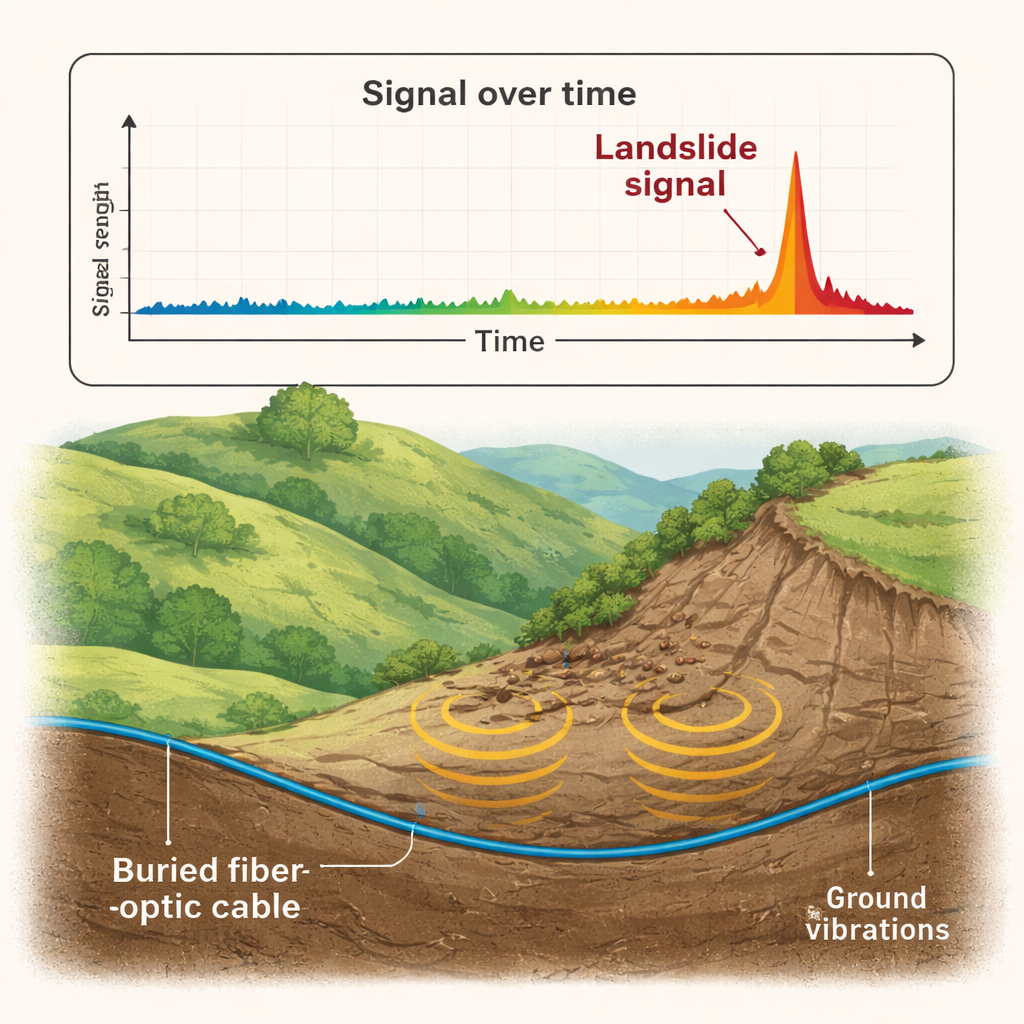
Seeing storms in multiple dimensions
The study also compares the DAS‑derived indicators with weather station records of rainfall, wind, and humidity. Peaks in the landslide‑like signals line up with the most intense phases of the typhoon, showing how heavy rain and strong winds load the slopes until they fail. Unlike satellite imaging or traditional instruments that watch only a few points, the fiber‑optic network offers continuous, fine‑scale coverage along tens of kilometers, and it keeps working through clouds, darkness, and driving rain. The authors argue that with more stations and linked cable networks, regions could build large‑scale, ground‑based sensing webs that track how hillsides react to storms in near real time.
What this means for future safety
Put simply, this research shows that the same type of cable used for internet and pipeline safety can double as a sensitive, continuous landslide watcher during extreme weather. By defining clear indicators for suspicious ground motion and tying them to storm conditions, the study takes a step toward practical early‑warning systems that could give communities precious extra time to close roads, evacuate, or prepare emergency responses. While more work is needed—especially smarter software to automatically recognize risky patterns—the results suggest that existing buried fiber networks could become a powerful new tool in managing natural disasters as climate change brings more intense rainfall and stronger storms.
Citation: Zhu, C., Yang, Y., Yang, K. et al. Monitoring landslide disturbances using distributed acoustic sensing under extreme weather conditions. npj Nat. Hazards 3, 23 (2026). https://doi.org/10.1038/s44304-026-00182-y
Keywords: landslides, extreme rainfall, fiber-optic sensing, early warning, natural hazards