Clear Sky Science · en
Incorporating compound temporal precipitation dynamics to enhance landslide susceptibility modeling
Why Rainfall Patterns Matter for Hillside Safety
Landslides can strike with little warning, wiping out homes, roads, and power lines in a single rush of mud and rock. Many of these disasters are triggered by rain, but not just any rain: it is the combination of how wet the ground has been for weeks and how hard it rains over a few days that really matters. This study asks a simple but crucial question for public safety: can we predict landslides more accurately if we look at both long-term soaking rains and short, intense downpours together, rather than treating them separately?
Looking Beyond Single Storms
Most traditional landslide studies either rely on physics-based models that simulate water seeping into soil, or on data-driven models that search for patterns in past events. Both approaches often reduce rainfall to a single number, such as total rain over a season or the intensity of a storm. That makes it hard to capture the real way slopes fail in nature: weeks of wet weather gradually saturate the ground, and then a brief cloudburst delivers the final push. The authors argue that this “compound” timing of rain is a missing piece in many current prediction systems, especially when working over large areas where detailed ground data are scarce.
Combining Long Soaks and Sudden Downpours
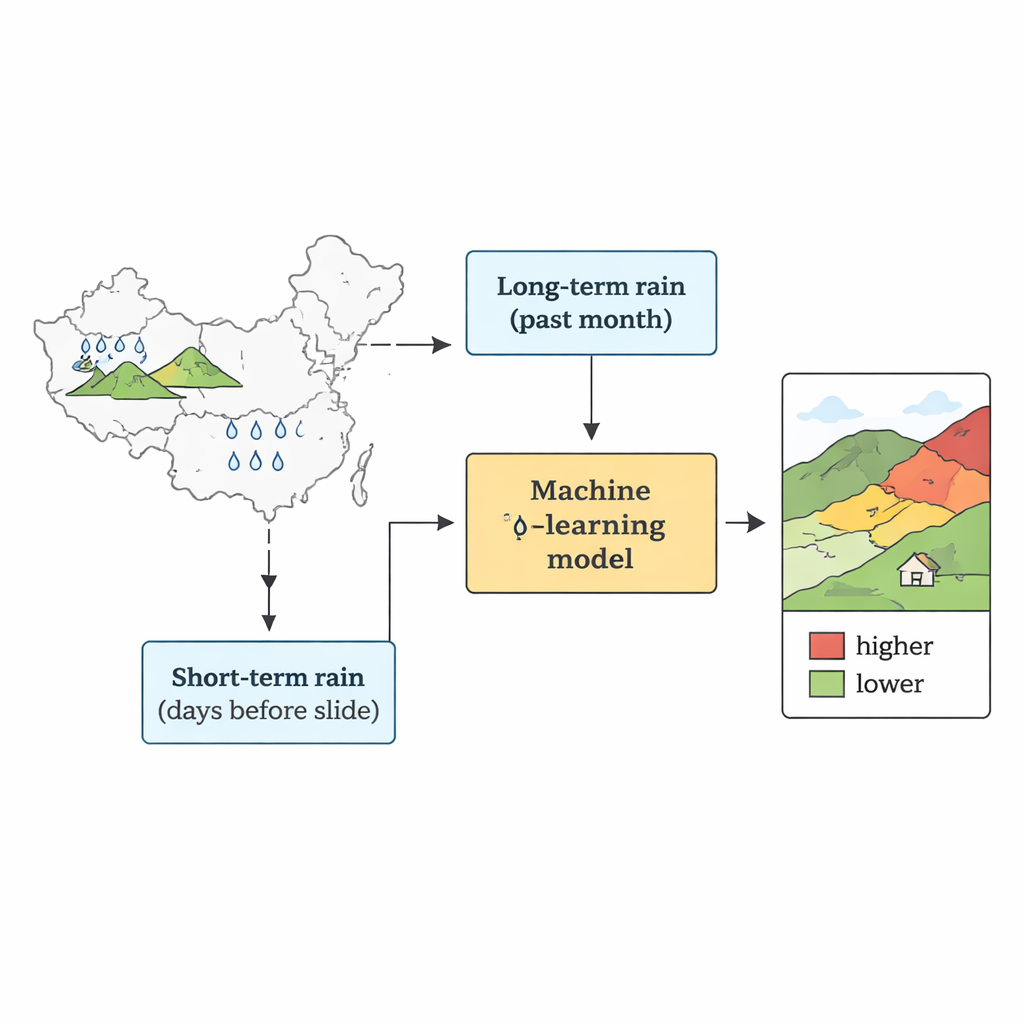
The researchers focused on landslides that occurred across China in 2014, a year with more than five thousand recorded events. For each location, they assembled information about terrain, rock type, soil moisture, land use, and typical yearly rainfall. On top of this, they built new rainfall indicators that capture both long-term and short-term behavior: how much it rained in the month before each landslide, how much fell over the previous three, five, or seven days, and how much rain came on the very day of failure. These paired measures of rainfall over different time windows are what the authors call “compound temporal precipitation.”
Teaching a Model to Spot Dangerous Combinations
To see whether this richer description of rainfall improves prediction, the team compared several popular machine-learning methods and selected a fast, accurate one called LightGBM. They trained different versions of the model: one using only static landscape features, a second adding just the previous month’s rain, and four more that also included various short-term rain measures. They then tested these models in several ways, including splitting the data by region and by time, to mimic real-world forecasting conditions. Models that used compound rainfall information were consistently more accurate. In the best case, adding both monthly and event-day rain pushed the model’s skill close to perfect in standard tests and improved its ability to generalize across different regions by nearly seven percentage points.
Where and When the Ground Is Most Sensitive
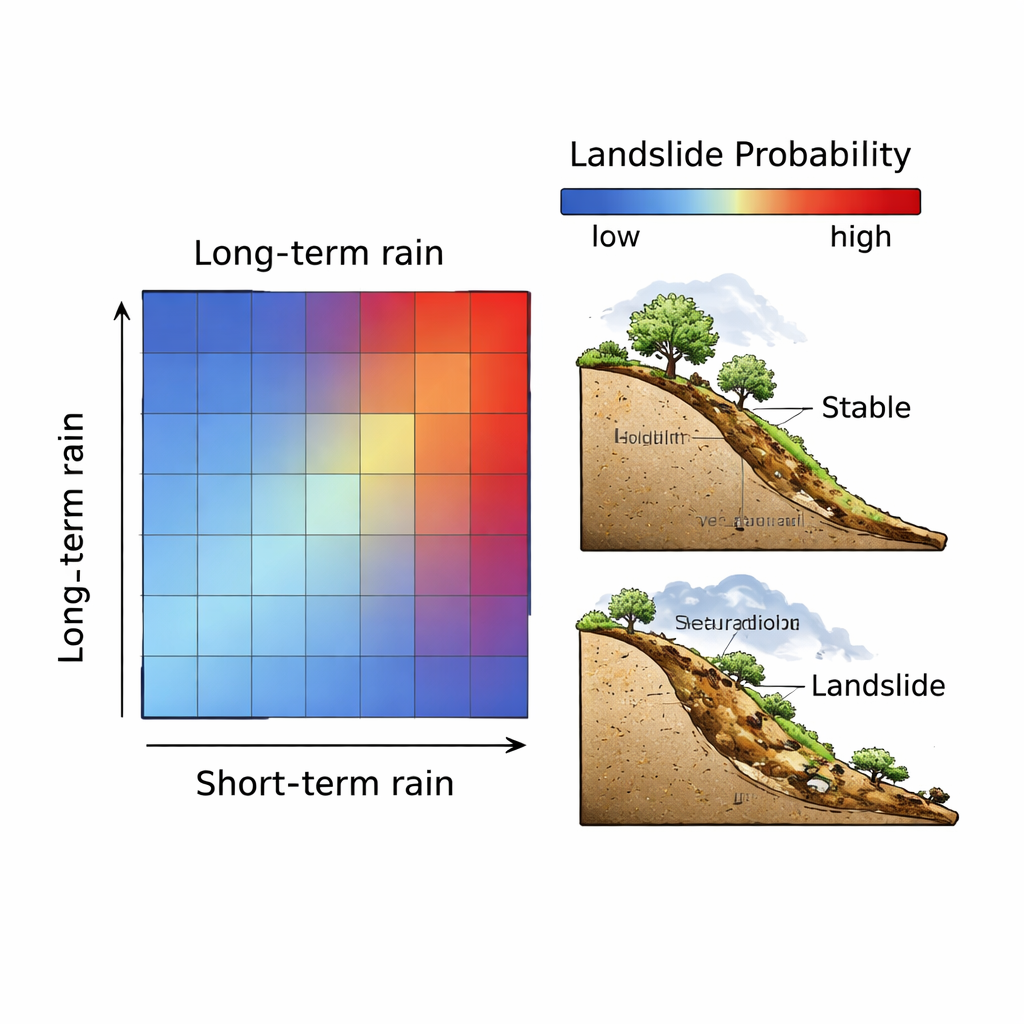
Beyond overall accuracy, the authors wanted to understand how and where compound rainfall matters most. Using interpretation tools designed for complex models, they showed that while average yearly rainfall sets the broad background, the combination of recent soaking and short bursts of heavy rain strongly boosts the predicted chance of a slide once certain thresholds are passed. Danger rises sharply, for example, when heavy rain on the landslide day occurs after an already wet month. Mapping these effects across China revealed marked regional differences: river basins in southeastern and southern China, especially coastal areas, are particularly sensitive to this compound pattern, while some drier northern basins react less. Seasonally, the impact of compound rainfall peaks in summer and autumn, when monsoon rains are strongest, but it remains noticeable in other months as well.
Turning Complex Rainfall into Practical Warnings
For non-specialists, the core message is straightforward: it is not just how much it rains, but how rainfall stacks up over time that drives many landslides. By teaching a computer model to recognize the interplay between long wet spells and short intense storms, this study shows that we can draw clearer, more detailed maps of where slopes are likely to fail, and how that risk shifts with the seasons. These insights could help agencies design better early-warning systems and land-use plans, especially in humid, mountainous regions. As climate change continues to intensify rainfall extremes, capturing this compound timing of rain will be essential for keeping communities on steep terrain safer.
Citation: Wang, J., Wu, J., Fang, H. et al. Incorporating compound temporal precipitation dynamics to enhance landslide susceptibility modeling. npj Nat. Hazards 3, 18 (2026). https://doi.org/10.1038/s44304-026-00181-z
Keywords: landslide prediction, rainfall patterns, machine learning, disaster risk, China monsoon