Clear Sky Science · en
Global acceleration of compound flood risks through fluvial-tidal interactions in a warming climate
Why rising waters matter to everyone
For people living near coasts and rivers, floods are no longer rare, once-in-a-lifetime shocks. As the planet warms, heavy rain and rising seas are increasingly lining up to hit at the same time, turning what used to be manageable high tides or river floods into far more dangerous disasters. This paper explores how that double punch—river floods coinciding with high tides—is becoming more likely around the world, what’s driving the change, and why it matters for homes, farms, and cities from the tropics to the Arctic.
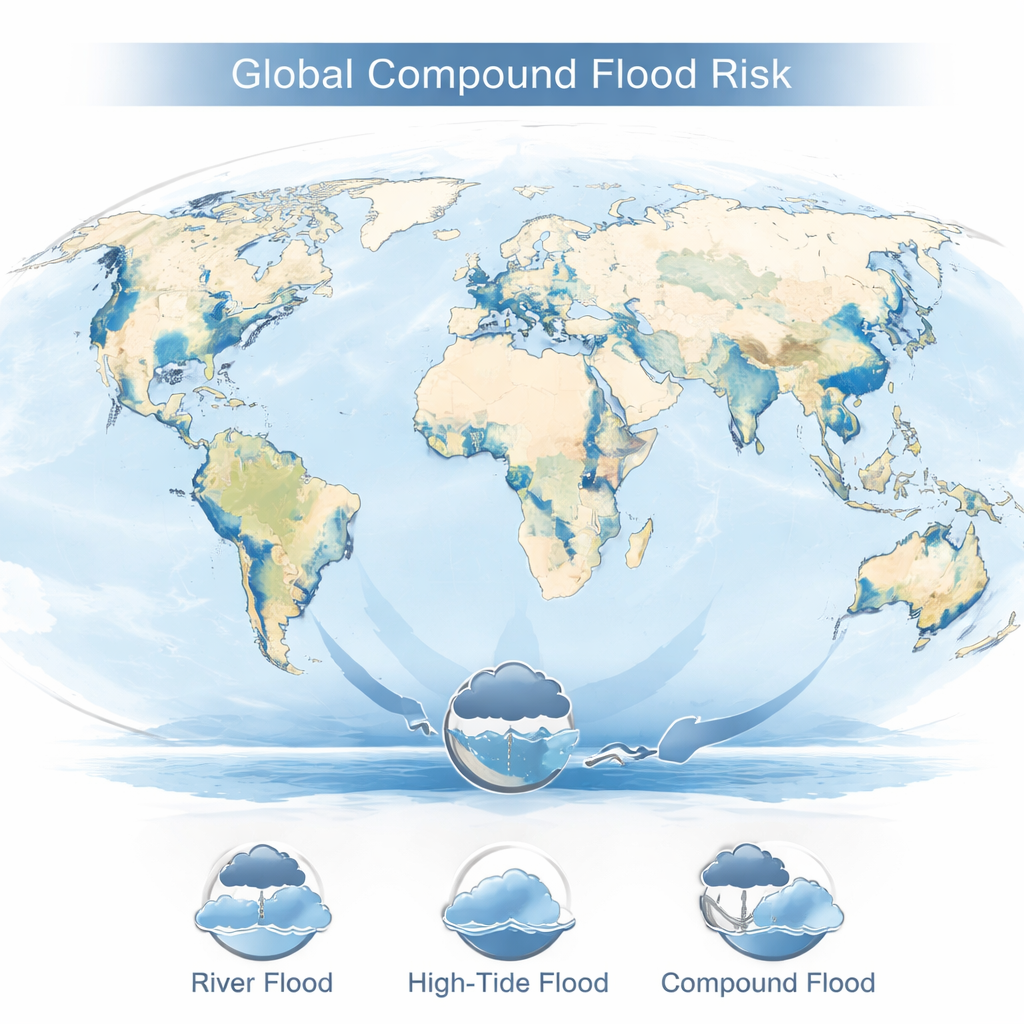
Two kinds of floods, one growing threat
River floods occur when intense rainfall sends large volumes of water rushing downstream. High-tide floods happen when the sea surface rises unusually high because of tides, storm surges, and long-term sea-level rise. When these two arrive together in estuaries—where rivers meet the sea—the high ocean water acts like a stopper in a sink, slowing the river’s ability to drain and pushing water back upstream. The study calls this "compound flooding": the combined effect of river and coastal flooding that is more damaging than either one alone. Because millions of people live on low-lying coasts and deltas, understanding how often these events will occur is crucial for planning defenses, insurance, and emergency response.
What the researchers examined worldwide
The authors focused on 20 of the world’s major river–estuary systems, from the Amazon and Niger to the Mississippi, Rhine, and Yangtze, covering nearly every major climate zone. They stitched together several types of data and models: historical sea levels from 1950 onward, climate-model projections of future sea-level rise, detailed rainfall and river-flow simulations, and high-resolution flood maps of estuaries. Using statistical tools, they measured how often extreme high tides and extreme river flows have occurred in the past, and how often they are likely to coincide in a warmer future under a high-emissions scenario. They then used fine-scale computer models to see how much farther and deeper floods would reach when both river and tide forces act together compared with each acting alone.
Rising seas outpacing changes in rivers
The team found that sea levels at 19 out of the 20 studied estuaries have been rising steadily since 1950, in some places by more than 5 millimeters per year. As a result, days with extremely high tides are already becoming more frequent. Looking ahead to mid-century, the climate projections show a striking imbalance: the frequency of high-tide flooding is expected to increase by nearly 274 percent on average, while intense river-flood days increase by only about 11 percent. In several tropical basins—including the Amazon, Congo, Niger, Nile, and Orinoco—high-tide floods could shift from occasional to near-constant in some years, with dozens to hundreds of days above today’s extreme levels.
When river surges meet higher tides
Even though river floods themselves are not growing as fast as tidal extremes, their impact is being reshaped by the ocean. When the researchers calculated how often extreme river flows and high tides occur on the same day, they found that the chance of such compound events roughly doubles in many large basins between the historical period and the coming decades. In tropical and subtropical deltas, several rivers are projected to see more than 150 high-tide days a year by 2050, greatly raising the odds that some of those days will overlap with heavy river runoff. A detailed case study of China’s Pearl River Delta showed that, under an extreme scenario, including high tide increased flooded area by about 25 percent compared with a river-only flood, and by more than 50 percent when fully combining river and tide effects. Similar patterns emerged across the 20 basins, with compound events expanding inundated areas by roughly 23–54 percent relative to single-flood situations.
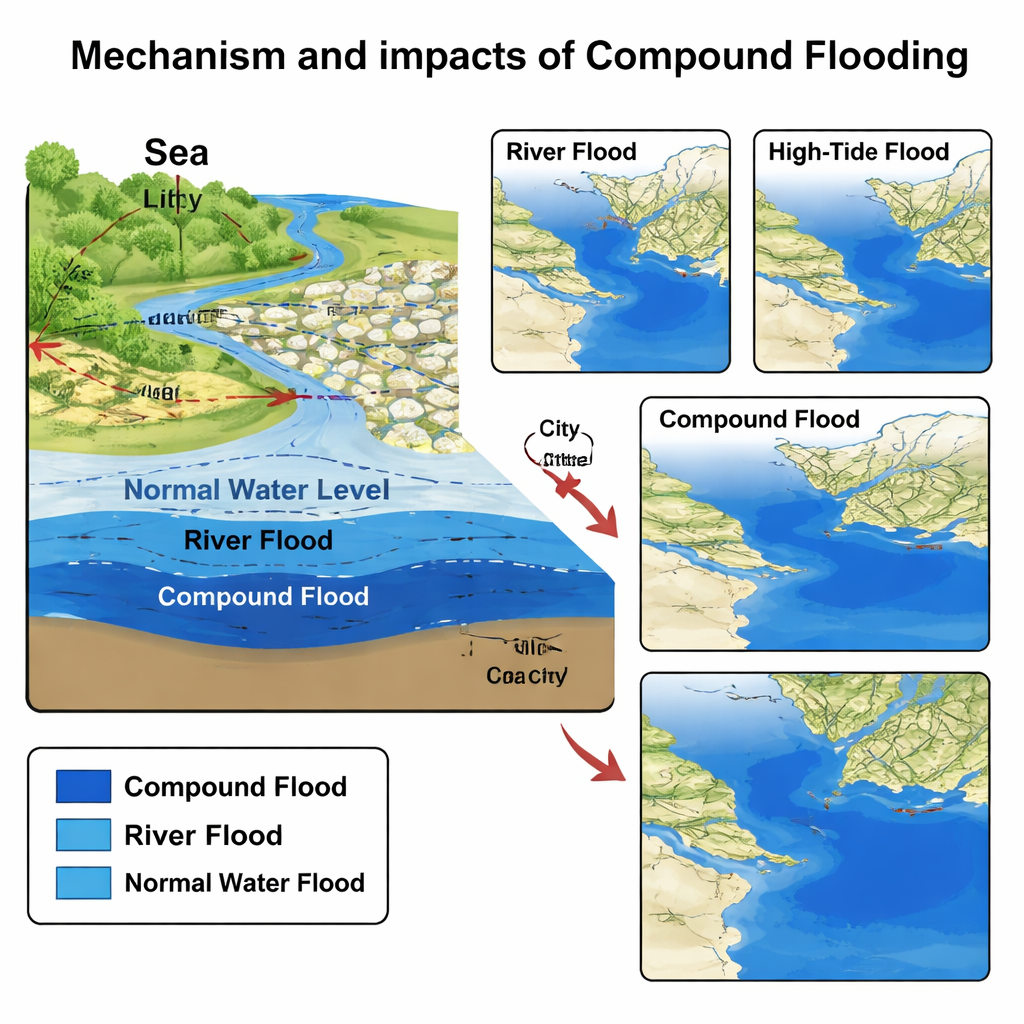
What this means for coasts and communities
The study concludes that global sea-level rise is not just adding water on top of existing river floods—it is fundamentally changing how floods behave in estuaries. High tides are increasingly the dominant trigger of future flooding in many low- and mid-latitude basins, and their interaction with river flows can push dangerous water levels farther upstream than expected. For planners and residents, this means that protecting against “typical” river floods or coastal surges in isolation will underestimate risk. Instead, levees, drainage systems, zoning, and insurance must account for the growing likelihood that rivers and seas will rise together, turning more ordinary storms and tides into damaging compound flood events.
Citation: Chen, W., Zheng, Y., Zhou, Y. et al. Global acceleration of compound flood risks through fluvial-tidal interactions in a warming climate. npj Nat. Hazards 3, 13 (2026). https://doi.org/10.1038/s44304-026-00179-7
Keywords: compound flooding, sea-level rise, river floods, coastal risk, climate change