Clear Sky Science · en
Reconstructing storm Gloria in a changing climate using physical storylines
When One Storm Becomes Three Stories
In January 2020, a winter storm named Gloria battered Spain’s Mediterranean coast with record-breaking rain, waves, and flooding. This paper asks a deceptively simple question with big implications: how different would that same storm have been in a cooler past climate, in today’s climate, and in a warmer future? By replaying Gloria inside a cutting‑edge climate model under three different background temperatures, the authors show how global warming can quietly amplify a familiar storm into a more dangerous event.
A Mediterranean Tempest Under the Microscope
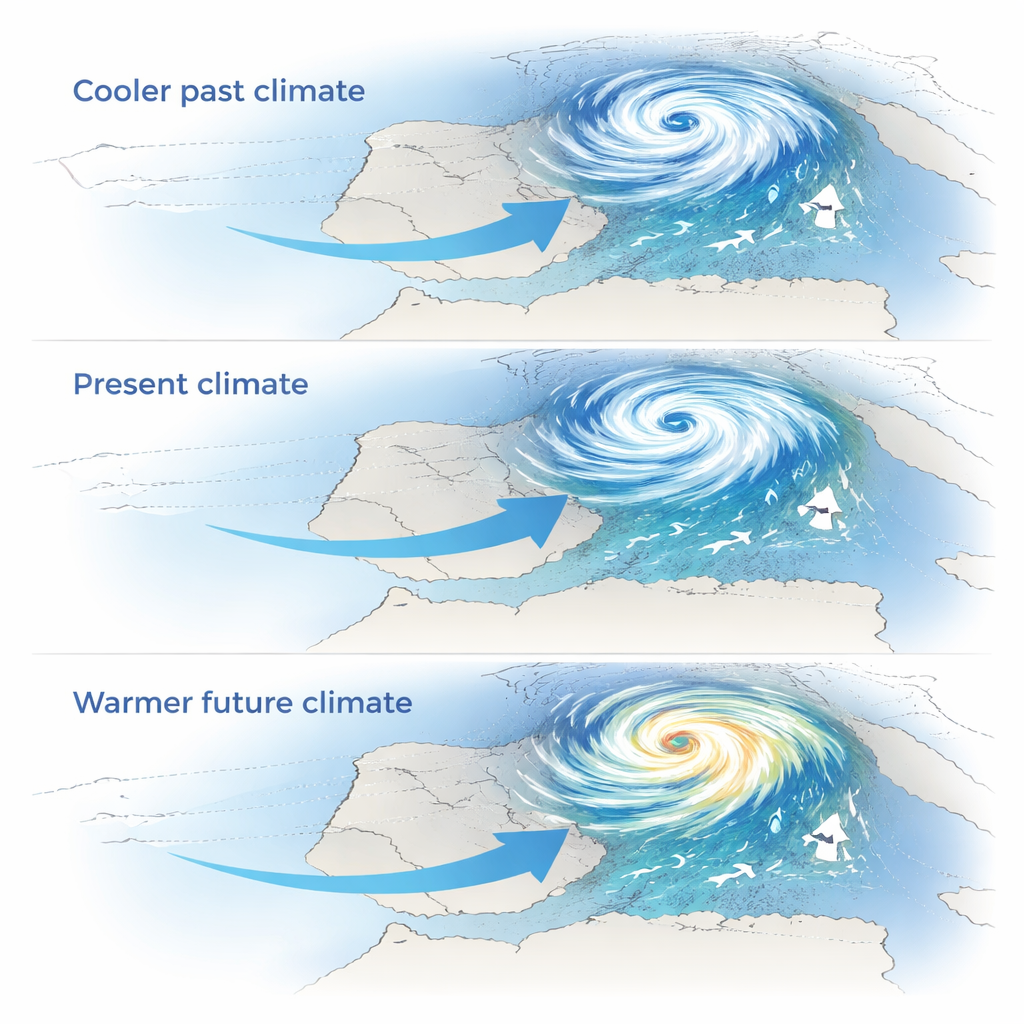
Storm Gloria formed over the North Atlantic before drifting toward the Iberian Peninsula in mid‑January 2020. As it arrived, a stubborn high‑pressure system to the north and a low‑pressure center near the Balearic Islands locked the circulation in place. Strong onshore winds pushed very moist air from the Mediterranean Sea onto the steep coastal terrain of eastern Spain, triggering intense, long‑lasting downpours. Some locations recorded more than four times their usual January rainfall, leading to flash floods, swollen rivers, powerful storm surge, and widespread damage costing hundreds of millions of euros and claiming 14 lives.
Replaying the Same Storm in Different Worlds
Instead of asking how often a “Gloria‑like” storm might occur, the authors follow a different path called a physical storyline. They use a global climate model, running at roughly 9‑kilometer resolution, and gently steer its large‑scale winds so that the model’s atmosphere follows the actual weather patterns observed during Gloria. On top of this fixed track, they run three versions of the model: one representing a cooler mid‑20th‑century climate, one matching today’s conditions, and one about two degrees Celsius warmer than pre‑industrial levels. This set‑up lets them keep the storm’s path and timing essentially the same while isolating how extra heat and moisture in the air and ocean alter its behavior.
More Moisture, Same Storm, Uneven Rain
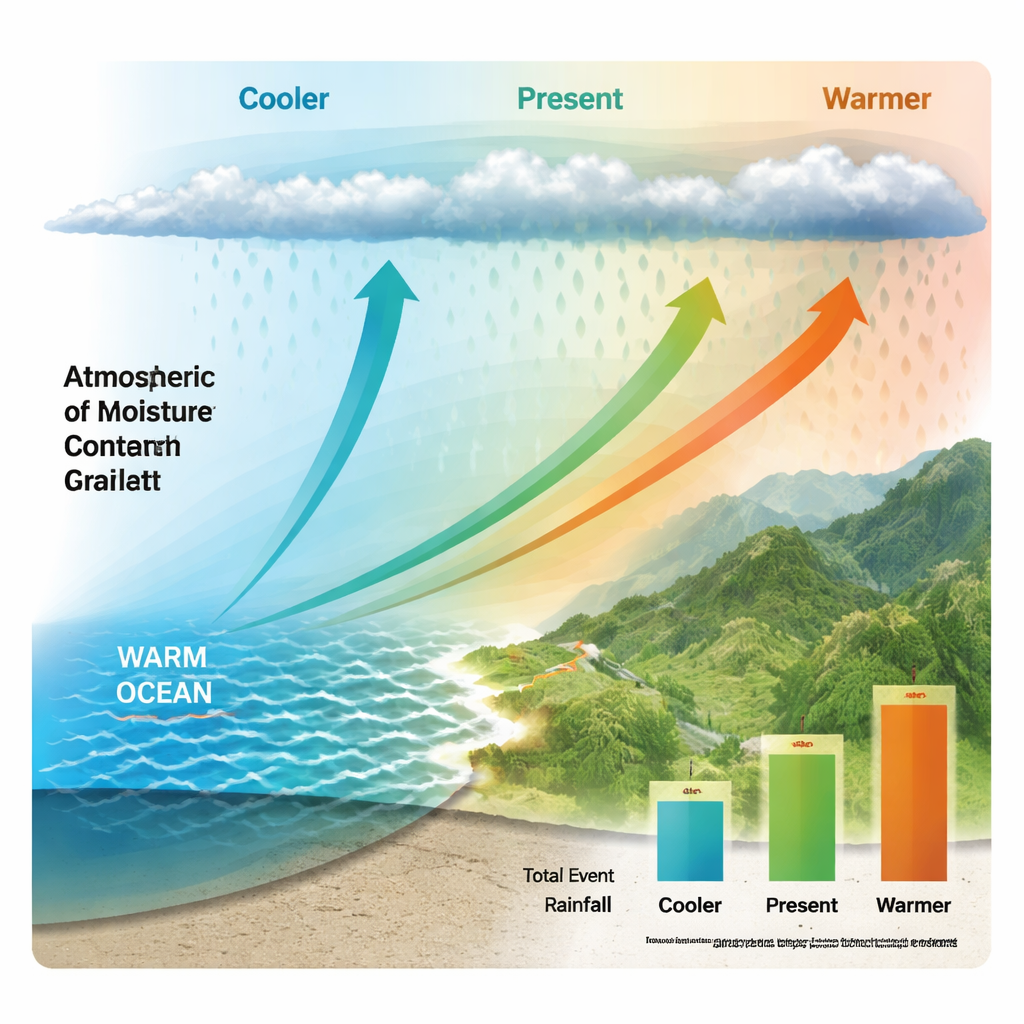
The warmed‑up versions of the atmosphere behave much as physics predicts. In the present and future climates, the air can hold more water vapor, and the model shows clear increases in total atmospheric moisture and in the flow of moist air toward Spain’s coast. These changes scale roughly with a well‑known relationship that says air’s moisture‑holding capacity rises by about 6–7 percent per degree of warming. Over the Mediterranean Sea, warmer surface waters further boost evaporation, feeding even more moisture and energy into the storm, and increasing the potential for heavy rainfall.
Why Added Heat Does Not Translate Neatly into Added Rain
Yet the rainfall response is far from uniform. While the model produces more total precipitation from Gloria as the climate warms—about 6 percent more when comparing the coolest and warmest worlds—local patterns shift in complicated ways. Some areas, such as parts of Catalonia and Valencia, see strongly amplified totals in one climate comparison but not in another. The reason is that rain depends not only on how much moisture is available but also on how long and how strongly air is forced to rise. In these simulations, the large‑scale winds are constrained, but small‑scale vertical motions are free to adjust. Subtle changes in how ascending and sinking air are organized can concentrate or disperse rainfall, sometimes offsetting the thermodynamic boost from extra moisture.
What This Means for Future Coastal Risks
For non‑specialists, the central message is both clear and unsettling: even if the “shape” and path of a storm like Gloria stayed the same, a warmer world loads it with more water, increasing the overall flood risk and enlarging the area hit by very heavy rain. At the same time, the precise locations of the worst impacts are governed by complex storm dynamics that do not scale linearly with temperature. This storyline approach—replaying a real, memorable storm under different climate backgrounds—helps translate abstract warming numbers into tangible consequences for cities, coasts, and infrastructure. It shows that climate change is not just about new kinds of extremes, but also about familiar storms becoming more damaging in subtle, hard‑to‑predict ways.
Citation: Grayson, K., Campos, D., Beyer, S. et al. Reconstructing storm Gloria in a changing climate using physical storylines. npj Nat. Hazards 3, 14 (2026). https://doi.org/10.1038/s44304-026-00174-y
Keywords: storm Gloria, Mediterranean flooding, climate change impacts, extreme rainfall, storyline attribution