Clear Sky Science · en
Extreme precipitation changes in relation to urbanization
Why Cities Are Getting Hit Harder by Downpours
As headlines about flash floods and overwhelmed drainage systems become more common, many people wonder: is it just bad luck, or are our cities changing the weather itself? This study looks at decades of rainfall records from around the world and asks a simple but urgent question: how much of today’s extreme rain comes from global climate change, and how much is made worse by the way we build and grow our cities?
Heavy Rain on the Rise
Scientists have long expected intense rainstorms to increase as the planet warms, because warmer air can hold more water. By analyzing daily rainfall from more than 6,000 weather stations over 60 years, the authors confirm that very heavy rain events have become more frequent overall. When they focused on the roughly one biggest downpour per year at each station, they found that, on average, these extremes now occur about 20% more often than they did in the early 1960s. The most intense events showed the strongest increases, meaning that the worst storms are getting noticeably more common.
Cities Versus Countryside
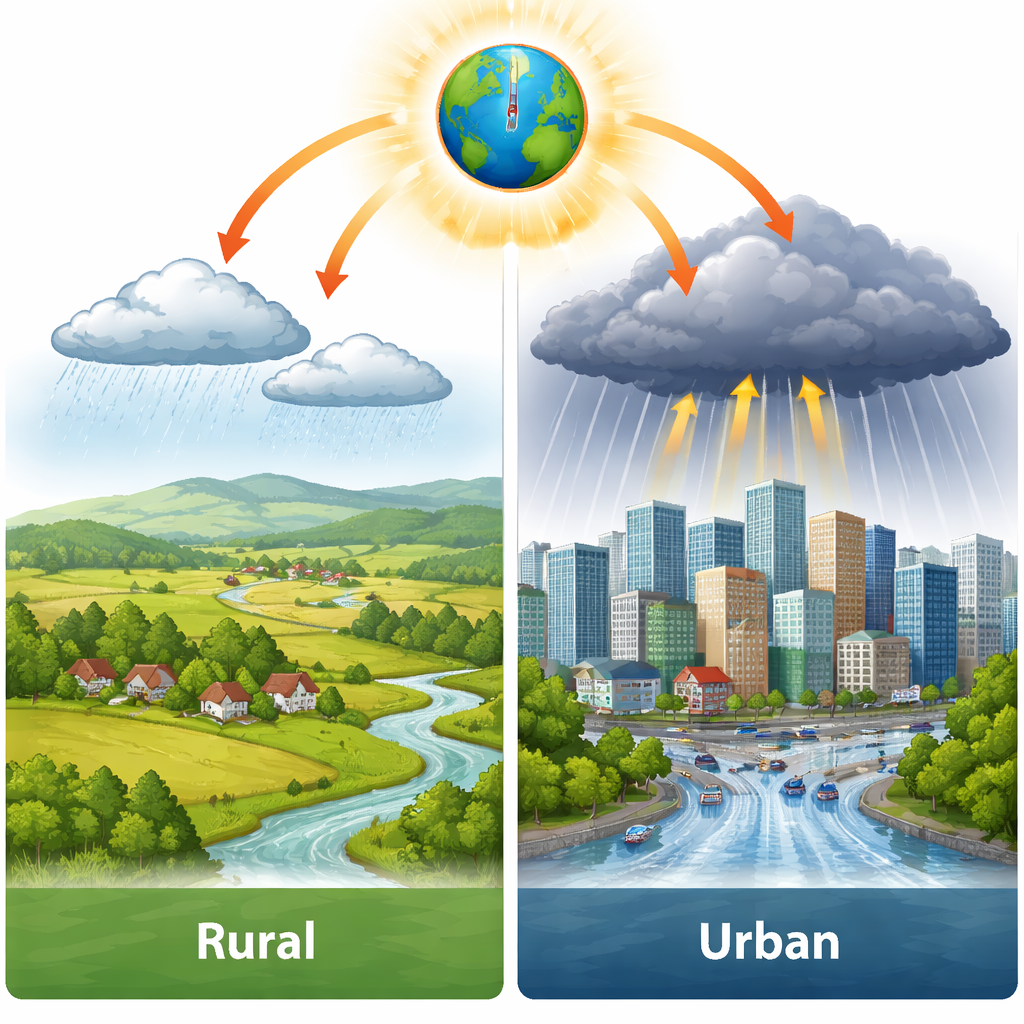
The researchers then compared what happens over big cities to what happens over rural landscapes. They used satellite-based maps and population data to classify each weather station as either urban or rural, and also created a “weighted population” index that measures how many people live near each station. Stations in rural areas did show more extreme rain over time, but stations in urban areas showed much larger increases. Over six decades, rural sites experienced about a 19% rise in the frequency of heavy rain, while urban sites saw an increase of about 29%. When stations were grouped from sparsely to densely populated surroundings, the least populated locations showed only a small rise in extreme rain, whereas the most populated ones showed nearly 40% more extreme events than in the 1960s.
A Closer Look Over Europe
Because weather stations are unevenly spread across the globe—concentrated in places like North America, Europe, and Australia—the authors also turned to a high‑resolution weather simulation covering Europe and the Mediterranean from 1981 to 2022. This dataset, produced by an advanced weather model at a grid size of just 3 kilometers, allowed them to examine thousands of grid cells and to compare neighboring urban and rural areas more directly. In this regional analysis, the overall frequency of intense daily rainfall increased by about 7%, but again cities stood out: urban locations saw roughly an 18% increase in extreme events, more than double the 6–7% rise found over nearby rural terrain.
How City Surfaces Feed Storms
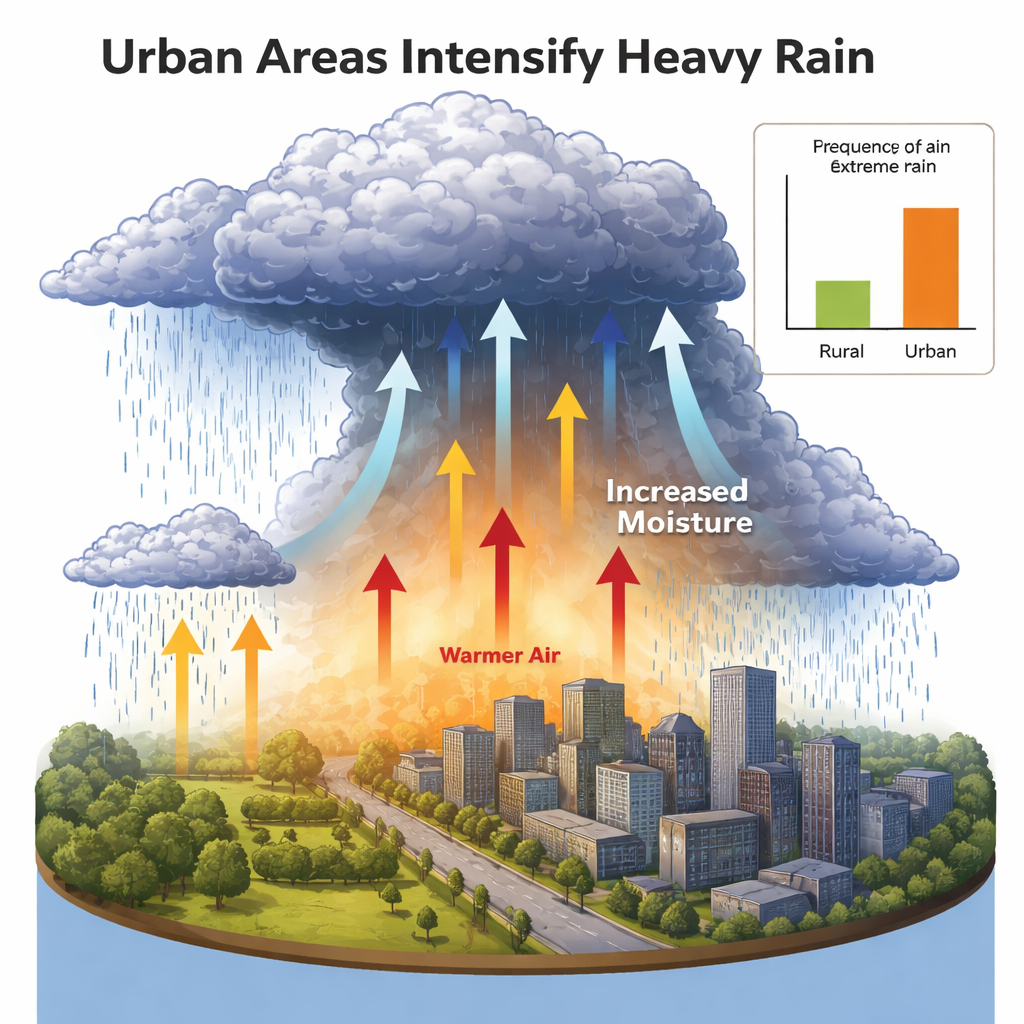
Why would cities sharpen heavy rainfall in this way? The study points to the physical behavior of the air above urban surfaces. Buildings, asphalt, and concrete soak up and release heat differently than soil and vegetation, creating “urban heat islands” where the air is warmer and less stable. Using the European simulation, the authors examined vertical air motions inside storms and found that the maximum rising speeds—convective updrafts—have strengthened more over urban land than over rural areas during the past four decades. This suggests that city landscapes help boost the kind of vigorous upward motions that feed intense clouds and downpours, on top of the extra moisture supplied by global warming.
What This Means for Everyday Life
For non‑specialists, the takeaway is straightforward: both global climate change and local urban development are pushing heavy rain in the same direction—up—and their contributions are of similar order of magnitude. In other words, it is not only the warming planet that makes cloudbursts and flash floods more likely in cities; the way we pave, build, and concentrate people and infrastructure also plays a major role. As urban areas continue to grow, city planners and decision‑makers will need to treat streets, parks, drainage systems, and building materials as tools for shaping local climate, not just for everyday convenience. Thoughtful design of cooler, more permeable, and better‑drained urban landscapes could help reduce the added punch that cities give to extreme rainfall, making future storms a little less dangerous.
Citation: Guccione, A., Bassi, P., Desbiolles, F. et al. Extreme precipitation changes in relation to urbanization. npj Nat. Hazards 3, 10 (2026). https://doi.org/10.1038/s44304-026-00173-z
Keywords: urbanization, extreme rainfall, climate change, urban heat island, flood risk