Clear Sky Science · en
Widespread forest disturbance from windthrow in central African rainforests
Why powerful storms matter for quiet forests
Central Africa’s rainforests may look timeless from the ground, but high above the canopy, powerful storm systems are reshaping them in sudden bursts. This study reveals that giant swaths of forest can be knocked down in a single night by intense winds linked to tropical thunderstorms. Understanding these hidden “blowdowns” matters to anyone concerned with climate, wildlife, or the stability of one of the planet’s largest carbon stores.
Big forests, hidden damage
Central African rainforests form the world’s second largest tropical forest block and store immense amounts of carbon. Yet compared with the Amazon, much less is known about how natural disturbances such as wind damage shape these forests over time. In South America, organized clusters of thunderstorms called mesoscale convective systems are known to produce fierce downbursts that snap and uproot trees across many square kilometers. Until now, similar events in Africa’s forests had barely been documented, leaving a major gap in our understanding of how storms influence this crucial region.
Mapping scars from space
To uncover these hidden disturbances, the researchers turned to satellite data. Using Landsat and Sentinel imagery from 2019–2020, along with methods refined in Amazonian studies, they scanned Central Africa’s evergreen forests for distinctive fan-shaped patches of broken canopy known as windthrow. They focused on large events covering at least 30 hectares, roughly the size of dozens of city blocks. The team identified 74 such events, together affecting about 18,600 hectares of forest. These scars were not evenly scattered: they clustered in eastern Central Africa, where intense storm activity and extreme rainfall are most common. One massive event, nearly 4,000 hectares in area, accounted for about a fifth of the total damaged forest. 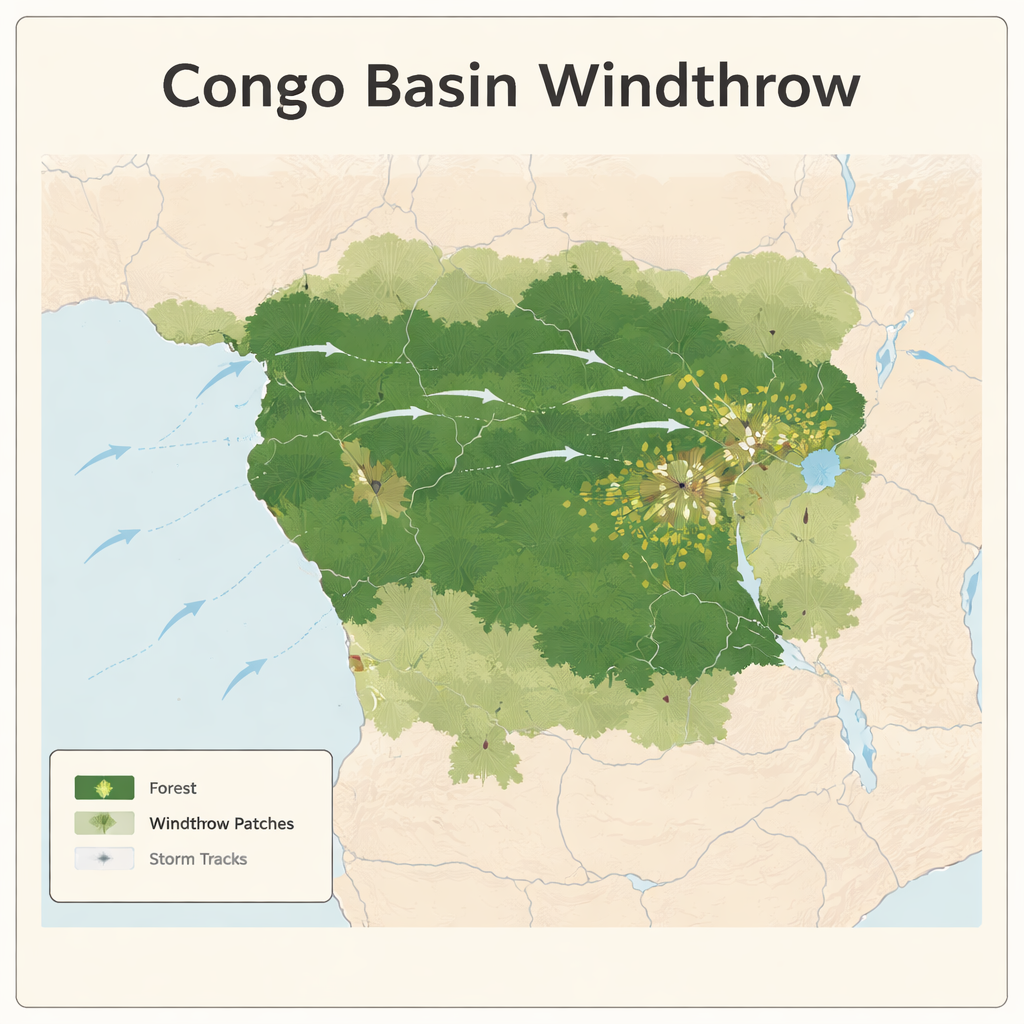
Storm fingerprints in rain and wind
By tracking the timing and orientation of these blowdowns, the authors were able to link them directly to violent weather. Most events occurred between October and April, when extreme rainfall peaks in the region. For the subset of windthrows whose dates could be pinned down precisely, the associated storms always produced very intense rain, far above typical tropical downpours. The long, fan-shaped scars mostly pointed westward, matching the prevailing direction of storm outflows across Central Africa. Statistical analysis showed that smaller blowdowns are relatively more common, while very large events are rare and spaced centuries or longer apart in any given location. Compared with the Amazon, such large windthrows appear less frequent in Central Africa, but still significant enough to influence forest structure.
Fast green comeback after a fall
Forest death is only half the story; recovery is the other. For seven windthrow sites with enough cloud-free satellite coverage before and after disturbance, the researchers tracked near-infrared reflectance, a part of the light spectrum that is strongly reflected by healthy leaves. Immediately after a storm, this signal dropped sharply as tree crowns disappeared and bare wood and soil were exposed. Yet within just two months, the near-infrared signal began to rise, and within about six months it had returned to pre-storm levels. This rebound was much faster than seen in similar Amazonian studies, where recovery in the same metric often takes a year or more. 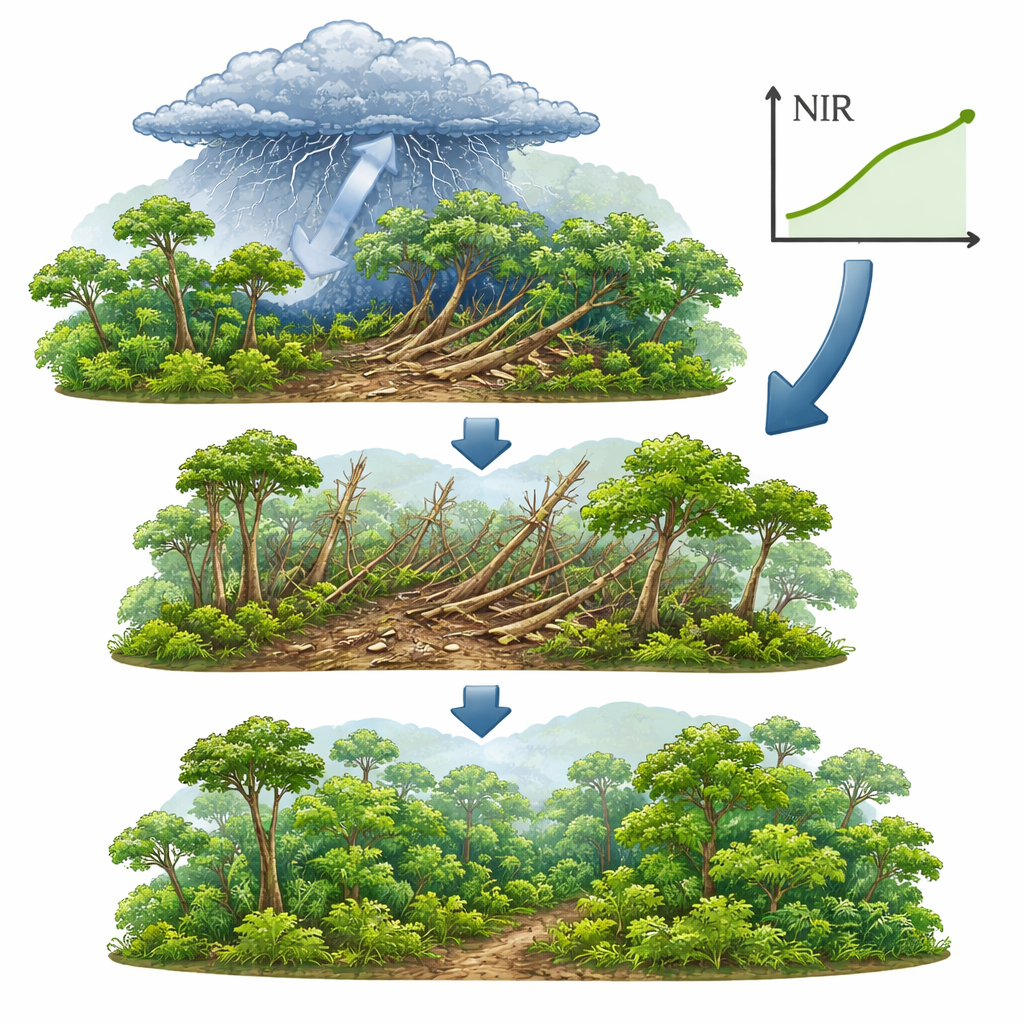
What fast recovery really means
Rapid recovery of satellite signals does not mean the original, towering forest has fully grown back. Instead, it suggests quick infilling by fast-growing shrubs, herbs, and young trees that reflect light strongly but store much less carbon than old giants. The authors propose that Central Africa’s regular rainfall, long history of past disturbance, and dominance of species adapted to regrow quickly all help explain this speedy green-up. Even so, large windthrows remain important because they open extensive gaps, alter which species thrive, and influence where carbon is stored across the region.
Stormier skies, shifting forests
This work shows that Central Africa’s forests, like those of the Amazon, are shaped in part by violent storm-driven blowdowns. As mesoscale convective systems become more frequent and intense under a warming climate, such events may become more common, with consequences for forest resilience and the global carbon cycle. For non-specialists, the takeaway is clear: what happens in the storm clouds above the Congo Basin can change the fate of the forests below, and with them, the climate we all share.
Citation: Negron-Juarez, R., Feng, Y., Sheil, D. et al. Widespread forest disturbance from windthrow in central African rainforests. npj Nat. Hazards 3, 9 (2026). https://doi.org/10.1038/s44304-026-00172-0
Keywords: Central African rainforests, windthrow, tropical storms, forest resilience, carbon cycle