Clear Sky Science · en
Venezuelan equine encephalitis virus: novel live-attenuated vaccines for inducing complete protective immunity
Why this virus matters to people and animals
Venezuelan equine encephalitis virus, or VEEV, is a mosquito-borne virus that sickens both humans and horses across the Americas. Most people infected develop a flu-like illness, but the virus can sometimes invade the brain and cause fatal swelling, especially in children and older adults. Horses are hit even harder, with some outbreaks killing large portions of entire national herds. Because VEEV can also spread efficiently through the air in laboratory experiments, health agencies consider it a potential biothreat, making the search for safe and effective vaccines a pressing priority.
How the virus spreads through nature
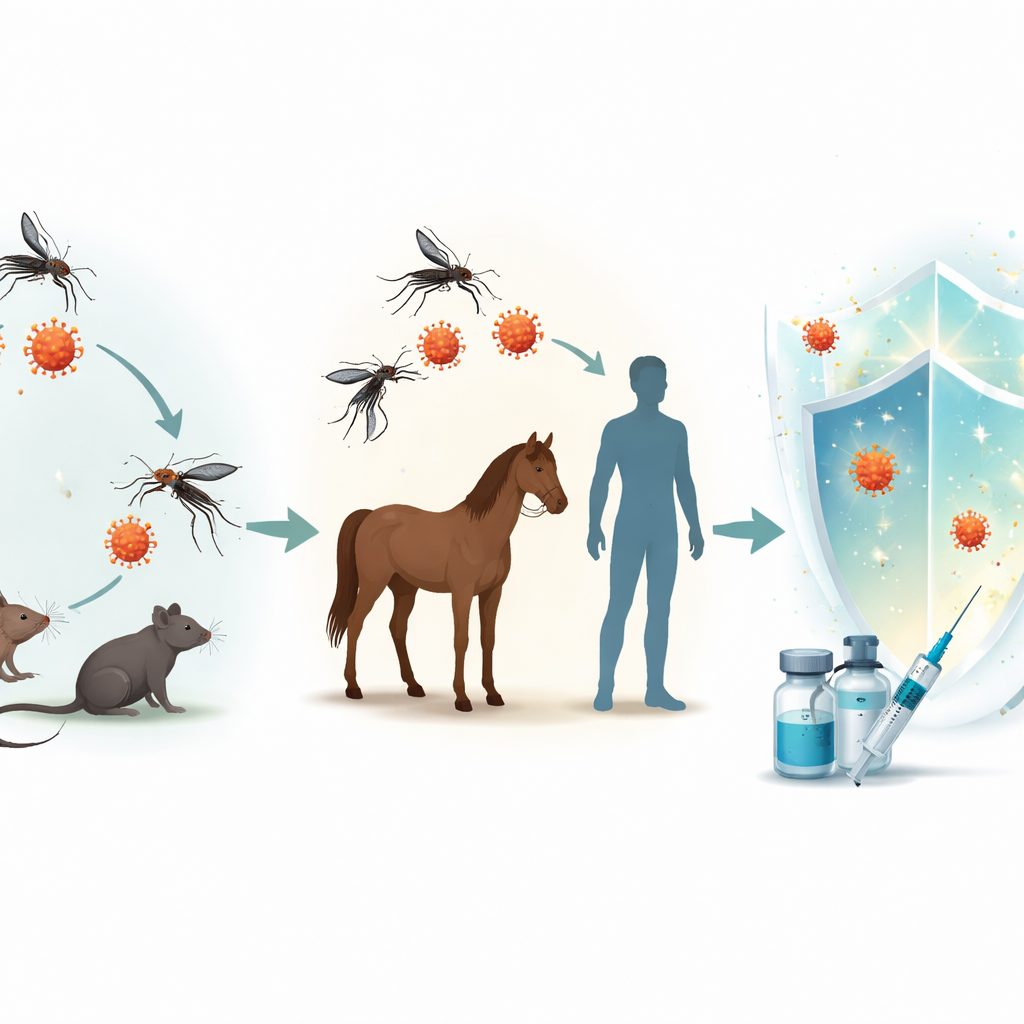
In the wild, VEEV circulates quietly between forest mosquitoes and small mammals such as rats, largely out of sight of humans. From time to time, genetic changes in these “endemic” strains allow them to infect different mosquitoes that readily bite horses and people. When that happens, the virus can spill over into farms and towns, triggering waves of disease in horses that, in turn, help mosquitoes pass the virus along more widely. Past epidemics in Latin America and the southern United States have infected tens of thousands of people and wiped out large numbers of horses. Although humans typically do not pass the virus onward, they suffer the consequences when animal outbreaks surge.
What the virus does inside the body
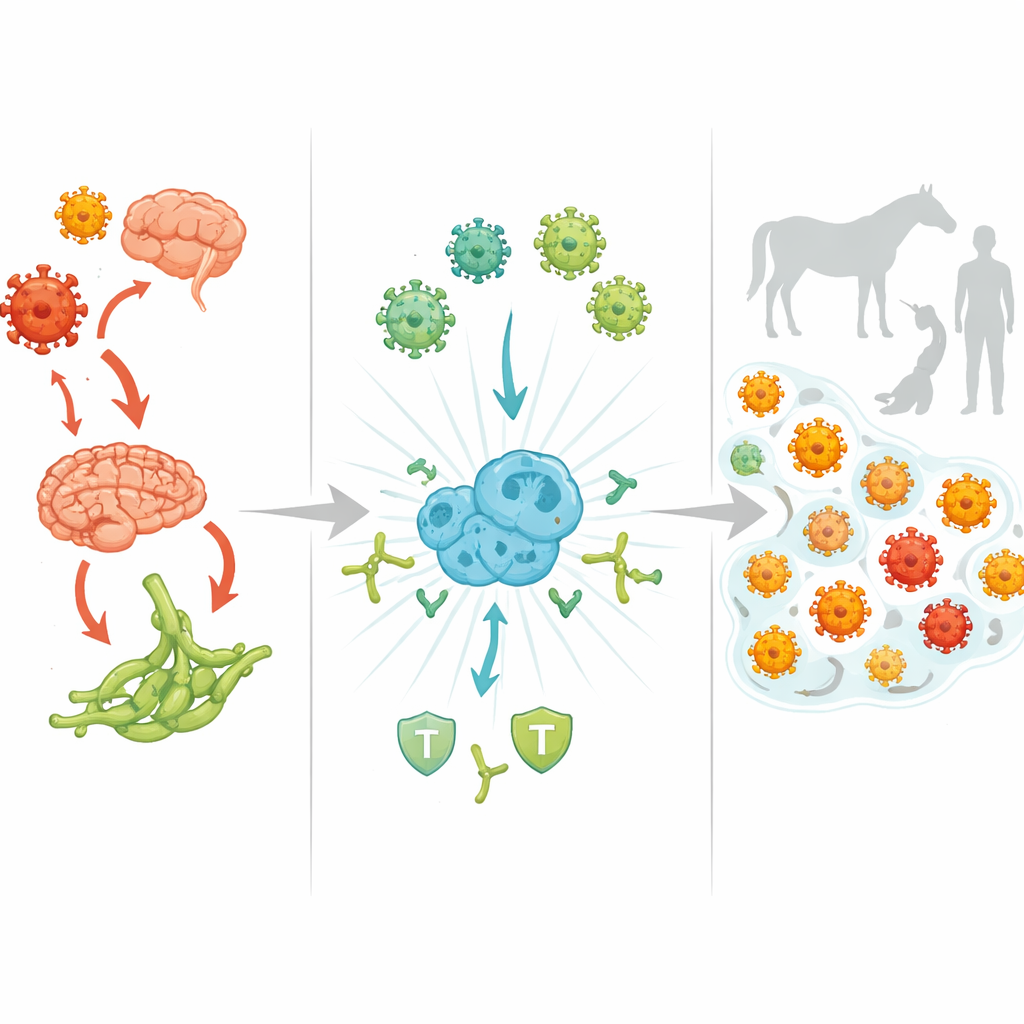
VEEV is a small, membrane-wrapped particle carrying a strand of genetic material that hijacks our cells to make more copies of itself. After entering through a mosquito bite—or through the air in experimental settings—it first infects immune cells and nearby lymph tissues. The virus then sweeps through the bloodstream and can cross into the brain by several routes, including along nerves in the nose and through the blood–brain barrier. Most people experience fever, chills, muscle aches, and stomach upset that resolve in about a week, but a fraction develop confusion, seizures, or coma as the brain and its blood vessels become inflamed. In horses, the infection is often more dramatic, with severe neurological signs and high death rates.
How the immune system fights back
The body responds to VEEV with two key lines of defense: antibodies that can latch onto the virus and block it, and T cells that hunt down infected cells. Animal studies show that both arms are needed for full protection. Potent neutralizing antibodies can sharply reduce virus levels in the blood and improve survival after airborne exposure, but alone they may not fully prevent brain damage. Conversely, T cells—especially a subset of helper cells—are crucial for clearing lingering virus from the central nervous system. Experiments in mice lacking either B cells or T cells reveal that each group contributes in complementary ways: together, they can stop the virus from causing lethal brain disease.
Old vaccines and their limits
Decades ago, researchers developed a weakened version of VEEV, called TC-83, by repeatedly growing the virus in guinea pig heart cells. This live-attenuated vaccine was given experimentally to laboratory workers at high risk of exposure and did stimulate lasting antibody responses in most recipients. However, it came with problems: up to one in five people failed to develop strong immunity, and many experienced uncomfortable side effects such as fever, headache, and malaise. The vaccine virus could occasionally be found in mosquitoes in the field, raising worries—though not confirming—that it might spread. Most troubling, its genetic changes could, in theory, drift back toward a more dangerous form. A related killed vaccine called C-84 avoided some safety concerns but produced weaker immune responses.
New vaccine designs to close the gaps
To overcome these drawbacks, scientists are now testing a new generation of VEEV vaccines built on different ideas. One leading candidate, V4020, starts from TC-83 but adds carefully chosen mutations and rearranges key genes to make it much harder for the virus to revert while further reducing its ability to invade the brain. In monkeys and small animals, V4020 produces strong antibody responses, shows little or no spread into the central nervous system, and protects against airborne challenge. Other approaches include live-attenuated strains engineered with regulatory elements that cripple replication in mosquitoes, virus-like particles that mimic the outer shell of VEEV without containing any genetic material, and DNA vaccines that instruct our own cells to briefly make viral proteins and train the immune system. Early trials in humans suggest that several of these designs are safe and can reliably trigger neutralizing antibodies.
What this means going forward
Viewed together, current research paints a hopeful picture: while no VEEV vaccine is yet licensed for broad use, multiple candidates now combine the strengths of strong, long-lasting immunity with the safety features needed for general deployment. The authors conclude that the field is moving beyond the aging TC-83 shot toward vaccines that can protect both people and horses from large outbreaks and potential airborne threats. For the public, this work underscores how understanding a virus’s life cycle and the subtleties of our immune defenses can inspire smarter, safer vaccines that shut down a dangerous pathogen before it reaches the brain.
Citation: Elliott, K.C., Saunders, D. & Mattapallil, J.J. Venezuelan equine encephalitis virus: novel live-attenuated vaccines for inducing complete protective immunity. npj Viruses 4, 20 (2026). https://doi.org/10.1038/s44298-026-00186-5
Keywords: Venezuelan equine encephalitis, mosquito-borne viruses, live-attenuated vaccines, viral encephalitis, veterinary and human vaccines