Clear Sky Science · en
SARS-CoV-2 crossreactive B-cells outnumber seasonal coronavirus spike-specific clones at the end of the COVID-19 pandemic
Why this study matters now
The end of the COVID-19 pandemic left billions of people with immune systems shaped by encounters with SARS-CoV-2 through infection, vaccination, or both. At the same time, four familiar “common cold” coronaviruses kept circulating quietly in the background. This study asks a timely question: now that our bodies have learned to recognize SARS-CoV-2, has that new immune memory changed how we respond to those older coronaviruses—and could this influence future colds and the design of broader coronavirus vaccines?

From common colds to a new pandemic virus
Long before SARS-CoV-2 appeared, almost everyone had been infected repeatedly with four seasonal coronaviruses—229E, NL63, HKU1, and OC43—that usually cause mild cold-like illness. All coronaviruses are studded with a protein “spike” used to enter our cells. That spike has two main parts: an outer head region that tends to differ between viruses, and an inner stalk region that is more similar. Because of this partial similarity, antibodies and B cells—immune cells that make antibodies—can sometimes recognize more than one coronavirus, a phenomenon known as cross-reactivity. Early in the pandemic, scientists worried that immune memories of old cold viruses might misdirect the response to SARS-CoV-2, or vice versa.
Comparing blood before and after the pandemic
The researchers examined blood samples from adults collected in the Netherlands either before COVID-19 existed (2018–2019) or several years into the pandemic (early 2023). They measured antibodies of two major types, IgG and IgA, that bind coronavirus spike proteins, and they grew B cells in the lab to see which specific spikes each clone recognized. They also tested how well people’s sera could neutralize OC43, one of the common cold viruses, by seeing whether it blocked the virus from infecting cells in culture. Alongside these experiments, they compared three-dimensional structures of spike proteins from SARS-CoV-2 and the seasonal viruses to map where they most closely matched.
How SARS-CoV-2 reshaped antibody landscapes
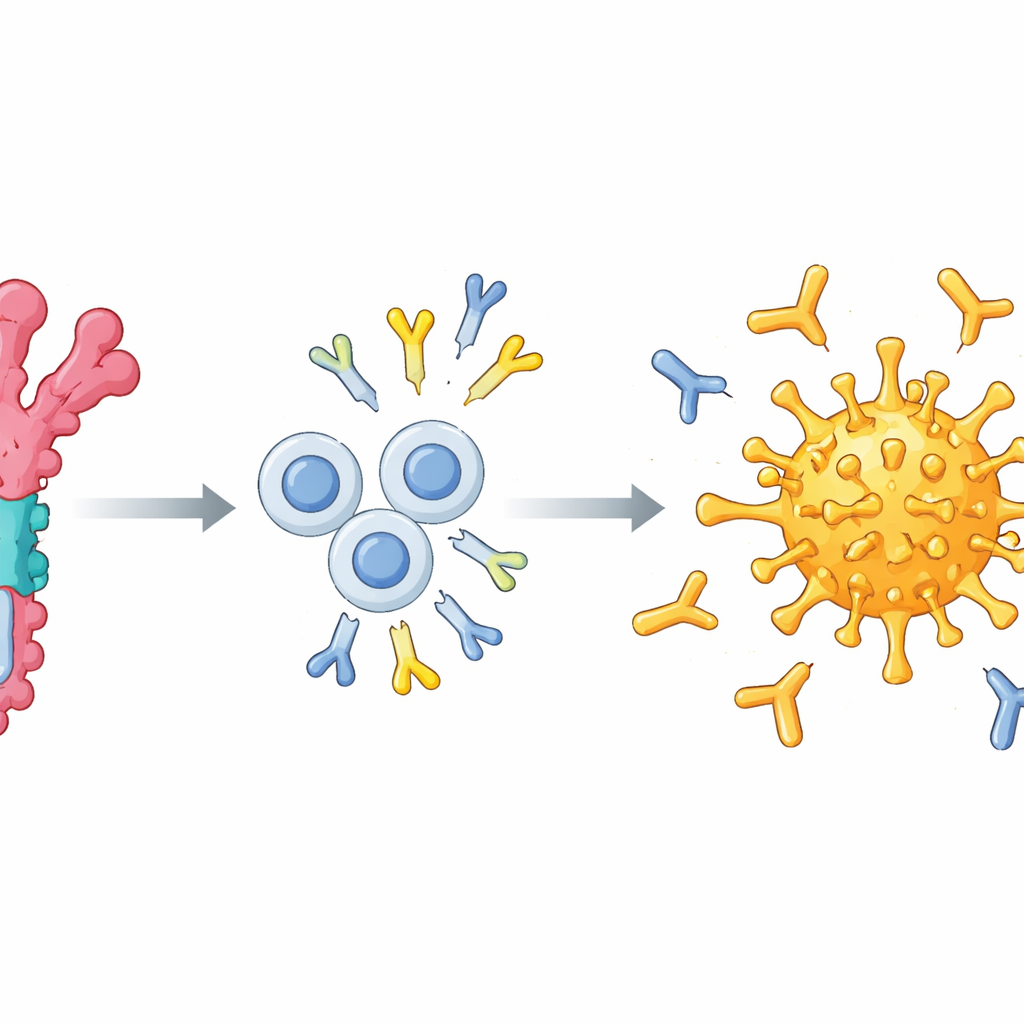
Before the pandemic, participants had antibodies against all four seasonal coronaviruses but essentially none against SARS-CoV-2, as expected. By 2023, this picture had flipped: strong responses to SARS-CoV-2 dominated, yet antibody levels against three seasonal viruses—NL63, HKU1, and especially OC43—were also higher. Detailed B-cell profiling revealed why. Many B-cell clones that recognized SARS-CoV-2 spike also recognized matching regions on seasonal spikes. This effect was most pronounced for the inner stalk-like S2 region of OC43, which is structurally very similar to the S2 region of SARS-CoV-2. These cross-reactive B cells were more frequent at the end of the pandemic, and they tended to bind more strongly to SARS-CoV-2 than to OC43, suggesting that the immune system had been “retrained” around the new virus.
Consequences for neutralizing a common cold virus
The team next examined whether this remodeled immunity had functional consequences. People sampled at the end of the pandemic had higher OC43-neutralizing activity in their blood than those sampled beforehand. Neutralization correlated best with antibodies aimed at OC43’s own spike but was also partially supported by cross-reactive antibodies that recognized the shared S2-like region between SARS-CoV-2 and OC43. When the researchers selectively removed certain antibody fractions from sera, OC43-neutralizing power dropped most when OC43’s head region antibodies were depleted, but it also declined modestly when S2-directed antibodies, including cross-reactive ones, were taken away. Individual B-cell–derived antibodies specific for OC43’s head neutralized strongly, while some, but not all, of the cross-reactive S2-targeting antibodies also reduced OC43 infection.
What this means for future infections and vaccines
Taken together, the findings suggest that widespread exposure to SARS-CoV-2 has not simply added a new layer of immunity; it has reshaped existing defenses against older coronaviruses, particularly OC43. Cross-reactive antibodies now outnumber purely OC43-specific ones targeting the shared stalk region, and they contribute—though less potently per antibody—to the overall ability of blood to neutralize this common cold virus. It remains to be seen whether this translates into milder OC43 infections in real life, but the work points to the stalk-like S2 region as a promising target for vaccines or antibody therapies that could protect against multiple coronaviruses at once.
Citation: Gonzalez-Lopez, C., Aguilar-Bretones, M., Reinders, J. et al. SARS-CoV-2 crossreactive B-cells outnumber seasonal coronavirus spike-specific clones at the end of the COVID-19 pandemic. npj Viruses 4, 19 (2026). https://doi.org/10.1038/s44298-026-00185-6
Keywords: coronavirus immunity, cross-reactive antibodies, SARS-CoV-2, OC43, pan-coronavirus vaccines