Clear Sky Science · en
North American Culex pipiens mosquitoes are competent for Usutu virus transmission
Why this mosquito story matters
Most people have heard of West Nile virus, a mosquito-borne infection that showed up in North America in the late 1990s. Fewer have heard of Usutu virus, a close cousin that has already caused large die‑offs of birds and rare but serious brain infections in people in Europe. This study asks a practical question for public health: if Usutu virus ever reaches North America, are our common backyard mosquitoes capable of spreading it?
A little-known virus with a worrying track record
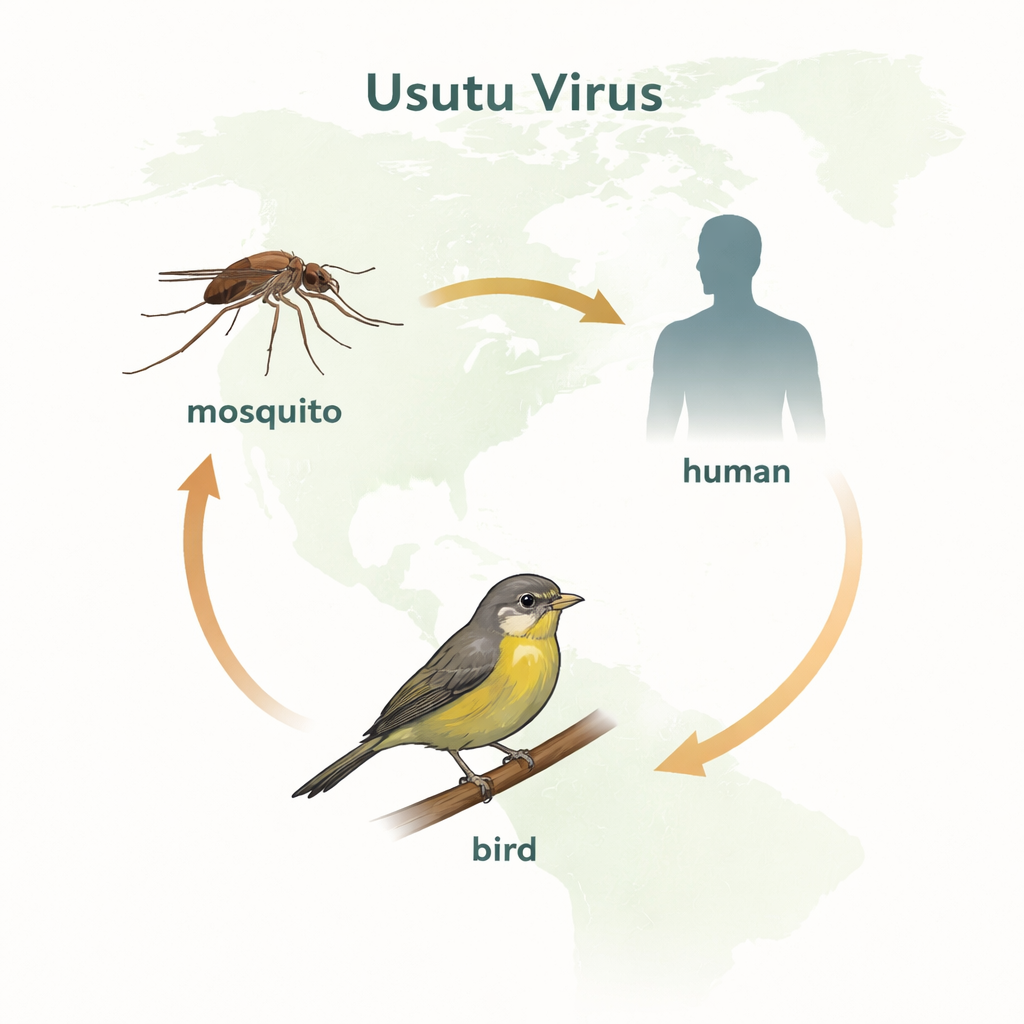
Usutu virus circulates mainly between mosquitoes in the genus Culex and songbirds. Humans and other mammals can become infected but usually do not pass the virus on, acting as “dead‑end” hosts. Since it was first found in Africa in 1959, Usutu virus has quietly expanded its range, becoming firmly established in Europe and killing large numbers of blackbirds and other passerine birds. Because it is so similar to West Nile virus in how it behaves and where it circulates, scientists are concerned that, given the right conditions, Usutu virus could also jump to North America.
Testing local mosquitoes in the lab
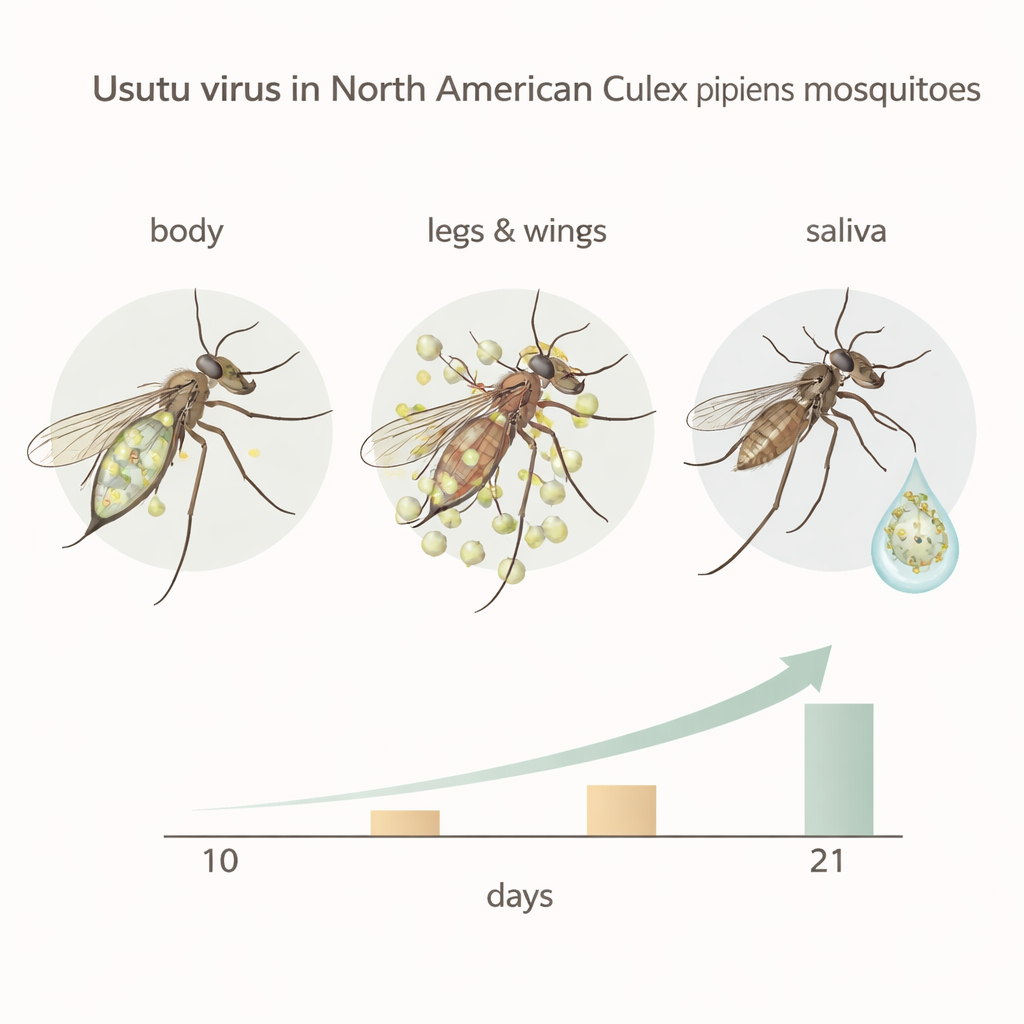
The researchers focused on two common North American mosquito species that already play major roles in spreading West Nile virus: Culex tarsalis, found widely in the western United States, and Culex pipiens, often called the northern house mosquito. In carefully controlled laboratory experiments, they allowed these mosquitoes to feed on blood containing known amounts of two modern Usutu virus strains, one from Europe and one from Africa. Over the following days, they checked whether the virus could infect the mosquito’s body, move into its legs and wings, and finally appear in its saliva—the last step needed for the insect to pass the virus on with a bite.
Which mosquitoes can actually pass the virus on?
The results showed a clear difference between the two species. Culex tarsalis mosquitoes could be infected by Usutu virus, and in some individuals the virus spread through the body, but only a tiny fraction had detectable infectious virus in their saliva. In contrast, Culex pipiens mosquitoes were easily infected by both virus strains, and about one in ten had infectious virus in their saliva ten days after feeding. When the scientists extended the waiting time to three weeks, roughly one third of the Culex pipiens mosquitoes were able to transmit the virus. This pattern suggests that, given enough time after feeding on an infected bird, North American Culex pipiens could be effective Usutu virus vectors.
How much virus is enough for infection?
To mimic more realistic conditions, the team next asked how high the virus level must be in a blood meal for Culex pipiens to become infected. Using artificial blood, they showed that mosquitoes rarely became infected below a certain threshold, and that infection rates rose steadily as the dose increased. Their analysis pointed to a minimum of around 5 on a logarithmic scale of viral particles per milliliter for infection from an artificial meal. When mosquitoes fed on live canaries that had been experimentally infected with Usutu virus, the bar was even higher: birds needed virus levels of roughly 6 on that same scale before any mosquitoes became infected, and even then no infectious virus was found in mosquito saliva ten days later. This indicates that in nature, only birds that reach quite high virus levels in their blood are likely to fuel sustained transmission cycles.
What this means for future outbreaks
The study’s take‑home message for non‑specialists is that a common North American mosquito, Culex pipiens, has all the biological tools needed to spread Usutu virus, much like it already does for West Nile virus. However, the virus would need to reach high levels in local bird species before mosquito infection and onward spread become likely, which may slow or limit its establishment. These findings give public health officials and ecologists an early warning: if Usutu virus is ever detected in North American birds, especially those developing high virus levels, monitoring and controlling Culex pipiens populations could be crucial to preventing another bird‑killing, mosquito‑borne virus from taking hold.
Citation: Persinger, R.D., Kuchinsky, S.C., Cereghino, C. et al. North American Culex pipiens mosquitoes are competent for Usutu virus transmission. npj Viruses 4, 16 (2026). https://doi.org/10.1038/s44298-026-00182-9
Keywords: Usutu virus, Culex pipiens, mosquito-borne disease, West Nile virus, vector competence