Clear Sky Science · en
Revisiting Ravn virus as the lesser known orthomarburgvirus
Why a little-known virus matters
Most people have heard of Ebola, but far fewer know that a closely related group of viruses, including Marburg virus and its quieter cousin Ravn virus, can cause equally deadly disease. This review article takes a deep look at Ravn virus—where it comes from, how it circulates in bats, how it sickens people, and what scientists are doing to prevent future outbreaks. Understanding this lesser known threat helps public health officials and researchers prepare for emerging epidemics before they spiral out of control.
Two deadly relatives, not quite twins
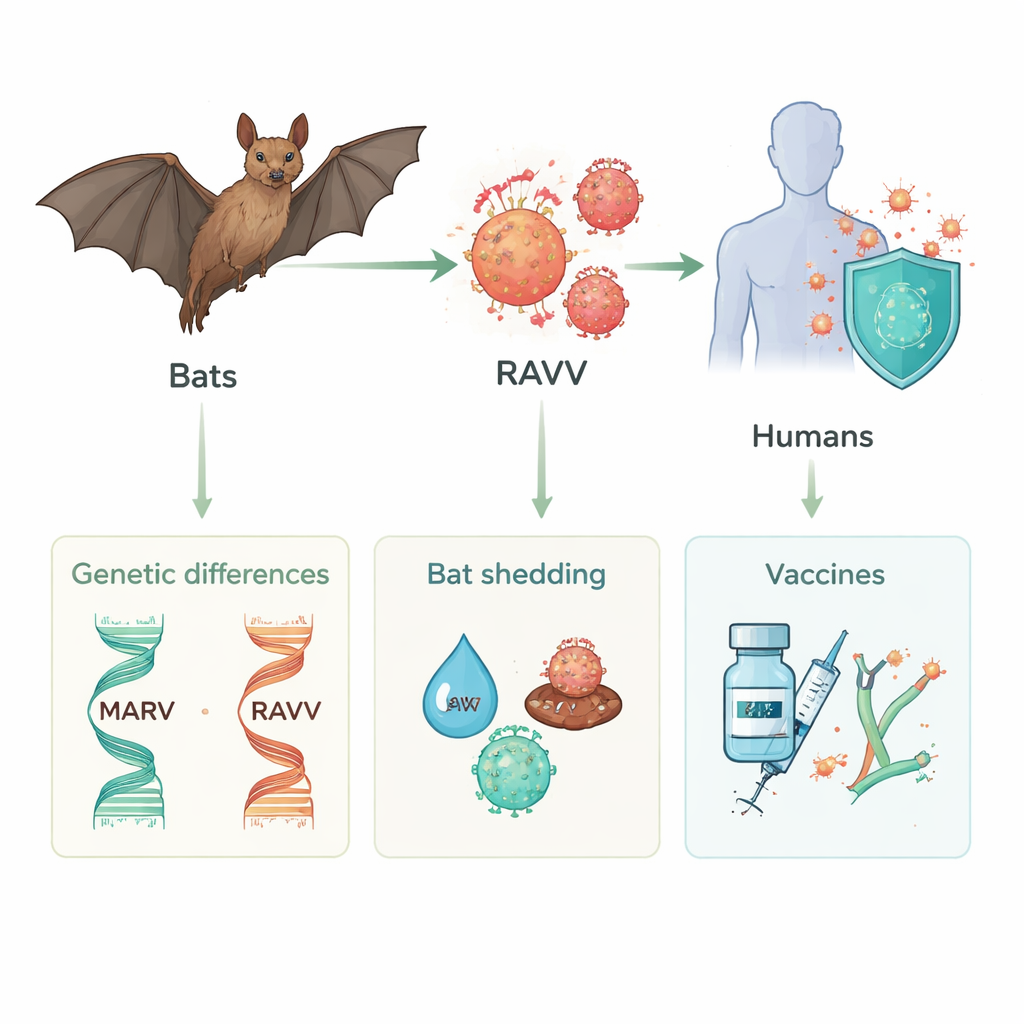
Marburg virus disease is a severe illness that can cause fever, organ failure, shock, and sometimes bleeding, with average fatality rates around two-thirds of known human cases. Ravn virus belongs to the same species group as Marburg virus and causes a very similar form of hemorrhagic fever in people, but its genetic makeup differs by a bit more than one-fifth of its building blocks. That may sound small, yet for viruses this is a large gap that can change how they spread, how our immune systems see them, and how well vaccines work. Genetic analyses suggest that Marburg and Ravn viruses split from a common ancestor roughly 700 years ago and have been evolving separately ever since.
Outbreaks traced back to caves and mines
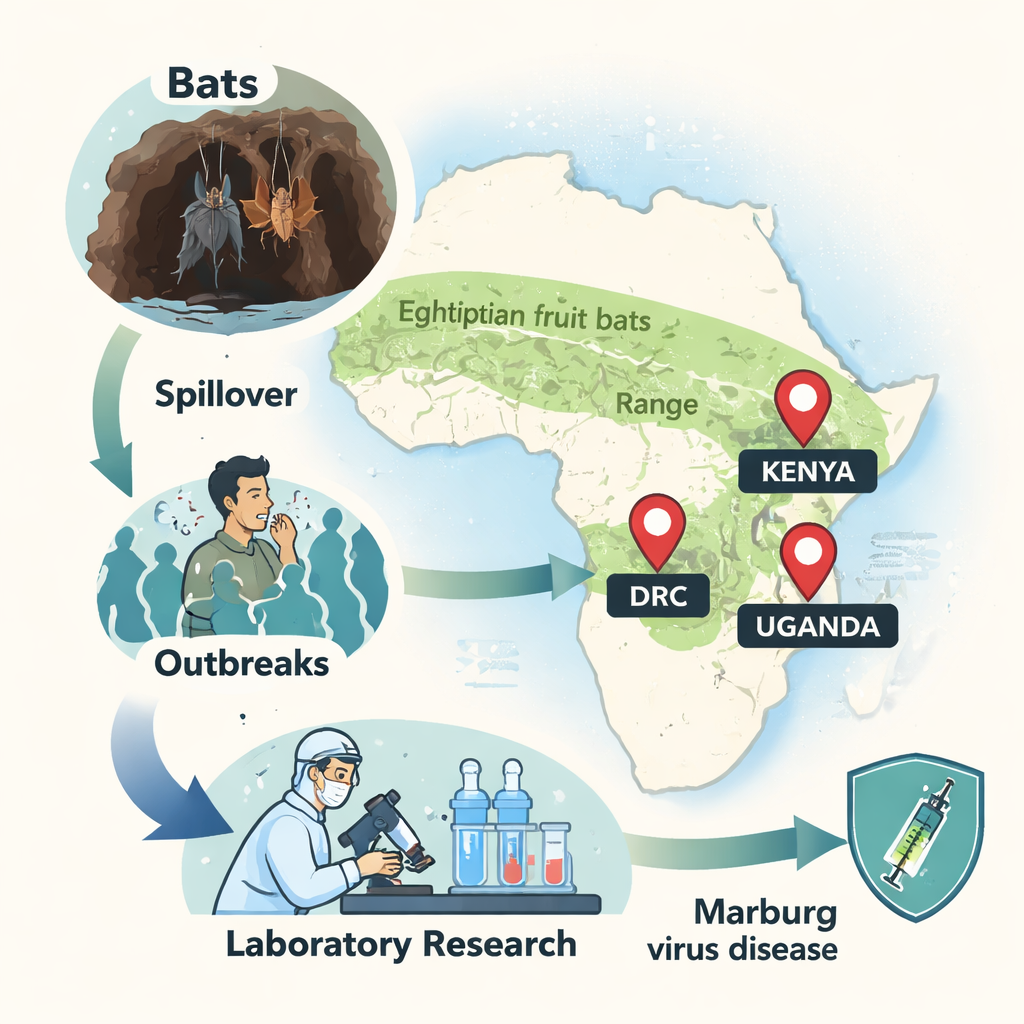
Since the first recognized Marburg outbreak among laboratory workers in Europe in 1967, there have been 19 documented outbreaks of Marburg virus disease across 15 countries in Africa and beyond, including only three with confirmed Ravn virus infections. Most events trace back to caves or deep mines where people spend time near large colonies of fruit bats. The first known Ravn case, reported in a teenage tourist in Kenya in 1987, followed a visit to a bat-filled cave. Later outbreaks in the Democratic Republic of the Congo and Uganda again pointed to underground mines, where many infected miners brought the virus home to families and health-care workers. Careful genetic tracking showed that multiple distinct virus lineages—both Marburg and Ravn—often spill over from bats to humans in the same location and season, suggesting repeated jumps from wildlife rather than a single chain of spread.
Fruit bats as hidden reservoirs
Ecological and laboratory studies converge on one main conclusion: the Egyptian rousette bat, a cave-dwelling fruit bat, is the natural reservoir for both Marburg and Ravn viruses. Researchers have repeatedly found viral genetic material, live virus, and virus-specific antibodies in these bats across several African countries. In carefully controlled experiments, bats infected with either virus show little or no obvious illness. Instead, they have short-lived bursts of virus in the blood and shed virus from the mouth and gut, especially around their twice-yearly birthing seasons. Recent work tracking Ravn virus directly in bats showed that it can persist and be shed for days through saliva and droppings, sometimes at even higher and longer levels than Marburg virus. Bats also develop long-lasting immune memory that prevents serious reinfection, meaning they can carry and pass on these viruses without dying from them.
What animal experiments reveal about disease
Because there have been only three confirmed human Ravn cases, scientists rely heavily on animal models to understand how dangerous it is and how it behaves in different hosts. Ordinary mice and guinea pigs resist infection by natural strains, so researchers adapt the virus through repeated passages until it becomes lethal, then study which mutations appear. These adapted strains help reveal which viral proteins help the virus evade immune defenses or damage tissues. In non-human primates, which most closely mimic human disease, Ravn virus can be as deadly as the most severe Marburg strains in some monkey species but relatively mild in others, highlighting strong host-specific differences. Importantly, experimental treatments such as a human antibody originally isolated from a Marburg survivor have been able to cure monkeys infected with either Marburg or Ravn virus, showing that some therapies can cross-protect against both.
Vaccines that aim to cover both threats
Vaccine developers have mainly targeted Marburg virus, but the close—yet not identical—relationship to Ravn virus raises concerns that a Marburg-only vaccine might leave gaps in protection. The review summarizes several promising approaches, including vaccines based on harmless adenoviruses, virus-like particles, and modern mRNA formulations. In guinea pigs and monkeys, some Marburg-based vaccines have generated immune responses that also recognize and protect against Ravn virus. Others, however, show uneven coverage: for instance, an mRNA vaccine built on Ravn virus’s surface protein produced strong protection against Ravn itself and only partial cross-protection against Marburg. These results highlight that the direction of cross-protection is not always symmetrical and that the exact vaccine platform and viral protein design matter.
What this means for future outbreaks
Overall, the article argues that Ravn virus is more than a footnote to Marburg virus: its genetic differences, subtle shifts in how it spreads in bats, and distinct behavior in experimental animals all suggest that it could pose unique risks in future spillover events. At the same time, shared features between the two viruses offer a realistic path toward broad vaccines and treatments, some of which have already cured infected monkeys in the lab. For the general public, the key message is that by understanding this quieter cousin now—where it hides, how it moves from bats to people, and how our immune system can be trained to block it—scientists and health agencies can better anticipate and blunt the impact of the next outbreak of Marburg or Ravn virus disease.
Citation: Yordanova, I.A., Prescott, J.B. Revisiting Ravn virus as the lesser known orthomarburgvirus. npj Viruses 4, 11 (2026). https://doi.org/10.1038/s44298-026-00180-x
Keywords: Ravn virus, Marburg virus, fruit bats, hemorrhagic fever, filoviruses