Clear Sky Science · en
Design for recycling in electronic manufacturing: enabling circularity and lower impact manufacturing through heterogeneous integration and lower impact recovery
Why greener gadgets matter
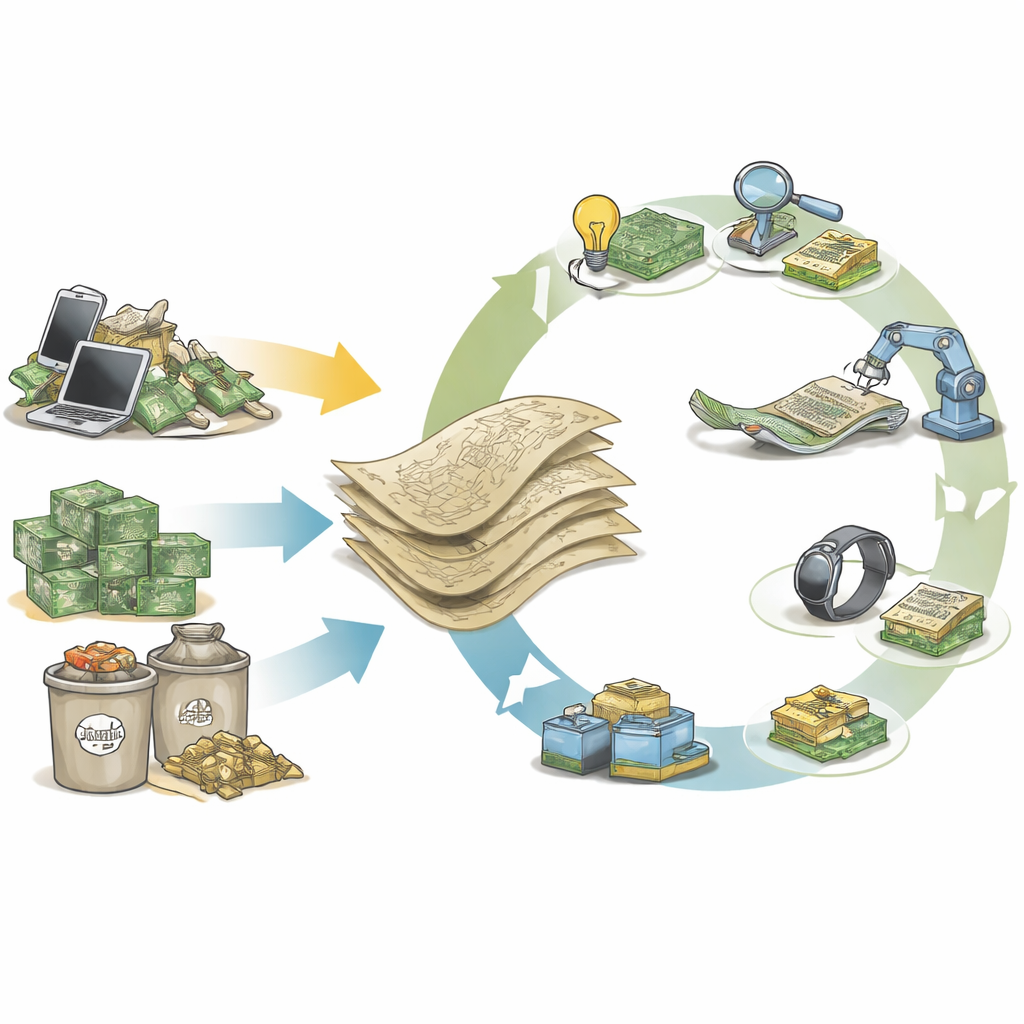
Our phones, laptops and smart devices quietly create a growing mountain of electronic trash. Most of it ends up in landfills or is recycled using harsh, polluting methods that waste valuable metals. This paper explores a different path: designing circuit boards from the start so they are easier to recycle, made from kinder materials, and still work just as well as today’s electronics. The researchers show that with smart design and manufacturing, we can keep the benefits of modern gadgets while sharply cutting their environmental footprint.
Rethinking the heart of electronics
Inside almost every electronic device sits a printed circuit board, or PCB, that holds chips and wiring. Today these boards are mostly made from a hard plastic called FR4, reinforced with glass and flame retardants. FR4 is tough and reliable, but it is also difficult to recycle and can release toxic compounds when burned or processed. The authors looked for biodegradable plastics that could replace FR4 without melting or warping during circuit printing. They tested several bio-based materials and papers, measuring how smooth and heat-resistant each one was, because smooth, stable surfaces are crucial for clean, precise wiring.
They found that certain bioplastics, especially one called PHBV and a related polymer blend, struck the best balance. These materials were smoother than standard FR4 and could withstand temperatures needed to dry printed metal inks. That means fine metal tracks can be printed directly on them without the board buckling or losing shape. This combination of printability and heat stability makes PHBV a strong candidate for future eco-friendly circuit boards.
Printing wires instead of carving them out
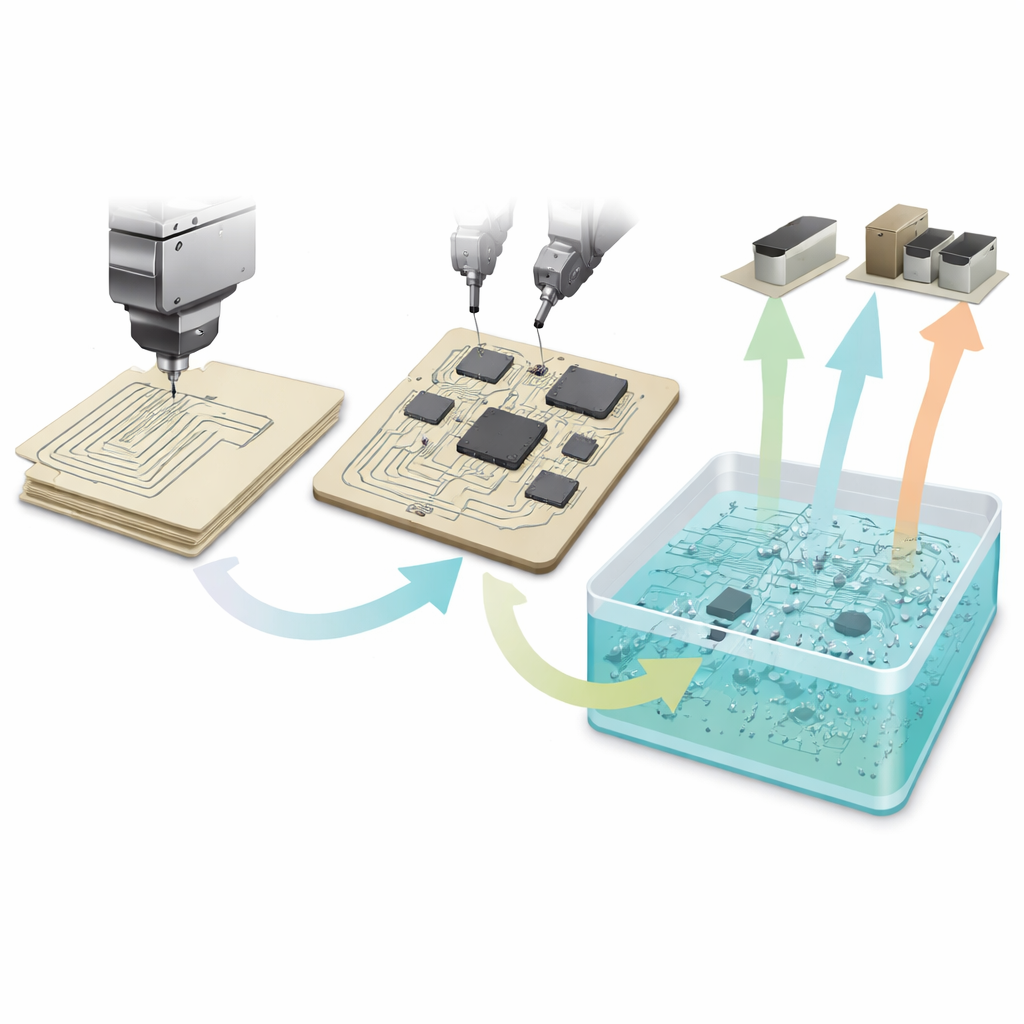
Traditional circuit boards start with a solid layer of copper that is mostly etched away using chemical baths, wasting metal and creating polluted liquids. The team instead used an inkjet-style printer to lay down only the silver needed for each wire, an “additive” process that greatly reduces waste. They then used an ultra-precise deposition tool to connect bare silicon chips directly to these printed tracks with hair-thin silver links. Tests showed that these tiny connections conducted electricity almost as well as solid silver and performed on par with conventional gold wire bonds, but with less material and lower heat buildup.
To prove that these boards can do real work, the researchers built two simple but fully operating circuits on PHBV: a touch-controlled light built from a transistor array, and a tiny counter powered by a low-voltage microcontroller that drives a pair of LEDs. Measurements of signal shapes and currents before and after the special silver connections showed only minor differences—about a 2 percent change—well within normal tolerances. The printed boards also survived bending, heat and humidity tests without noticeable change in performance over hundreds of cycles and many hours.
Gentler ways to recover precious metals
Designing for recycling means thinking about the end of a device’s life from the beginning. Here, the key target is silver, a valuable metal used in the printed tracks. Instead of harsh acids, the team used a water-based solution of iron chloride to strip silver from the circuit without destroying the biodegradable board or chips. The silver turns into tiny particles that can be filtered out and converted back into pure metal. In laboratory trials, about 87 percent of the silver was recovered, and chemical tests showed that almost none remained in the leftover board material, which would meet strict safety limits for landfill or, ideally, be reused or left to degrade.
This gentle process also helps preserve the electronic parts. After soaking, chips and other components could be separated and still function, making them candidates for reuse. The iron-based solution itself can be regenerated and reused many times, further lowering its environmental cost. In a future large-scale system, the authors estimate that silver recovery rates could exceed 95 percent while still avoiding toxic fumes and corrosive waste typical of current recycling methods.
Counting the full environmental savings
To understand the bigger picture, the researchers carried out a life cycle assessment, comparing a small PHBV-based board made with printed silver to a similar FR4 board made the usual way. They tracked raw materials, manufacturing energy, and end-of-life treatment across several categories, including climate impact and human toxicity. Even without recycling, the PHBV boards performed better, mainly because they avoid glass-reinforced epoxy and copper etching. When silver and components were recovered—and especially when the central microcontroller chip was reused—the environmental benefits became dramatic. The best-case PHBV scenario cut overall impacts by up to 90 percent, including a drop in climate-warming emissions from about 1.8 to 0.4 kilograms of carbon dioxide equivalent per board.
What this means for future gadgets
To a non-specialist, the message is straightforward: it is possible to build working electronics that are designed from the ground up to be recycled and to leave a much smaller environmental footprint. By choosing biodegradable circuit board materials, printing only the metal that is needed, and using mild chemicals to recover valuable silver and chips, this approach turns today’s linear "make–use–dump" model into a more circular system. While more work is needed to scale up the processes and prove long-term durability, the study shows a clear route toward gadgets that are not only smart in what they do, but also in how they are made and unmade.
Citation: Zhang, T., Harwell, J., Cameron, J. et al. Design for recycling in electronic manufacturing: enabling circularity and lower impact manufacturing through heterogeneous integration and lower impact recovery. npj Mater. Sustain. 4, 10 (2026). https://doi.org/10.1038/s44296-026-00098-8
Keywords: sustainable electronics, biodegradable circuit boards, design for recycling, printed electronics, electronic waste