Clear Sky Science · en
Cognition and the menopause transition: cross-sectional evidence from a large community cohort
Why this matters for everyday life
Many women in midlife describe “brain fog” during the years when their periods become irregular and eventually stop. They worry that forgetfulness or mental slowing may signal early dementia or permanent damage. This study followed more than 14,000 women aged 45 to 55 from a large community survey in England to ask a simple but urgent question: when women feel mentally foggy during the menopause transition, does that actually show up as poorer performance on demanding thinking tests?

What the researchers set out to explore
The team grouped participants into three stages based on their menstrual cycles: regular cycles (premenopause), irregular cycles (perimenopause), and stopped periods (postmenopause). All women completed an online battery of eight challenging tasks that measured memory, planning, reasoning, and mental speed, combined into an overall “global cognition” score. They also reported how often they had experienced symptoms in the previous two weeks, including brain fog, poor memory, low mood, anxiety, sleep problems, fatigue, and palpitations.
What women reported about their thinking and mood
Self-reported cognitive symptoms were common. Women in perimenopause and postmenopause had higher odds of saying they had brain fog, poor memory, low mood, anxiety, and sleep difficulties than women who had not yet entered the transition. For example, perimenopausal women were about a third more likely than premenopausal women to report brain fog or poor memory over the past two weeks. Postmenopausal women also reported more brain fog, poor memory, sleep problems, and severe fatigue than premenopausal women. In other words, from a lived-experience perspective, thinking problems felt worse for many women during and after the transition.
How thinking test scores compared across menopause stages
When the researchers turned to the objective testing, the picture looked very different. Average performance on the global thinking score was almost the same across all three groups. If anything, perimenopausal women showed slightly higher accuracy than both premenopausal and postmenopausal women, but the differences were tiny—just a few hundredths of a standard deviation—and unlikely to be noticeable in daily life. Reaction times on the tasks did not differ meaningfully by menopause stage either. In short, the study found no sign of broad mental decline tied to the menopause transition in this community sample.
What brain fog was really linked to
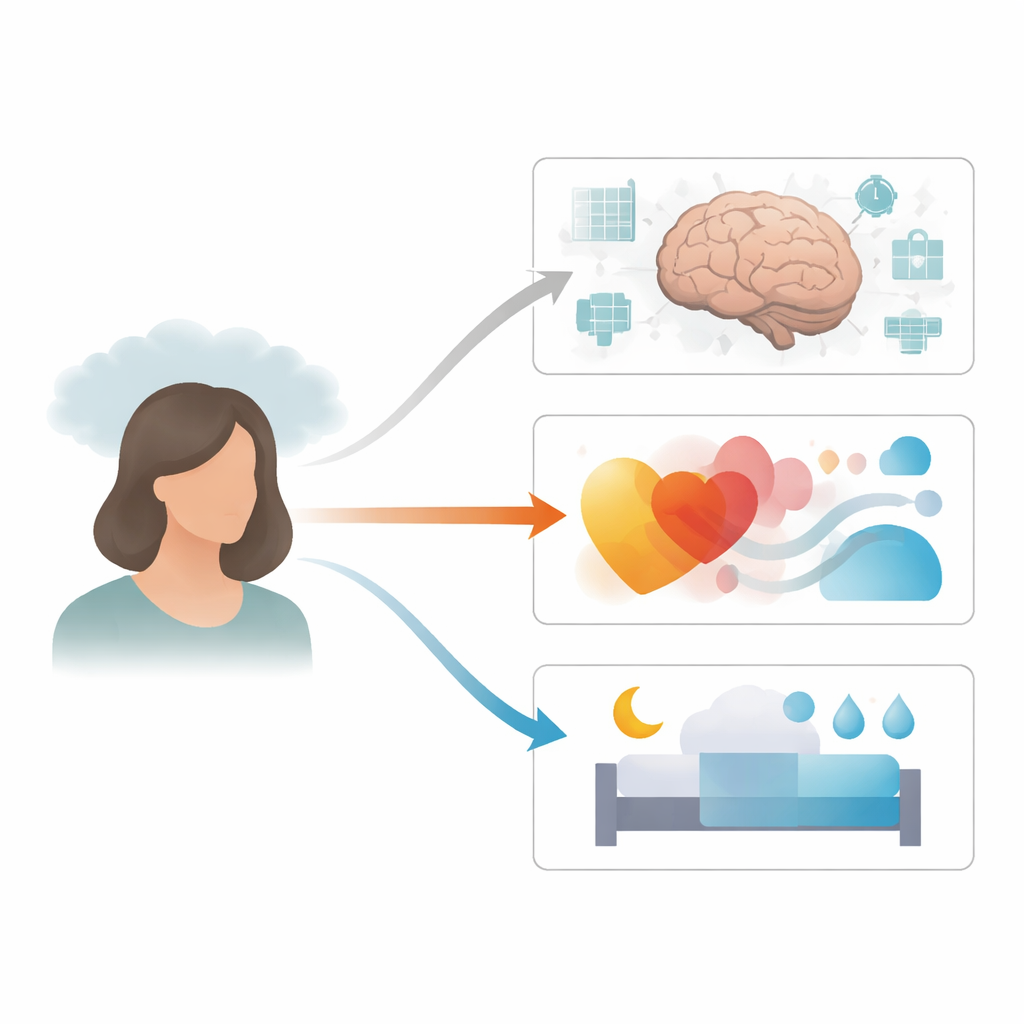
Next, the team asked whether women who felt foggy or forgetful actually did worse on the tests. The answer was: only very slightly. Across all menopause stages, correlations between reported brain fog or poor memory and objective scores were very weak. By contrast, cognitive complaints were moderately linked to psychological symptoms such as anxiety, low mood, and mood swings. Sleep problems and fatigue were also more common in women reporting brain fog. These patterns suggest that what many women experience as mental fog may arise less from a loss of raw thinking power and more from the combined effects of disturbed sleep, hormonal shifts, and changes in mood and energy.
What this means for women and their care
The study’s message is reassuring but also challenging. On the reassuring side, women who feel mentally foggy in midlife are unlikely to be experiencing major, measurable damage to their overall thinking ability. On the challenging side, their symptoms are real, distressing, and tightly intertwined with mood and sleep. The authors argue that healthcare providers should take these cognitive complaints seriously as part of menopausal care, rather than dismissing them because test scores look normal. Future research, they suggest, should develop more precise tools to capture short-lived lapses, explore how hormones, sleep, and mood interact, and track women over time to see how midlife symptoms relate to later cognitive aging and dementia risk.
Citation: Naysmith, L.F., Ward, H., Elliott, P. et al. Cognition and the menopause transition: cross-sectional evidence from a large community cohort. npj Womens Health 4, 14 (2026). https://doi.org/10.1038/s44294-026-00132-z
Keywords: menopause and brain fog, midlife cognition, women’s mental health, hormones and memory, sleep mood and cognition