Clear Sky Science · en
Patients’ responses & reflections when receiving news of cancer progression: a qualitative study
Why this moment matters
Hearing that cancer has grown or spread is one of the hardest moments a person can face, yet it happens every day in clinics around the world. This study listens carefully to patients’ own words about that moment. By understanding how people actually react—emotionally and in their thinking about the future—doctors, nurses, patients, and families can navigate these conversations with more compassion and less guesswork.

Listening to patients’ stories
The researchers interviewed 86 adults in Canada who were living with advanced, incurable solid tumors and receiving palliative treatments meant to control the disease or ease symptoms rather than cure it. In earlier work, these patients had discussed how they weigh treatment trade-offs. At the end of those interviews, they were asked a simple but powerful question: why is it difficult to hear that your cancer is growing or spreading? The team recorded, transcribed, and carefully analyzed the answers, looking for patterns that emerged from the patients’ own language rather than forcing responses into predefined boxes.
A wide range of feelings
One major theme was a spectrum of emotional responses—some deeply painful, others surprisingly hopeful. Many people described shock, fear, denial, devastation, and disappointment, often tied to a sense that hard treatments had “not worked” or to self-blame for “not fighting hard enough.” These reactions could be so overwhelming that patients felt unable to process what their doctors were saying. At the same time, nearly a third of participants recalled meeting the news with some measure of acceptance, optimism, gratitude, or hope, leaning on positive mindsets or surrounding themselves with encouraging people. Together, these accounts show that there is no single “typical” way to feel when cancer progresses.
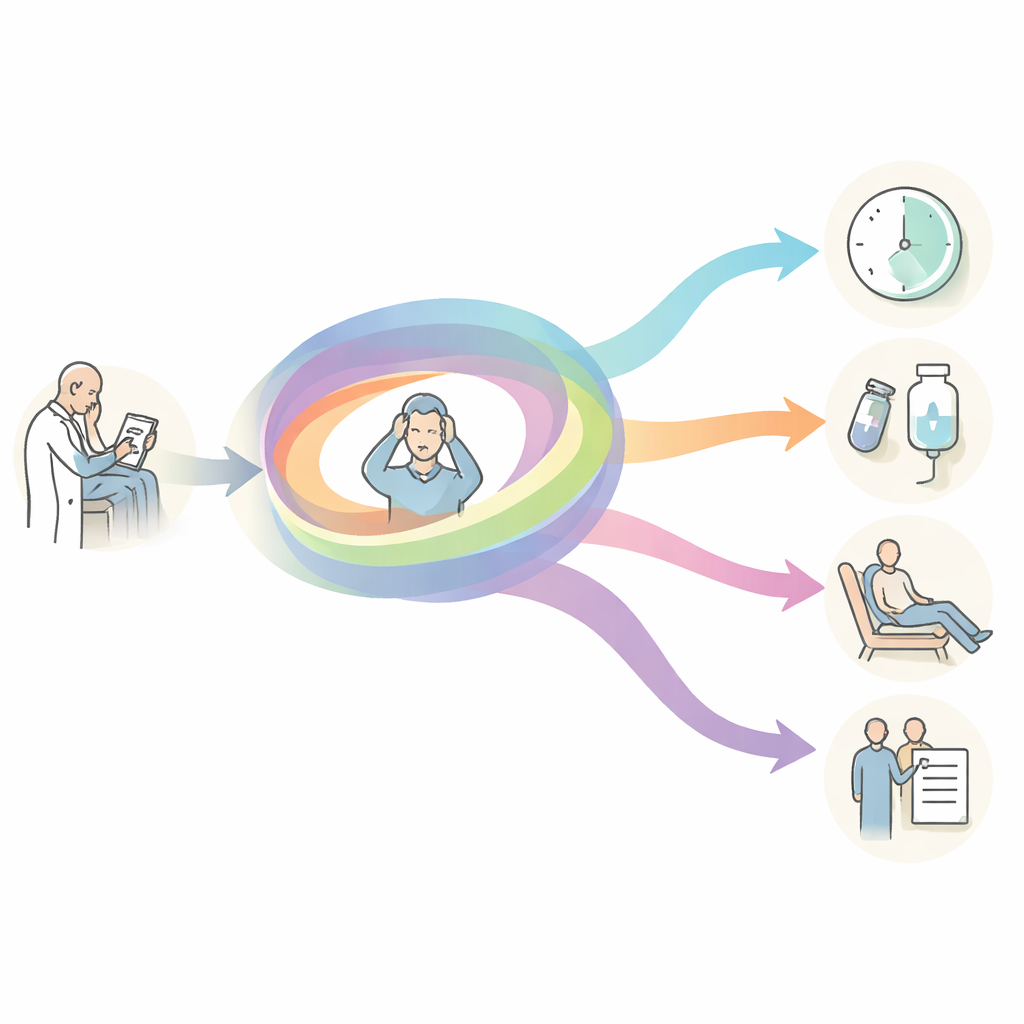
Thinking about time, treatment, and support
The second major theme captured what happens once the first wave of emotion settles: patients start asking, “What now?” Many spoke about suddenly seeing their remaining time as shorter and being forced to confront their own mortality. This prompted reflection on how to use the time left, and whether to focus on more treatment, comfort, or both. Some saw new treatment options as a source of hope; others worried about harsher side effects and how those might erode the quality of whatever time remained. Across responses, quality of life—how they would feel and function day to day—mattered as much as, or more than, how long they might live.
The role of family, faith, and planning ahead
Patients also highlighted the importance of support. Many leaned on family, friends, or spiritual beliefs to get through difficult news. Others emphasized a need for clearer communication from health care providers, describing times when medical discussions felt like a foreign language or were too rushed for questions. A smaller group found that expecting bad news in advance helped them cope when it arrived, allowing them to “face reality,” adjust their expectations, and begin planning. For some, knowing the truth—however grim—was less stressful than living with uncertainty, because it allowed them to prioritize important activities, relationships, and decisions about care.
What this means for real-world conversations
The study concludes that patients’ reactions to learning their cancer has progressed are highly individual, stretching from intense distress to calm acceptance and hope, and quickly branching into concerns about time, comfort, treatment options, and support. For clinicians, this means there is no one script that fits everyone. Instead, effective communication frameworks should be used flexibly, with room to explore each person’s emotions, values, and questions in the moment. For patients and families, the message is equally important: whatever you feel when you hear such news is valid, and openly sharing those feelings and priorities can help your care team tailor information and support to what matters most to you.
Citation: ten Hove, J., Kain, D., Galica, J. et al. Patients’ responses & reflections when receiving news of cancer progression: a qualitative study. BJC Rep 4, 9 (2026). https://doi.org/10.1038/s44276-026-00213-1
Keywords: cancer communication, bad news, patient emotions, quality of life, serious illness conversations