Clear Sky Science · en
Shape-transitions of a morphing illusory contour can be decoded during multiple-object tracking from the ongoing EEG
How Our Eyes Keep Track in a Moving World
When you try to follow several players in a sports match, or keep an eye on your kids in a busy playground, your eyes and brain pull off a quiet miracle: they track many moving objects at once without mixing them up. This study asks a deceptively simple question about that everyday skill: does the brain follow each object one by one, like pins on a map, or does it also group them into a bigger, invisible shape that glides and bends across the scene? Using recordings of brain activity, the authors show that our visual system really does keep an ongoing, abstract outline that links tracked objects together—and that the brain reacts when this hidden outline changes its shape.
Following Dots with an Invisible Outline
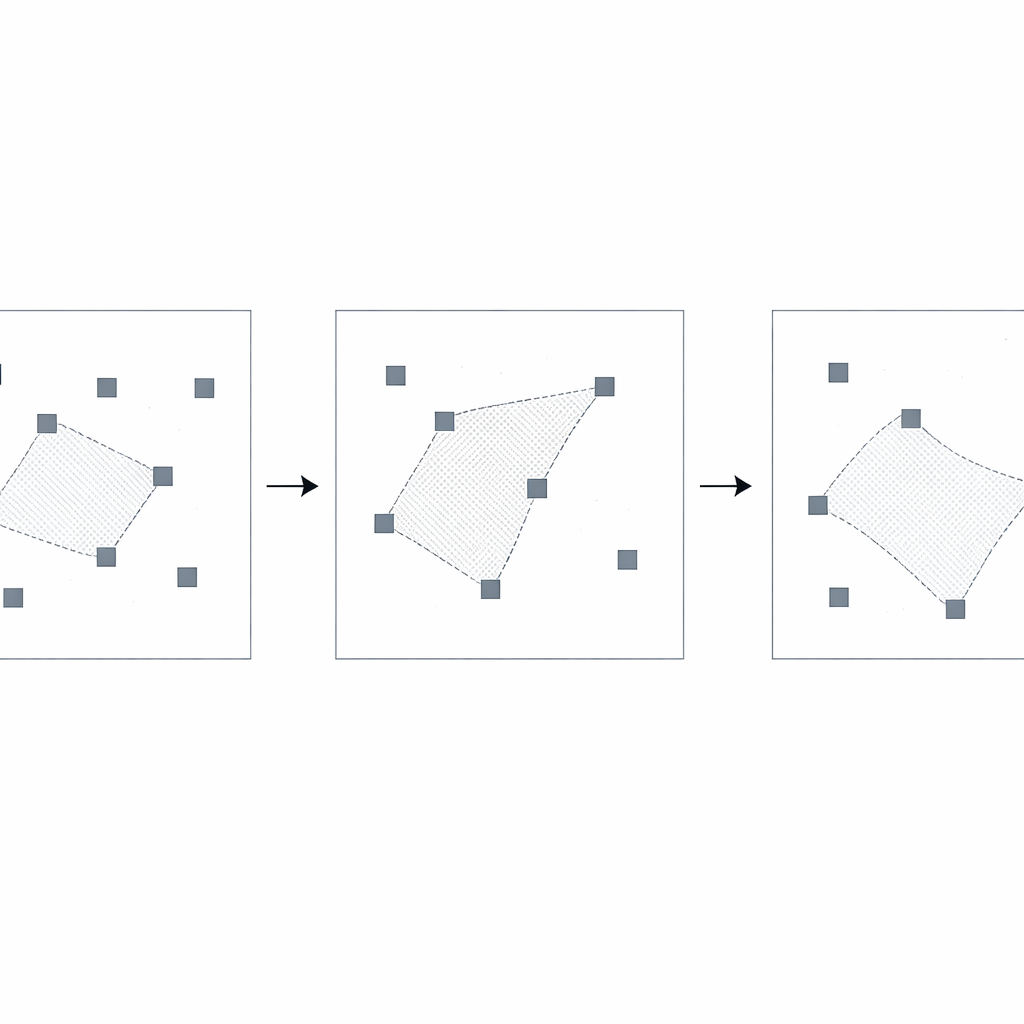
To probe how we track motion, the researchers used a classic lab setup called a multiple-object tracking task. Volunteers watched eight identical small squares drift around a screen. At the start of each trial, four of these squares briefly flashed, marking them as the ones to follow, while the others served as distractors. The dots then meandered smoothly for several seconds, never getting too close or overlapping, while participants had to keep their eyes on the central fixation point and mentally track the four targets. At the end, four squares were highlighted, and people had to decide whether these were exactly the four they had been following. This task is demanding, and past work has shown that performance drops as the objects move faster, get closer, or become more numerous.
A Hidden Shape that Never Appears on the Screen
Earlier work by the same group hinted that, during this kind of task, the brain treats the tracked dots not only as separate points but also as corners of an invisible shape. Mathematically, there is always a unique “shortest” closed path that connects all four targets without crossing itself, forming a kind of ghostly polygon. This contour is never actually drawn on the screen, but it can be computed from the stored positions of the dots. As the targets move, this polygon morphs smoothly—except at special moments when it undergoes sudden, qualitative changes. Sometimes the order in which the dots are connected abruptly switches, a “flip” of the outline. At other times the shape changes from bulging outward (convex) to having an inward dent (concave), or the other way around. These moments are more than just tiny shifts in position; they alter the very structure of the shape.
Reading Shape Changes from Brain Waves
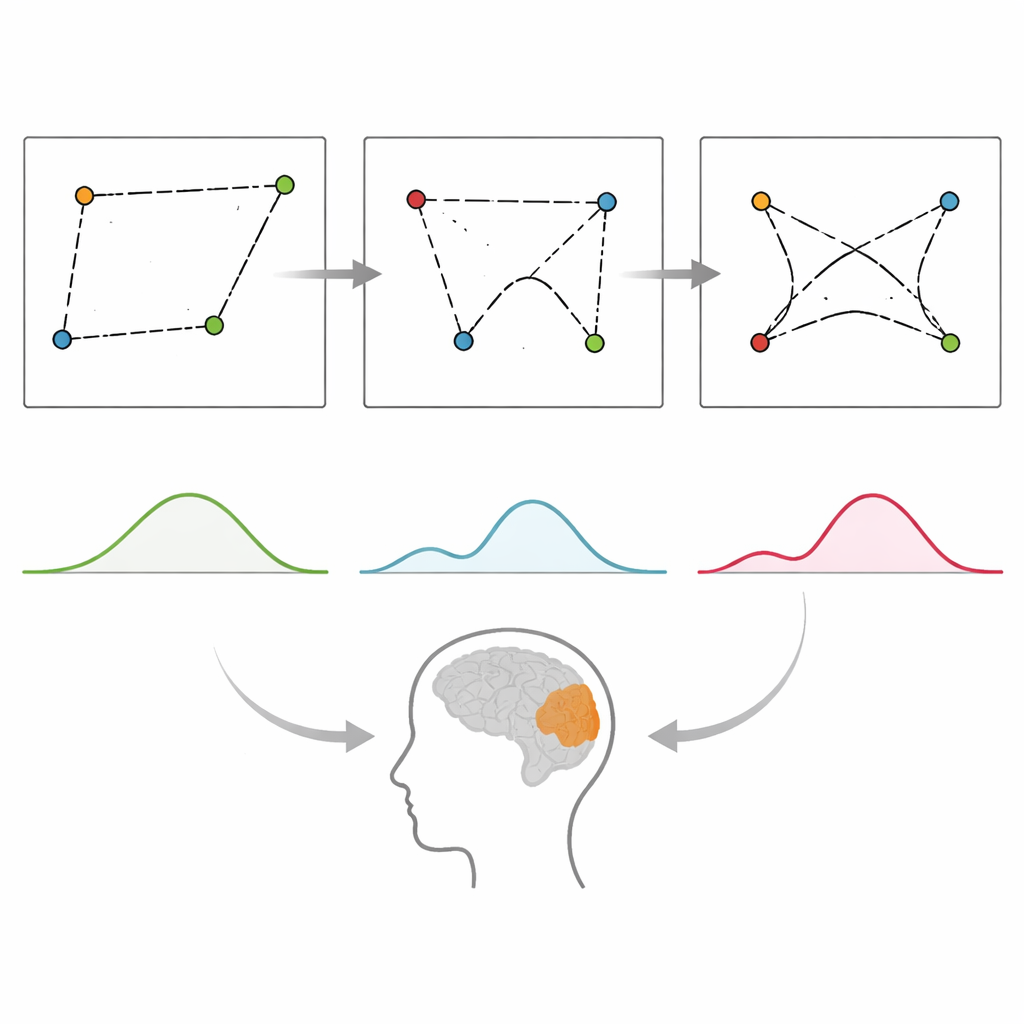
While people performed the tracking task, the researchers recorded their ongoing brain activity using electroencephalography (EEG), a technique that measures faint electrical signals at the scalp. For each trial, they used the stored motion paths to mark the exact moments when the invisible polygon linking the four targets flipped or switched between concave and convex forms. They then looked at how the EEG signal behaved around these transition times. A first pass showed that the brain’s response over visual areas at the back of the head differed depending on which kind of shape change had just occurred, but only when the polygon was drawn through the target dots, not through the distractors. This already suggested that attention was tied to the shared configuration of the tracked items.
Decoding the Invisible Motion in Real Time
The team went further by asking whether they could infer these shape changes directly from the ongoing EEG, as if reading the brain’s internal monitoring of the phantom polygon. They first distilled the complex 32-channel signal into a few main components and extracted a short “signature” pattern for each type of shape transition. They then slid these signatures across the continuous EEG from other trials and measured how well they matched at each moment, producing a time-varying estimate of how likely a given transition was happening. For two transition types—flips and convex-to-concave switches—these similarity measures reliably peaked around the true transition times for the target polygon, but not for the distractor polygon. Intriguingly, the signal for flips was detectable about 150 milliseconds before the transition, while the signal for concavity emerging into the shape appeared about 150 milliseconds afterward, suggesting different underlying processes.
Why These Findings Matter for Everyday Seeing
Finally, the researchers split participants into better and worse trackers based on their accuracy in the task. Those who performed better showed clearer, more distinct EEG signatures of shape transitions, especially for changes that introduced concavities. This pattern implies that people who more strongly maintain the invisible shape linking the targets gain a tracking advantage. Altogether, the study indicates that our visual system does not merely juggle a handful of separate locations. It also weaves them into a single, changing outline and devotes attention to how that outline bends, flips, and develops dents over time. The brain’s sensitivity to these subtle shape changes, especially the creation of inward curves, seems to support the way we carve up the visual world into coherent, trackable units—helping us follow the action in fast, cluttered scenes with surprising ease.
Citation: Merkel, C., Merkel, M., Hopf, JM. et al. Shape-transitions of a morphing illusory contour can be decoded during multiple-object tracking from the ongoing EEG. Commun Psychol 4, 48 (2026). https://doi.org/10.1038/s44271-026-00427-6
Keywords: multiple object tracking, visual attention, illusory contours, EEG, shape perception