Clear Sky Science · en
Inferring mind wandering from perceptual decision making
Why our minds drift off
Anyone who has missed a turn while driving or reread the same sentence three times knows that attention is fragile. Our thoughts often slip away from what we are doing into daydreams or worries. This paper explores whether those hidden lapses of focus can be detected moment by moment without repeatedly stopping people to ask what they are thinking. The authors combine a simple computer task with advanced statistical models to read out when the mind is on task or wandering, using behavior alone.
A simple game that invites autopilot
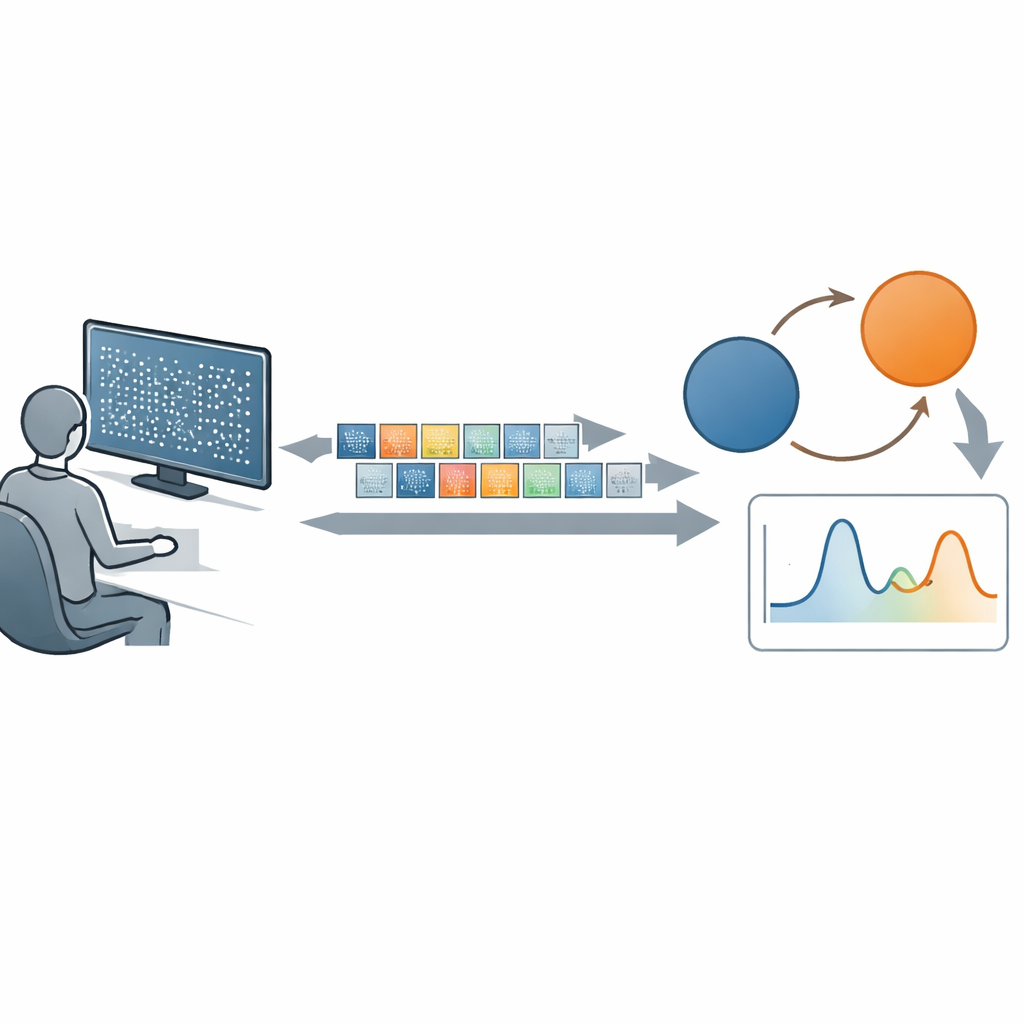
To study attention, the researchers asked university students to perform a repetitive visual game. On each trial, they watched a cloud of moving dots and pressed a key to indicate whether the overall motion was toward the left or right. Crucially, one direction appeared on 90% of the trials, creating a strong habit to press the same key over and over. This setup makes it tempting for people to respond automatically, rather than carefully checking the dots on every trial. Occasionally, the game paused and a slider asked participants how focused they had been just before the interruption, from fully on the task to fully on unrelated thoughts.
What behavior reveals about drifting attention
The thought probes showed that mind wandering leaves a distinct behavioral fingerprint. When participants reported being off-task, they responded faster and more often chose the frequent, “dominant” direction, even when the dots strongly indicated the rarer direction. In other words, they relied more on habit and less on visual evidence. When they said they were focused, their choices tracked the actual motion more closely and their responses were a bit slower, consistent with taking time to process the stimulus. A separate decision-making model confirmed that off-task periods were marked by a stronger starting bias toward the dominant response and altered evidence accumulation.
Using hidden states to infer mind wandering
The central innovation of the study is a modeling framework that does not need to ask people about their thoughts. The researchers used a type of hidden-state model that assumes behavior is generated by a small number of internal modes—here, a focused state and a wandering state. For each participant, the model learned how strongly each state linked the motion in the dots to the chosen response, and how likely the person was to switch between states across trials. A two-state version of this model was enough to capture people’s choices better than a simpler one-state approach, and it produced a trial-by-trial estimate of whether the person was likely on-task or off-task throughout the 30-minute session.

Testing the model against real experience
To check whether these hidden states truly reflected attention, the authors compared the model’s predictions with data it had never seen. Trials that the model labeled as on-task tended to occur when people later reported higher focus, and when response times were longer and more sensitive to how clear the motion was—just as in the self-reported focused state. Across the session, both the model and the self-reports showed a gradual shift toward the off-task state, matching the well-known tendency for mind wandering to increase over time. The model also suggested that both focused and wandering episodes typically lasted tens of seconds, in line with estimates from physiological and brain-based studies.
Why this matters beyond the lab
The study shows that it is possible to track when the mind is wandering, second by second, using only patterns of choices in a cleverly designed task. By capturing how people slide between focused and drifting states without interrupting them, this approach opens the door to richer studies of attention in settings ranging from driving simulators to brain scanners. For a layperson, the key takeaway is that your behavior silently reveals when you are mentally checked out—and that with the right tools, scientists can detect those lapses without ever asking what you are thinking.
Citation: Zhang, C., Kool, W. Inferring mind wandering from perceptual decision making. Commun Psychol 4, 60 (2026). https://doi.org/10.1038/s44271-026-00424-9
Keywords: mind wandering, attention, decision making, hidden Markov model, reaction time