Clear Sky Science · en
Psychosocial interventions indicate prolonged survival in cancer patients in a systematic review, meta-analysis, and multiverse meta-analysis of randomized controlled trials
Why Talking and Coping Might Change the Course of Cancer
When we think about cancer treatment, chemotherapy, radiation, and surgery usually come to mind. But decades of research suggest that what happens in a therapist’s office or support group room might also influence how long people live. This article pulls together all the best randomized trials on psychosocial care for cancer patients and asks a simple question with huge consequences: can structured psychological and social support, added to standard medical treatment, actually help patients live longer?

Looking Across Decades of Trials
The authors conducted a large systematic review and meta-analysis, meaning they searched multiple medical and psychology databases for every randomized controlled trial in which cancer patients were assigned either to structured psychosocial programs or to usual care or light comparison conditions. These programs included things like cognitive-behavioral therapy, support groups, meaning-focused discussions, and education about coping with illness. In total, 32 trials with 5,704 patients and many different cancer types met strict inclusion criteria. Earlier studies and previous meta-analyses had come to conflicting conclusions, so the team also examined why past summaries disagreed—looking at which trials were included, what statistical methods were used, and how survival was measured.
Do Psychosocial Interventions Extend Life?
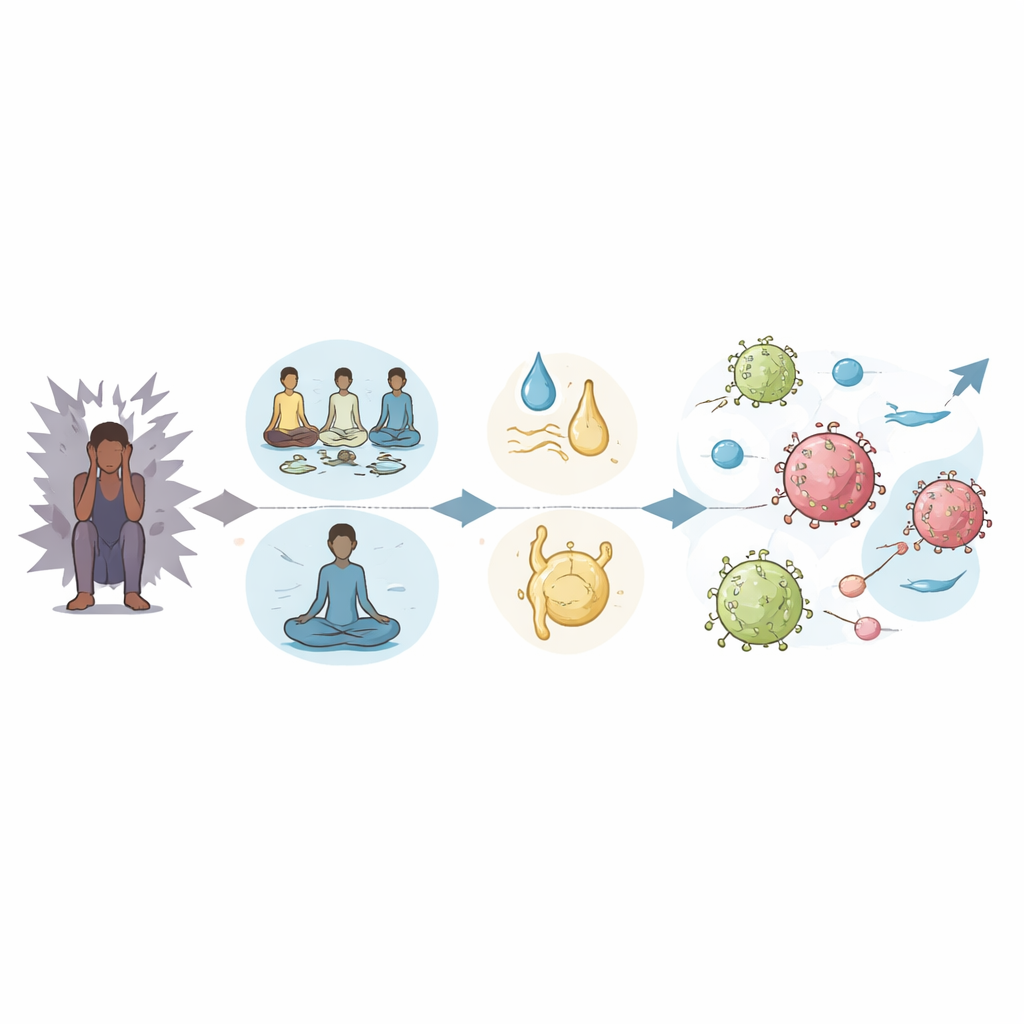
Pooling all 32 trials, the researchers found a clear, though modest, survival advantage for patients receiving psychosocial care in addition to their medical treatment. On average, the chance of dying during the study period was about 20% lower in the intervention groups than in the control groups. Put in more everyday terms, for the 16 trials that reported enough detail, the median gain in survival time was estimated at roughly four additional months, although the uncertainty range ran from slightly below zero to about eight and a half months. Importantly, none of the trials showed a statistically reliable harm from receiving psychosocial care. The authors also note that this survival benefit is similar in size to what many standard cancer drugs achieve, but without the physical side effects.
What Exactly Were Patients Getting?
The psychosocial programs were not vague “chat sessions” but structured packages with active components. The most common ingredients were education about illness and treatment, training in coping skills and problem-solving, techniques for relaxing the body and calming the mind, opportunities to express difficult emotions, and group-based social support. Some programs helped patients find meaning in their illness or reflect on their life stories; others focused on practical communication with doctors and family. Most interventions combined several of these elements and lasted from a few hours to many weeks. Across this diverse mix, the overall pattern still pointed to longer survival when such support was provided.
Why Earlier Studies Disagreed
One puzzle in this field has been why some previous meta-analyses found benefits while others did not. The authors tackled this by running what they call a “multiverse” meta-analysis: they re-analyzed the evidence in many different reasonable ways, mirroring the choices earlier reviewers had made. They varied which patients were included (for example, breast cancer only versus all cancers), which statistics summarized survival, and how long follow-up lasted. When many trials were included and survival was measured in the most appropriate way, benefits consistently emerged. When analyses focused on narrow subgroups or short follow-up periods, results often became statistically non-significant simply because there were too few patients or events to see a small effect clearly. This exercise showed that the basic survival benefit is robust, and that past disagreements were mostly about analytic choices and limited statistical power, not about whether an effect exists.
Limits, Caveats, and What Comes Next
The authors stress that the effect, while meaningful, is not guaranteed for every patient or setting. The trials varied widely in cancer type, stage, and the exact content of interventions, and the statistical analyses showed moderate differences in outcomes across studies. Many individual trials were too small to detect anything but large effects, and information on patients’ use of outside counseling or later medical treatments was often incomplete. Still, careful checks found no strong evidence that the results were skewed by selective publication or data manipulation. Using an evidence-rating framework commonly applied to drug trials, the certainty of the evidence for a life-prolonging effect was judged “moderate”: high enough to take seriously, but leaving room for refinement.
Why This Matters for Patients and Care Systems
For people living with cancer and those who care for them, these findings support a shift in how we think about psychological care. Structured psychosocial programs not only ease distress, anxiety, depression, and pain, but also appear to extend survival by an amount comparable to many accepted medical treatments—at far lower cost and with virtually no physical risk. The authors argue that such care should no longer be seen as an optional extra or mere comfort measure. Instead, it should become a standard part of comprehensive cancer treatment, offered routinely alongside surgery, chemotherapy, radiation, and hormone therapy, while future research sharpens our understanding of which kinds of support work best for which patients.
Citation: Asakawa-Haas, K.D., Spiegel, D., Bossert, L. et al. Psychosocial interventions indicate prolonged survival in cancer patients in a systematic review, meta-analysis, and multiverse meta-analysis of randomized controlled trials. Commun Psychol 4, 49 (2026). https://doi.org/10.1038/s44271-026-00414-x
Keywords: psychosocial interventions, cancer survival, supportive care, mind–body health, psycho-oncology