Clear Sky Science · en
Pre-stimulus alpha power modulates trial-by-trial variability in theta rhythmic multisensory entrainment strength and theta-induced memory effect
Why your brain’s starting point matters for memory
Imagine trying to remember a short movie you watched while listening to an unrelated sound. Whether you later recall that pairing is not just about the movie or the sound themselves, but also about how your brain is already humming along before they appear. This study shows that a particular background rhythm in the brain, known as alpha, can determine how effectively another rhythm that links sight and sound supports the making of new memories.
Rhythms that bind sights and sounds
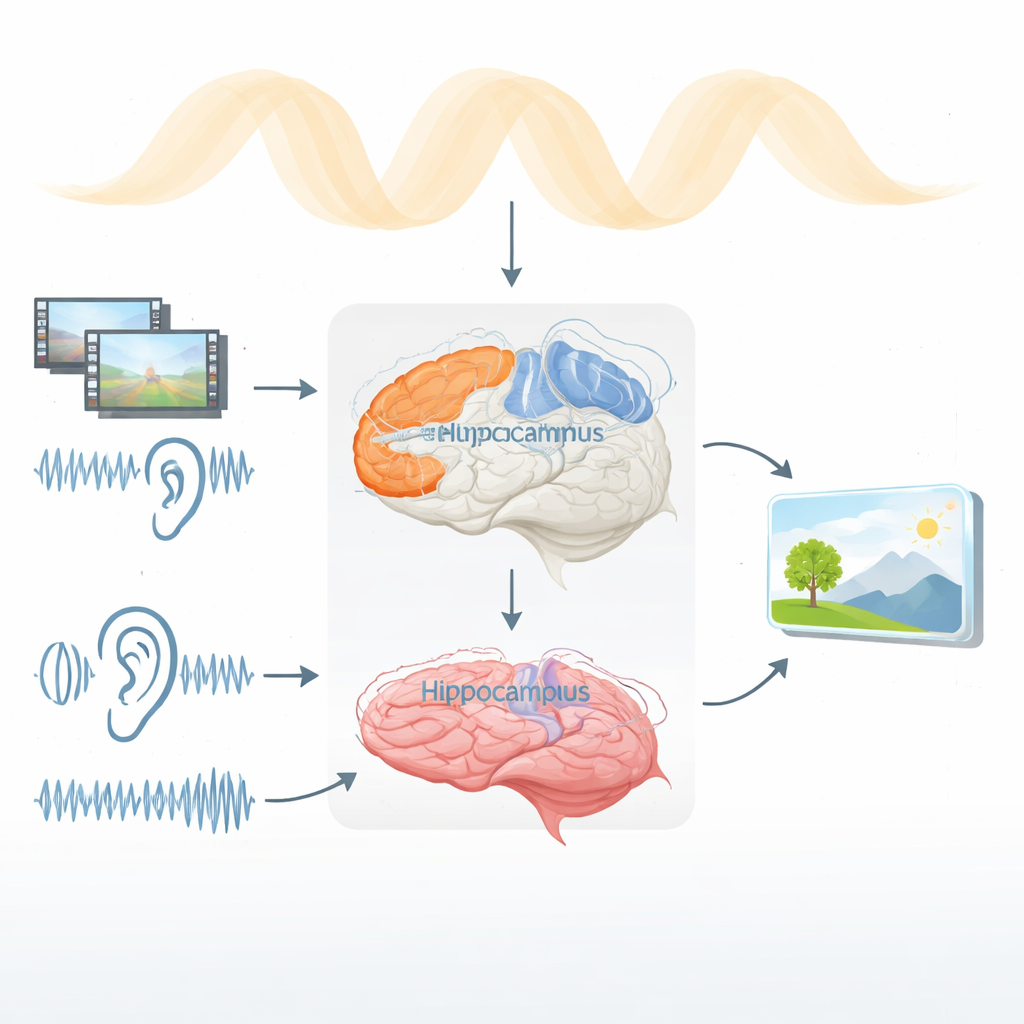
Our everyday memories are built from many senses at once: what we see, hear, and sometimes even smell and feel. Deep in the brain, the hippocampus acts as a hub that binds these pieces together into episodes, like a concert or a holiday scene. Animal research has shown that this hub works in time with a slower electrical beat called theta. When sensory signals arrive at the right moment in this rhythm, connections between nerve cells are strengthened; at the wrong moment, they can weaken. Inspired by this, researchers developed a way to rhythmically flicker pictures and “flutter” sounds at a theta-like pace to see if timing alone can make memories stronger in humans.
A carefully staged memory experiment
In this study, volunteers lay in a brain scanner while they watched three‑second video clips paired with three‑second sounds. Both the brightness of the videos and the loudness of the sounds rose and fell four times per second, like tiny waves. Sometimes the visual and auditory waves rose and fell together, and sometimes they were exactly out of step. After short number‑judgment tasks to break up the rhythm, participants heard each sound again and had to choose which of four still images matched the original video partner. Throughout, their brain activity was recorded with magnetoencephalography, which measures fast-changing magnetic fields produced by brain cells.
When following the beat helps memory
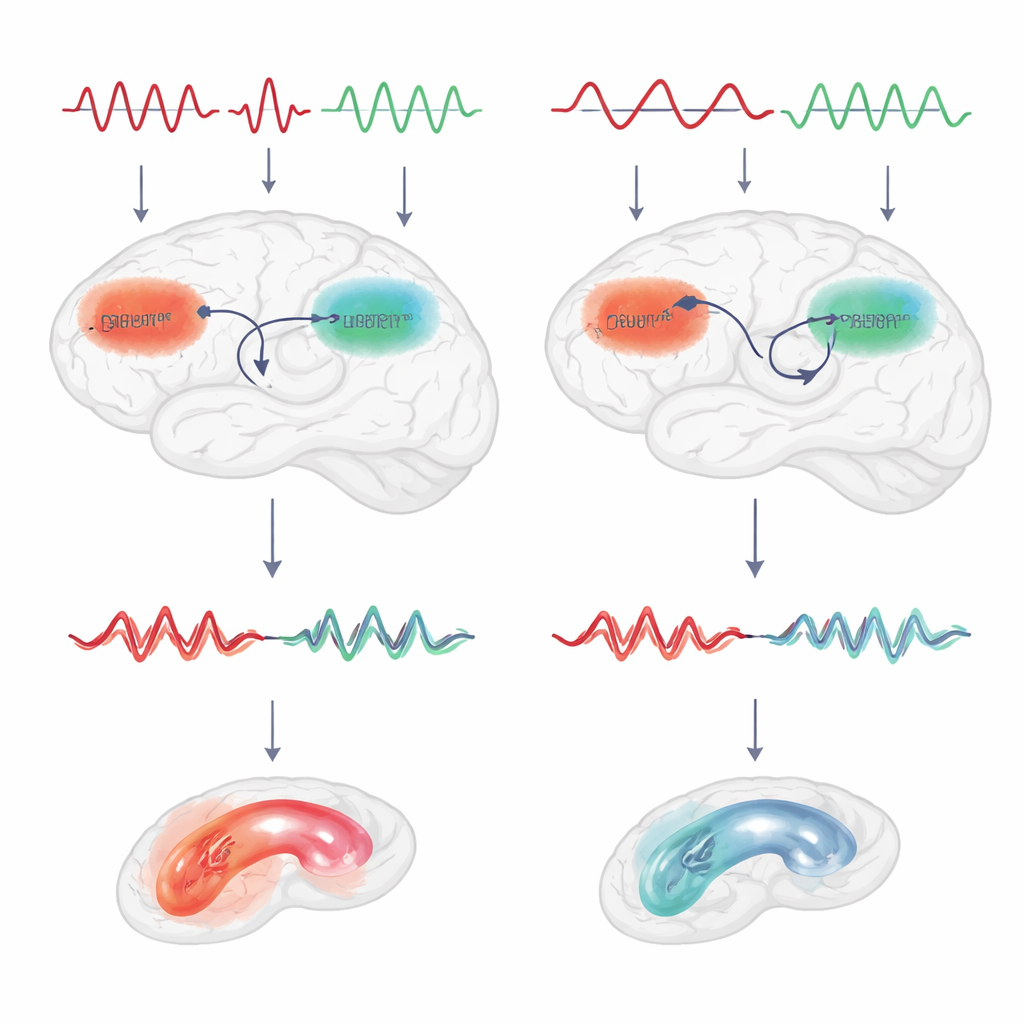
On average, people did not remember synchronized pairs better than out‑of‑step pairs, a result that contrasts with some earlier work. But looking more closely at individual trials revealed a different story. For each sound–video pair, the researchers calculated how tightly the visual and auditory brain areas followed the imposed rhythm. When these areas truly moved in lockstep at the intended timing, people were more likely to remember the pair later. If the rhythm in the brain slipped away from the stimulus timing, memory suffered. In other words, the success of the timing trick depended on how well each trial actually “entrained” the brain, not just on how the stimuli were programmed.
The hidden role of alpha “idling”
The team then asked why the brain sometimes followed the rhythm and sometimes did not. They focused on alpha activity, a slightly faster background rhythm often seen when people are relaxed or less focused on the outside world. Measuring alpha in the brief pause before each sound–video pair, they found that lower pre‑stimulus alpha power predicted trials in which visual and auditory areas locked more faithfully to the four‑per‑second flicker. Those trials, in turn, more often led to successful memory when the external rhythm was set to the helpful timing. Source analysis pointed to a patch of parietal cortex at the back of the brain, a region known for guiding attention, as the main site where this alpha drop occurred. During those low‑alpha moments, communication between this area and the hippocampus in the memory network also strengthened.
What this means for boosting memory
To a lay observer, this work suggests that brain stimulation techniques that try to enhance memory by driving rhythmic activity cannot ignore the brain’s current state. The same flickering sights and sounds may help or fail depending on whether attention is already engaged and alpha activity is temporarily lowered. Rather than applying one fixed rhythm to everyone, future non‑invasive interventions may need to monitor ongoing brain rhythms and time their pulses to moments when the brain is most receptive. This state‑dependent view could be key to turning rhythmic sensory stimulation into a reliable tool for supporting memory in aging and disease.
Citation: Wang, D., Marcantoni, E., Shapiro, K.L. et al. Pre-stimulus alpha power modulates trial-by-trial variability in theta rhythmic multisensory entrainment strength and theta-induced memory effect. Commun Psychol 4, 40 (2026). https://doi.org/10.1038/s44271-026-00406-x
Keywords: episodic memory, brain rhythms, attention, multisensory integration, noninvasive stimulation