Clear Sky Science · en
Implicit bias attribution reduces prosocial emotions and donation intentions for natural disaster victims
Why the way we explain bias matters
News coverage doesn’t just tell us what is happening in the world; it also quietly shapes whose suffering we notice and whose we overlook. This study asks a timely question: when people learn that news about Muslim victims of natural disasters is biased, does it matter whether that bias is described as an unconscious slip or a deliberate prejudice? The answer turns out to be yes—and the difference can affect how angry we feel and how willing we are to help victims.
Unequal attention to human suffering
Media outlets decide which events become big stories and how those stories are told. Prior research shows that this power can reinforce social inequalities, for example by giving less space to issues affecting women or minority groups. The authors focus on coverage of natural disasters, where victims are generally seen as blameless but still may not receive equal attention. Work on “agenda setting” shows that when disasters in certain regions—such as majority-Muslim countries in the Middle East—are underreported or framed negatively, donations to survivors can suffer as a result.
Unconscious bias versus open prejudice
In everyday conversations, many people now explain discrimination by pointing to “implicit bias”—automatic associations we might not even realize we hold. That language can feel less accusatory than calling someone openly prejudiced. But what does it do to our moral judgments? Building on earlier psychological studies, the researchers tested whether pinning biased news coverage on reporters’ unconscious attitudes, rather than their conscious beliefs, would change how readers feel about both the journalists and the victims, and whether they would be moved to donate.
A simple experiment with real-world stakes
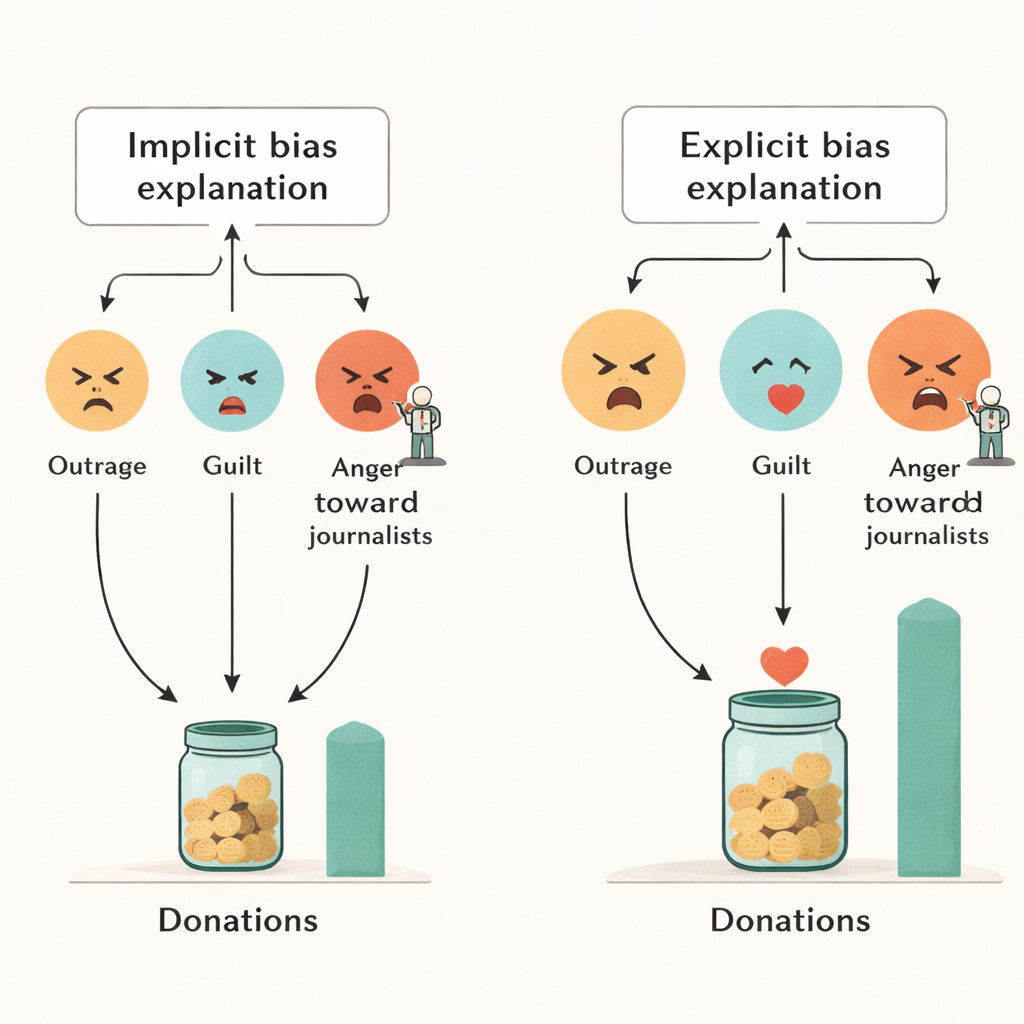
The team recruited 350 adults in the United States to take an online survey. Everyone read that Americans donate less to natural disaster victims in Middle Eastern, Muslim-majority countries than to similar victims elsewhere, and that this gap is linked to skewed media portrayals of Muslims. Participants then saw an example news story that downplayed Muslim victims’ suffering. For half the group, the biased coverage was said to come from journalists’ “implicit” anti-Muslim attitudes—habits of thought operating outside awareness. For the other half, the same bias was described as “explicit” and openly acknowledged by the journalists. Afterward, people reported how outraged, guilty, and angry at the journalists they felt, how much empathy they felt for the victims, and how interested they were in donating to future Middle Eastern disaster victims or to those affected by the 2023 floods in Libya.
Cooler emotions, weaker help
Labeling the bias as unconscious had a clear dampening effect. Compared with those who read about explicit prejudice, participants told that the bias was implicit felt less moral outrage, less guilt, and less anger toward the journalists. They also saw the journalists as less to blame. Their empathy for victims was slightly lower as well, though this difference was not statistically firm. Most importantly, people in the “implicit bias” condition reported less interest in donating to future Middle Eastern disaster victims and were less likely to request information or click a link to donate to Libyan flood survivors. Further analyses suggested that the weaker donation intentions arose because the implicit-bias framing softened feelings of outrage and guilt that often push people toward reparative action.
What this means for public conversations about bias
The study highlights an unintended downside of leaning too heavily on the language of unconscious bias. While it can help explain how discrimination occurs even without overt hatred, it may also make wrongdoers seem less responsible and sap the emotional energy that drives people to correct injustices—such as by supporting disaster victims who have been unfairly neglected. For readers and journalists alike, the findings suggest that how we talk about the causes of biased coverage can either spur or stall real-world help for those harmed by it.
Citation: Bak, H., Kazakoglu, G., Sulaiman, S. et al. Implicit bias attribution reduces prosocial emotions and donation intentions for natural disaster victims. Commun Psychol 4, 35 (2026). https://doi.org/10.1038/s44271-026-00405-y
Keywords: media bias, implicit bias, disaster relief, charitable giving, Muslim representation