Clear Sky Science · en
Impaired slow-wave sleep accounts for brain aging-related increases in anxiety
Why Sleep Matters as We Grow Older
Many older adults notice that their sleep feels lighter and their worries heavier. This study asks a simple but powerful question: could changes in deep sleep be one reason anxiety grows with age, even in people who are otherwise mentally healthy? By tracking the sleep, brain structure, and anxiety levels of older adults over several years, the researchers show that a specific kind of deep sleep—called slow‑wave sleep—may act as an overnight "emotional reset" that becomes weaker as the brain ages.
Deep Sleep as the Brain’s Nightly Reset
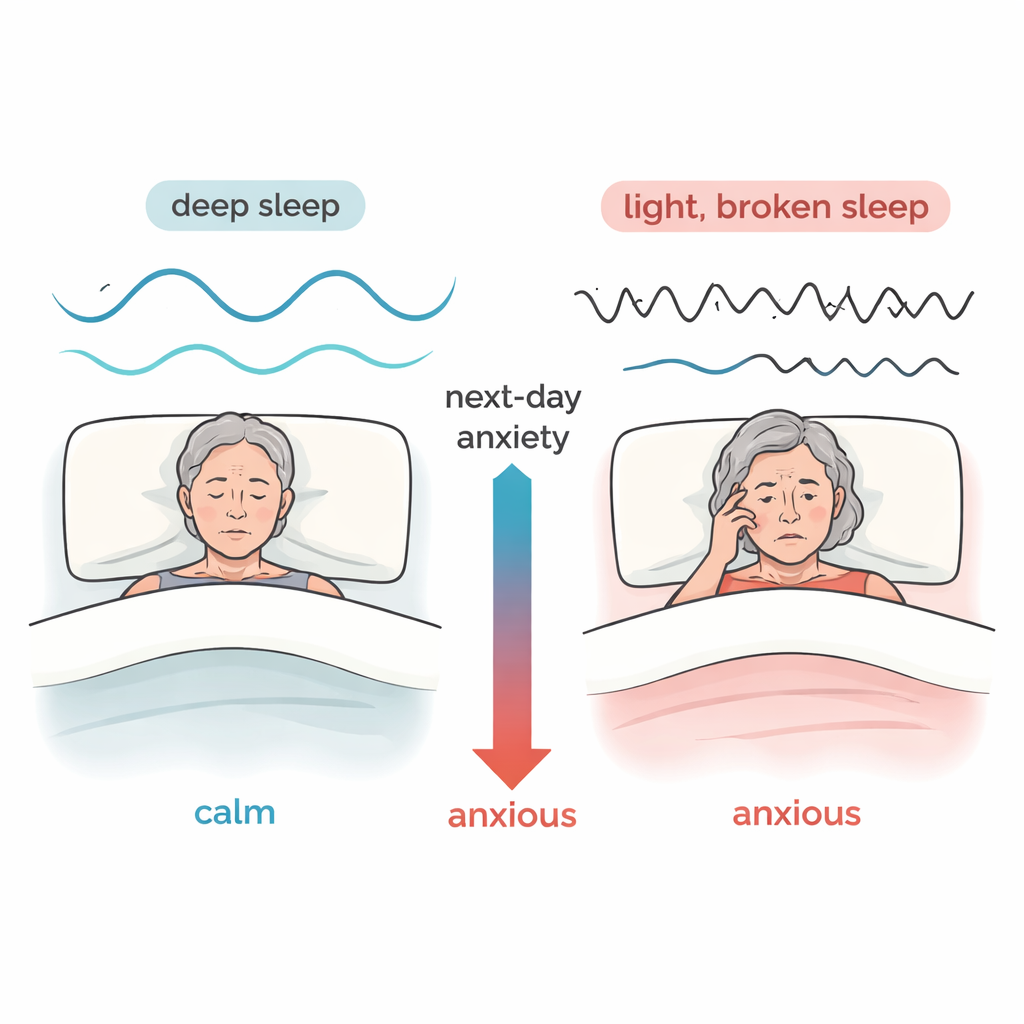
Not all sleep is the same. During a normal night, the brain cycles through lighter and deeper stages. Slow‑wave sleep is the deepest non‑dreaming phase, when large, slow electrical waves sweep across the brain. Earlier work in young adults showed that when this deep sleep is cut short, people feel more anxious the next day. The current study asked whether the natural loss of slow‑wave sleep that comes with aging might help explain why late‑life anxiety is so common and so closely tied to memory problems and dementia.
How the Study Was Done
The team studied 61 cognitively healthy adults over age 65, all with different levels of everyday anxiety. Each person spent two nights in a sleep laboratory, where their brain activity was carefully recorded to count how many slow waves appeared during the deep portions of non‑REM sleep. Before going to bed and after waking up, they filled out a standard questionnaire describing how anxious they felt at that moment. On the morning after the recorded night, participants also underwent a detailed brain scan to measure shrinkage—known as atrophy—in regions that help process and regulate emotions. About a third of the group returned roughly four years later so the researchers could see how changes in sleep related to changes in anxiety over time.
Less Deep Sleep, More Next-Day Worry
The results drew a clear line between deep sleep and emotional steadiness. Older adults who produced fewer slow waves during the night tended to feel more anxious the following day. This was not simply because they slept fewer hours, woke up more often, or had less dream (REM) sleep. Even after accounting for total sleep time, sleep quality, gender, age, and a person’s general tendency to be anxious, the protective effect of slow‑wave sleep remained. Over several years, people whose slow‑wave activity declined the most also showed the biggest increases in anxiety, suggesting that the loss of deep sleep is not just linked to anxiety, but may actively help drive it upward.
What Brain Aging Has to Do with It
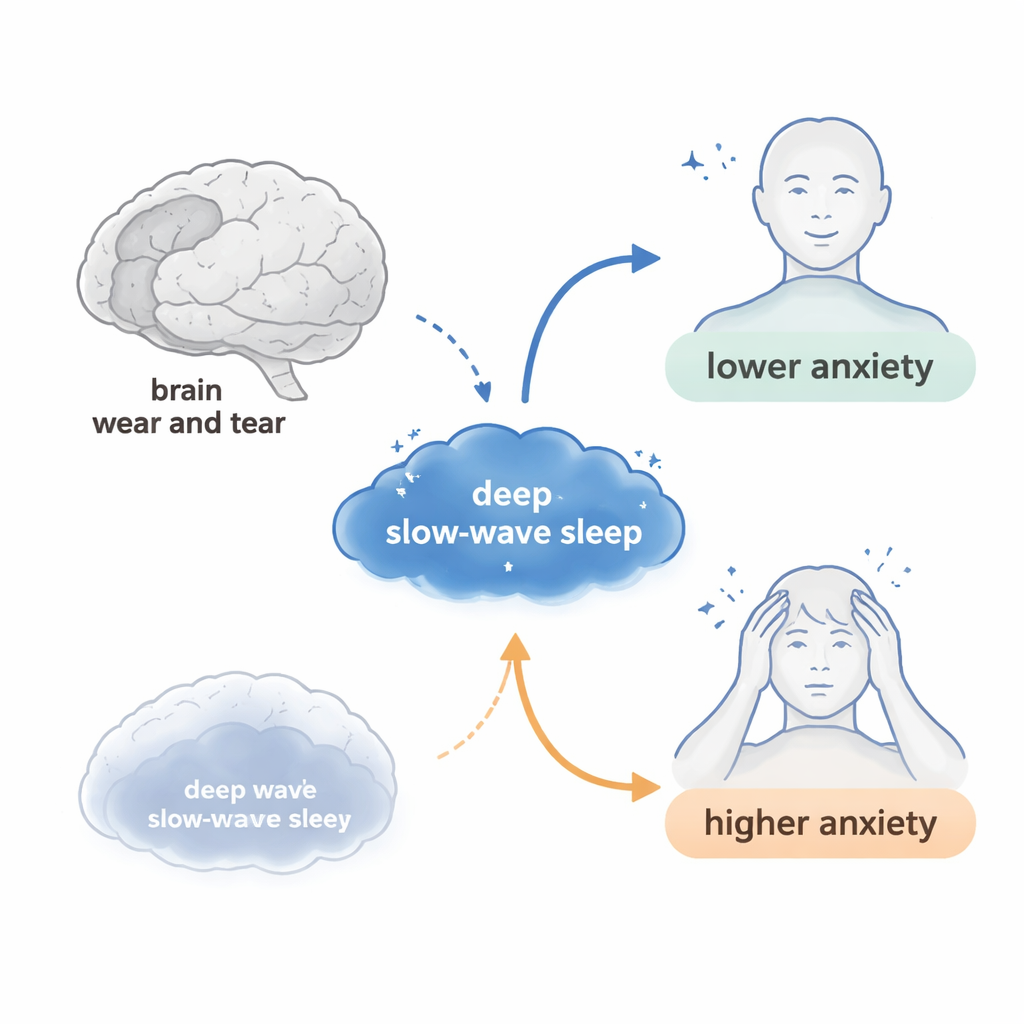
Brain scans provided a biological clue. Shrinkage in a set of emotion‑related areas—including structures deep inside the brain and along its inner surface—was tied both to fewer slow waves at night and to higher anxiety the next day. A statistical test called mediation analysis revealed a striking pattern: once slow‑wave sleep was taken into account, direct links between brain atrophy and anxiety largely disappeared. In other words, aging in these emotion centers seemed to fuel anxiety mainly by weakening the brain’s ability to generate robust slow waves, which in turn reduced its capacity to “cool down” emotions overnight.
What This Means for Healthy Aging
To a non‑specialist, the message is straightforward: in later life, deep sleep may be one of the body’s most important natural defenses against rising anxiety. Even when age‑related wear and tear in emotion‑sensitive brain regions is present, older adults who can still produce strong slow‑wave sleep appear better able to reset their emotional balance each night. This positions deep sleep not just as a passive by‑product of brain health, but as a potential target for treatments—from behavioral strategies to new forms of gentle brain stimulation—that aim to preserve emotional stability and quality of life as we age.
Citation: Ben Simon, E., Shah, V.D., Murillo, O. et al. Impaired slow-wave sleep accounts for brain aging-related increases in anxiety. Commun Psychol 4, 34 (2026). https://doi.org/10.1038/s44271-026-00401-2
Keywords: aging and anxiety, slow-wave sleep, older adults mental health, brain atrophy, sleep and emotion