Clear Sky Science · en
Long-term effects of working memory retrieval from prioritized and deprioritized states
Why some memories stick with us
Every day our minds are flooded with sights, sounds and thoughts, yet only a tiny fraction becomes lasting memories. This study asks a deceptively simple question: when we briefly hold information in mind—like the tilt of a road sign or the angle of a picture—what makes some of those fleeting details survive into long-term memory while others vanish? The authors focus on a very short-lived store called working memory and show that how and when we are asked to recall its contents can shape what we remember hours or days later.
Holding pictures in mind
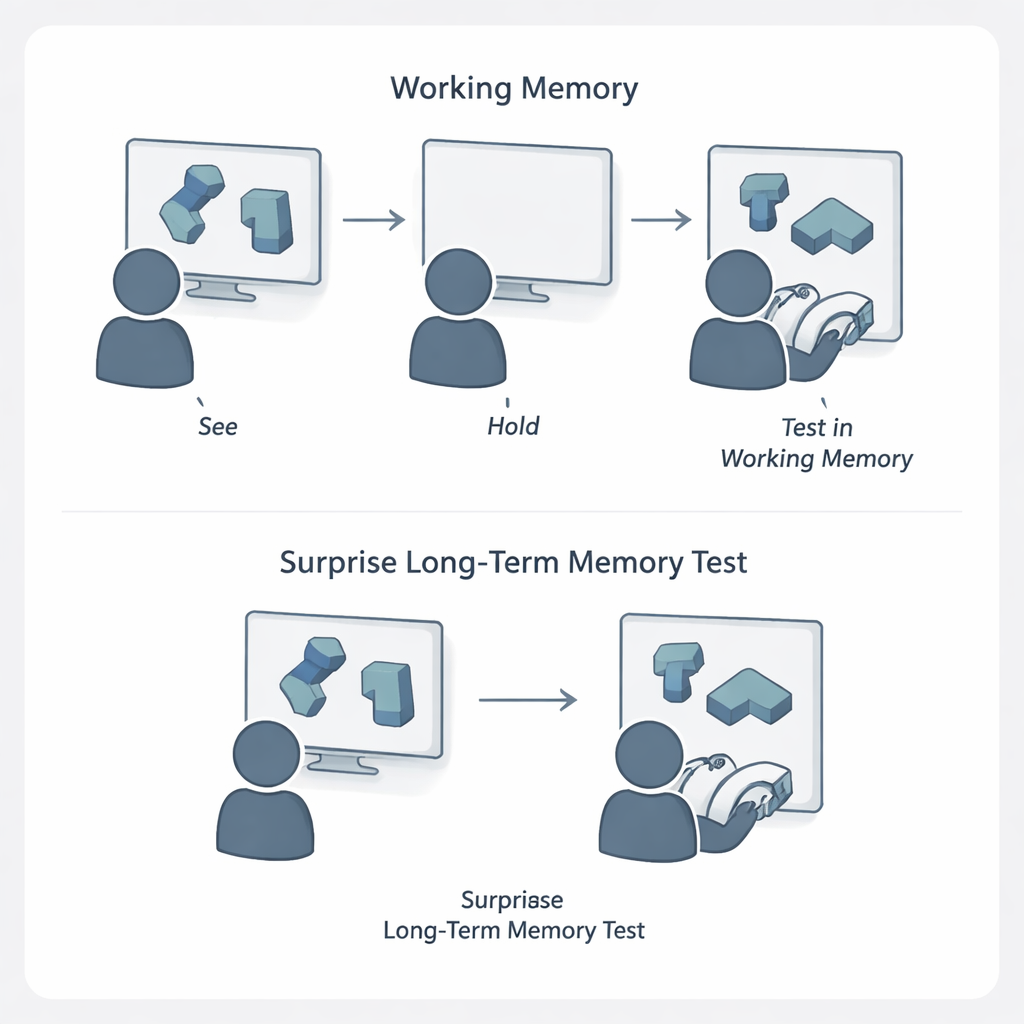
The researchers ran three online experiments with more than 380 adults. In all of them, people saw pictures of everyday objects, each tilted at a particular angle, on a computer screen. Sometimes they saw one object, sometimes two in a row. Their task was to remember the exact orientation of these objects over a brief pause of a few seconds. This kind of short-term storage is what psychologists call working memory: it is the mental scratchpad we use to keep information active for an upcoming task, such as comparing, deciding or responding.
Surprise test: what lasts in long-term memory?
After finishing the working-memory part, participants solved a short series of simple math problems to clear their minds. Then came a surprise: a long-term memory test. One by one, all the previously seen objects reappeared, now in random orientations. Participants had to rotate each object back to the angle it had when first shown. This allowed the researchers to compare how accurately people remembered the same item a few seconds after seeing it (working memory) versus several minutes later (long-term memory).
Priority flips the outcome
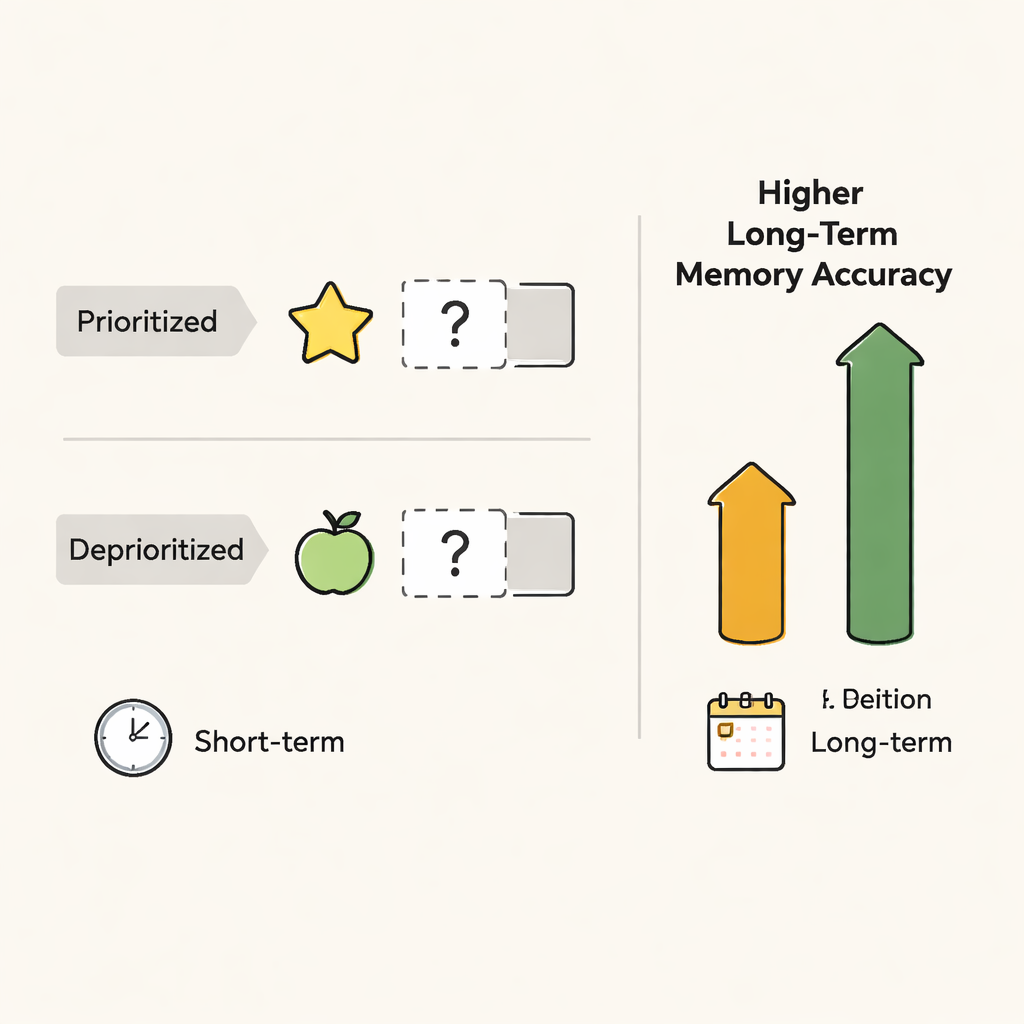
A central idea in the study is priority. At any given moment, only some items in working memory are in the spotlight of attention; others are temporarily set aside. The authors manipulated this in two ways. In one experiment, when two objects were shown, only one was tested first, leaving the other deprioritized until later. In another experiment, a cue (“1” or “2”) told participants which of two objects was most likely to be tested, making the other less important. As expected, deprioritized items were recalled less accurately in the short term. But when the surprise long-term test arrived, the pattern flipped: items that had been deprioritized during working memory, yet still tested, were remembered better in the long run than the high-priority items. This was true across different ways of shifting attention, suggesting a robust effect.
How testing style changes what we learn
Another key factor was the way working memory was tested. In the first two experiments, when an object was probed, participants had to rotate it freely to reproduce its exact angle—a demanding, “from scratch” recall. In a third experiment, working memory was tested with a simpler yes/no style judgment: was the probe slightly clockwise or counterclockwise relative to the original? Here, long-term memory barely benefited from having been tested at all, and deprioritized items no longer enjoyed an advantage. The strong benefits appeared only with the effortful, reconstruction-style responses. Analyses also showed that in long-term memory people tended to remember the angle they had reported earlier, even if it was slightly off, more than the angle that had actually been shown—hinting that we may store our own reconstruction as a new memory.
What this means for everyday learning
To a non-specialist, the main message is this: briefly recalling something in an effortful way can strengthen it for the long term, especially if it was not in the center of your attention at the time. When people had to actively rebuild the orientation of deprioritized objects, those self-generated responses became particularly durable memories. In contrast, merely making easy comparisons with nearly identical images did little for long-term retention. The work suggests that challenging yourself to reconstruct information—rather than just rechecking it—and occasionally revisiting “background” details may be a powerful route to making fragile, momentary impressions last.
Citation: Born, F., Spitzer, B. Long-term effects of working memory retrieval from prioritized and deprioritized states. Commun Psychol 4, 32 (2026). https://doi.org/10.1038/s44271-026-00399-7
Keywords: working memory, long-term memory, attention, retrieval practice, visual cognition