Clear Sky Science · en
Modeling information demand in the framework of probabilistic reasoning
Why we care about the information we choose
In today’s digital world, we constantly decide what to click, what news to read, and which results or diagnoses we’d rather not see. These choices about seeking or avoiding information can shape our finances, our health decisions, and our emotional well-being. This study asks a deceptively simple question: when people decide whether to learn more, are they mainly driven by different motives, or by the way their minds subjectively distort chances of gains and losses?
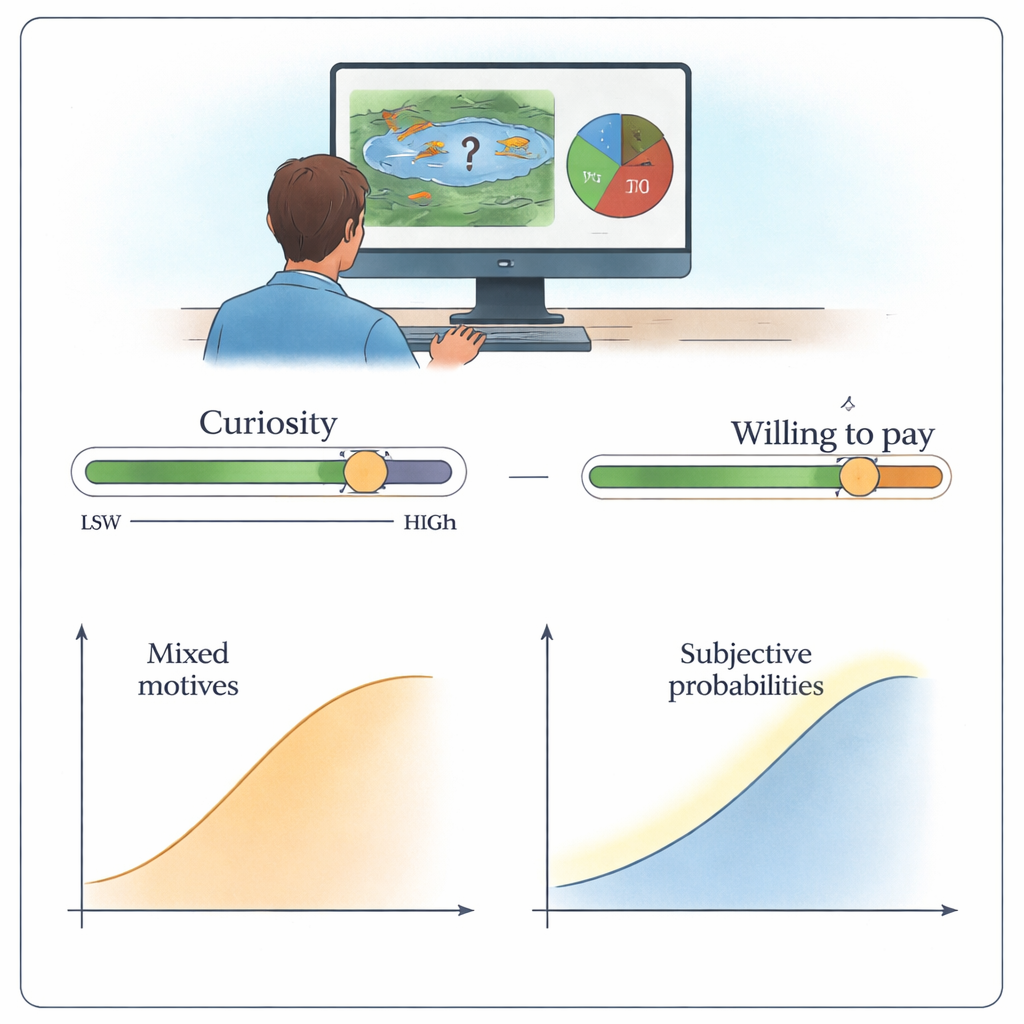
Decisions in a pond of fish
The researchers designed online experiments where volunteers faced many small lotteries. On each trial, people saw a cartoon “pond” filled with 10 items: combinations of gold fish, red fish and seaweed, along with a pie chart showing the exact chances. Drawing a gold fish meant winning extra money, a red fish meant losing money, and seaweed meant no change. Sometimes participants simply rated how curious they were to find out the result early, even though that information could not help them earn more. In other versions of the task, they stated how much money they would pay to see the outcome before it was revealed, because early information could improve their chances of making a correct money-earning guess.
Curiosity, money, and the shape of uncertainty
The team compared two broad explanations of people’s information-seeking. One, called a mixed-motive view, assumes that people add up different drives: the desire to reduce uncertainty, the desire to increase payoffs, and the desire to feel good or avoid dread. In this view, these elements combine linearly, and everyone’s behavior can be explained by how strongly they weight each motive. The competing view, a probabilistic reasoning framework, assumes that people do not see chances and outcomes objectively. Instead, they systematically distort probabilities (for example, treating rare events as more likely than they really are) and weigh gains and losses in uneven ways. These distortions then drive their curiosity and willingness to pay for information.
Subjective chances beat mixed motives
Across three experiments with 250 participants in total, the probabilistic reasoning models consistently explained behavior better than the mixed-motive models. When participants rated curiosity about future gains or losses, their interest peaked at 50–50 lotteries, but they also showed a striking flip: for unlikely events they were more curious about possible losses than gains, while for likely events the pattern reversed. A simple additive “good vs. bad news” term could not reproduce this crossing pattern, but models that allowed probabilities for gains and losses to be warped in different, S-shaped ways could. Similarly, when people stated how much they would pay for helpful information, their bids deviated from what would maximize earnings in a way that lined up with distorted internal views of chance rather than with a simple blend of motives.
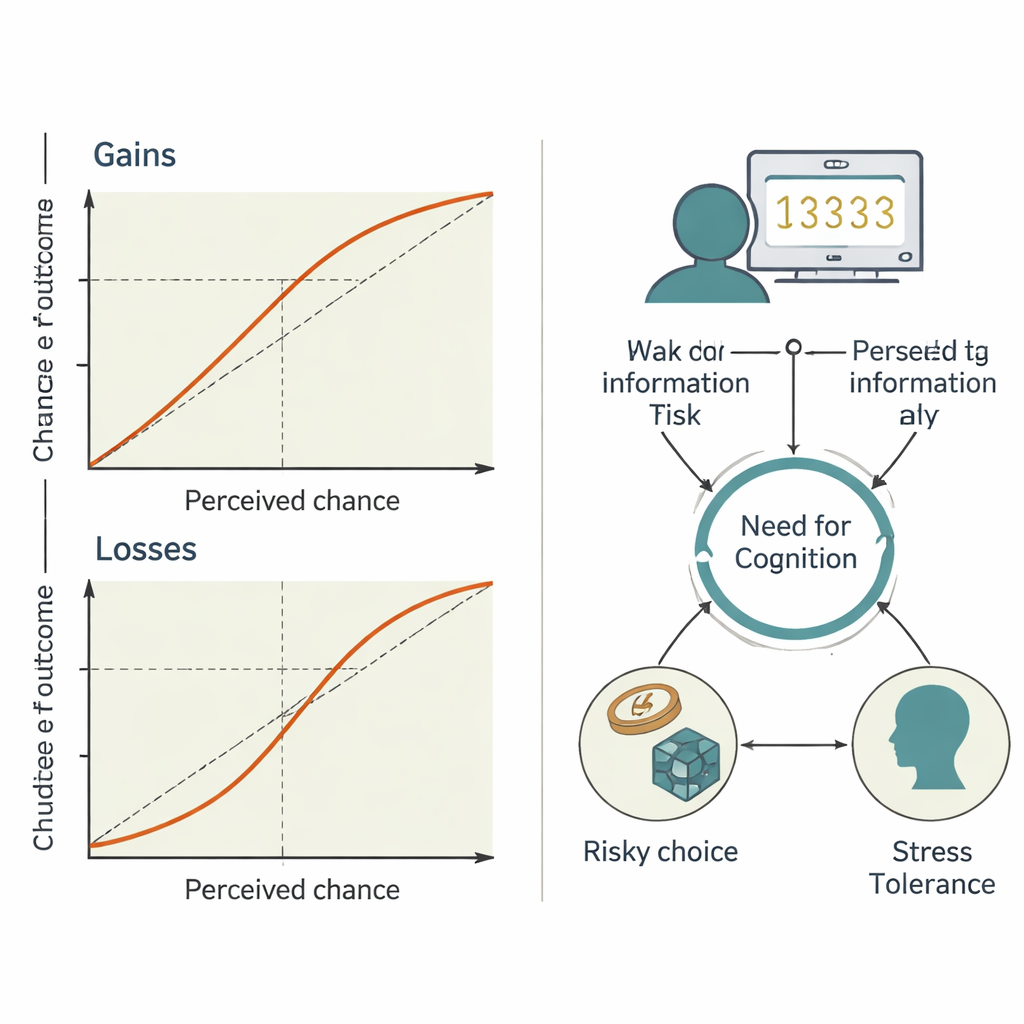
Risky choices, personality, and shared mental shortcuts
In a larger experiment, the same people also completed a risky-choice task that used lotteries structurally identical to the information task. This time, they reported the smallest guaranteed amount they would accept instead of playing the lottery. Here too, their choices reflected classic patterns: they overvalued low-probability gains and losses and undervalued high-probability ones. Crucially, the parameters that best described each person’s distorted sense of chance and value were highly correlated across the information and risk tasks, suggesting a common underlying way of perceiving uncertainty. Measures of personality added another link: people high in “Need for Cognition” (those who enjoy thinking hard) tended to behave more in line with objective probabilities, whereas those high in “Stress Tolerance” showed larger deviations from normative responses, perhaps reflecting a greater comfort with rough heuristics over precise calculations.
What this means for everyday decisions
For non-specialists, the main lesson is that many puzzling patterns in what information people want—and when they want it—may stem less from mysterious extra motives and more from the mental lenses through which we see chances of good and bad outcomes. Our brains do not treat a 10% and a 90% chance as simple mirror images, and they weigh possible gains and losses in subtly different ways. These built-in distortions can explain why we sometimes seek out news about unlikely threats, or underpay for information that could genuinely help us. Understanding these mental shortcuts may help improve tools for communicating risk, designing better decision aids in areas like healthcare and finance, and tailoring interventions to people’s cognitive styles and stress responses.
Citation: Jiwa, M.W., Gottlieb, J. Modeling information demand in the framework of probabilistic reasoning. Commun Psychol 4, 31 (2026). https://doi.org/10.1038/s44271-026-00398-8
Keywords: information seeking, probability perception, risk and uncertainty, curiosity, decision making