Clear Sky Science · en
Multi-year study of maize under elevated tracking agrivoltaic system and simplified yield modeling
Growing Food and Harvesting Sunlight Together
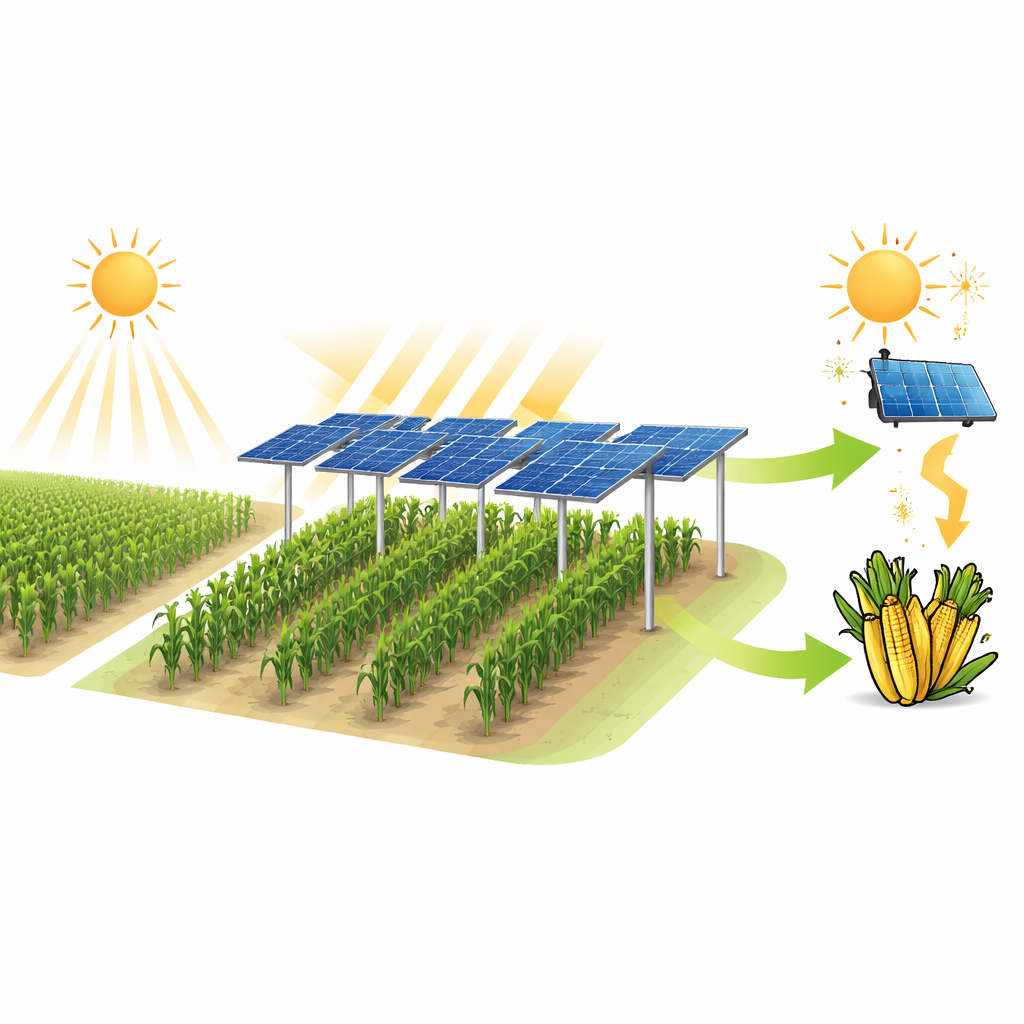
Agricultural land faces a double demand: it must feed a growing population while also hosting the solar panels that power our homes, cars, and industries. This study explores whether one of the world’s most important crops—maize, or corn—can grow well beneath elevated solar panels, allowing farmers to earn income from both grain and electricity on the same field.
Why Farming and Solar Are Competing for Space
As the global population rises and the climate warms, farmers are under pressure from more frequent heat waves, shifting seasons, and uncertain rainfall. At the same time, societies are racing to install more clean energy, especially solar power, to cut greenhouse gas emissions. Flat, open farmland is often the most practical place to put large solar arrays, but covering fields entirely with panels would reduce the area available for crops. Agrivoltaic systems offer a compromise: solar panels raised high enough that crops or livestock can thrive underneath, sharing the same land for two purposes.
Testing Corn Under Moving Shade
The researchers ran a multi-year experiment at a research farm in Indiana, in the heart of the U.S. “corn belt.” They installed tall, single-axis tracking solar panels over parts of a maize field. Some areas lay directly under solid rows of panels, others under a checkerboard pattern that let more sun through, and the rest of the field served as an unshaded control. The panels created a shifting patchwork of light and shade during the day, changing as the sun moved and as the corn plants grew taller. Over four growing seasons, the team carefully recorded plant development, plant height, grain yield, and detailed weather and soil moisture data.
How Shade Changed Plant Growth and Yield
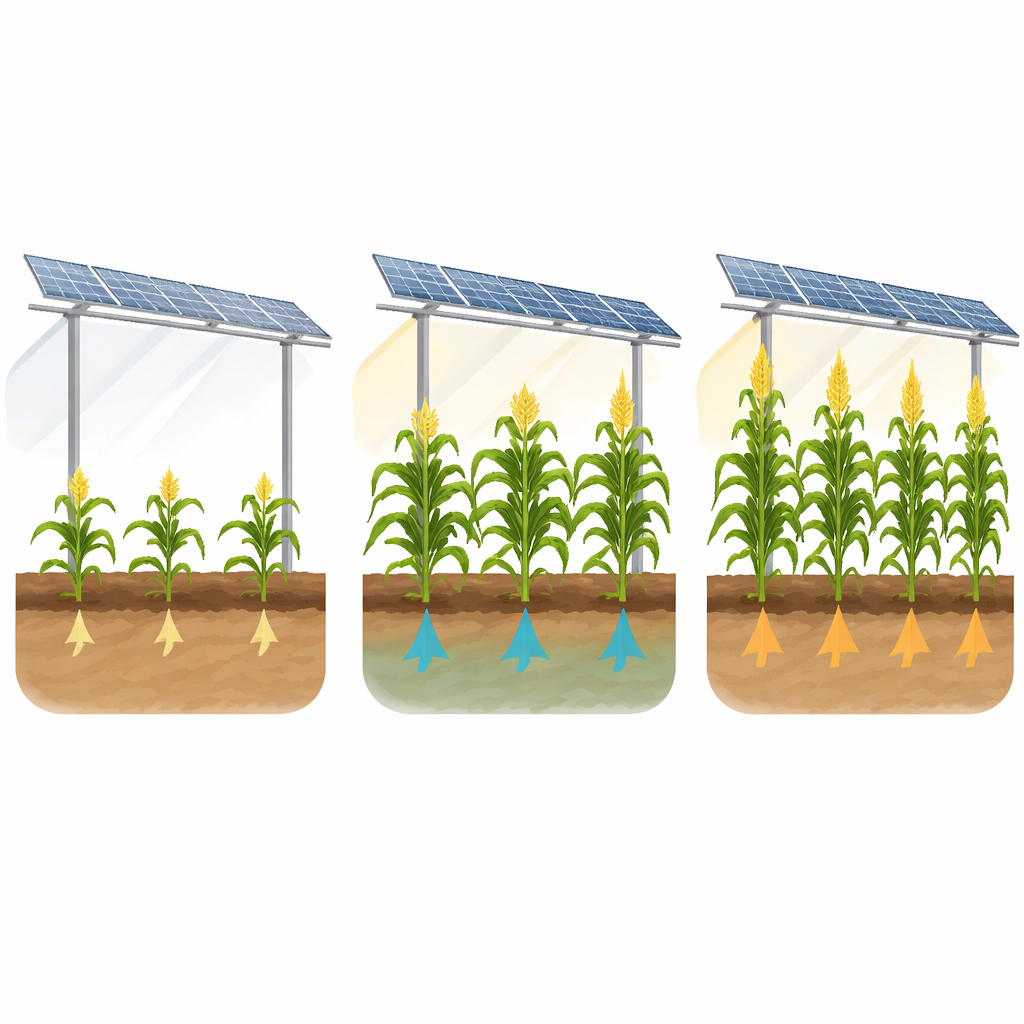
Maize under the panels matured a little later than the unshaded corn, typically by one to three days. Plants in the shaded zones were slightly shorter—by a few centimeters on average—but still healthy. Most importantly for farmers, the grain harvested under 20–25% shading was only modestly lower than in the fully sunlit plots. Across the four years, the average yield reduction in the most shaded area was just 7.7%. In some seasons the difference was larger, in others it was very small, reflecting natural year-to-year swings in weather. Interestingly, in several years the zones with more consistent shade produced slightly better yields than the more lightly shaded ones, hinting that a small cooling and moisture-conserving effect of shade can partly offset the loss of sunlight.
Linking Light, Water, and Harvest in a Simple Way
To help designers and planners, the team wanted more than raw measurements: they aimed to build a simple rule-of-thumb model that links weather conditions to expected corn yield under agrivoltaic systems. Instead of using very complex crop models that require many inputs, they combined just two key influences—sunlight reaching the field and soil moisture—into a single “joint” variable. Using field measurements and computer simulations of how shadows moved across the maize canopy, they calculated, for many locations in the field, how much combined light-and-water “resource” the plants experienced over the season. This combined indicator showed a moderate correlation with the actual grain yields and could explain a substantial share of the variation between points and years, even though it ignored many finer biological details.
Doing More With Each Acre of Farmland
By comparing the slight drop in corn yield to the significant gain in electricity from the panels, the study estimated a land-use efficiency factor, called the land equivalence ratio, of about 1.37 on average. In simple terms, the same piece of land produced the equivalent of 37% more combined “output” than if it had been used for either corn or solar alone. This result suggests that, with thoughtful design—adequate panel height, spacing that allows farm machinery, and attention to local climate—maize can be a practical crop for agrivoltaic systems. While the model will need testing in other regions and under irrigation or different crops, the core message is accessible: we do not always have to choose between food and clean energy. With elevated solar arrays, farmers may be able to grow robust corn harvests and generate significant renewable power from the same fields.
Citation: Sanchez, G., Agrawal, R., Brouder, S. et al. Multi-year study of maize under elevated tracking agrivoltaic system and simplified yield modeling. npj Sustain. Agric. 4, 25 (2026). https://doi.org/10.1038/s44264-026-00141-0
Keywords: agrivoltaics, maize, solar energy, land use, crop yield