Clear Sky Science · en
Producing more rice with fewer emissions: a global meta-analysis
Why this matters for dinner and the planet
Rice is the daily staple for billions of people, but the way we grow it also releases a surprising amount of climate‑warming gases. This study asks a simple question with huge consequences: can the world produce more rice for a growing population while cutting the emissions that drive climate change? By pulling together results from thousands of field trials around the world, the authors show that smarter farming methods can, in many cases, deliver more grain with less climate impact.
How rice fields warm the world
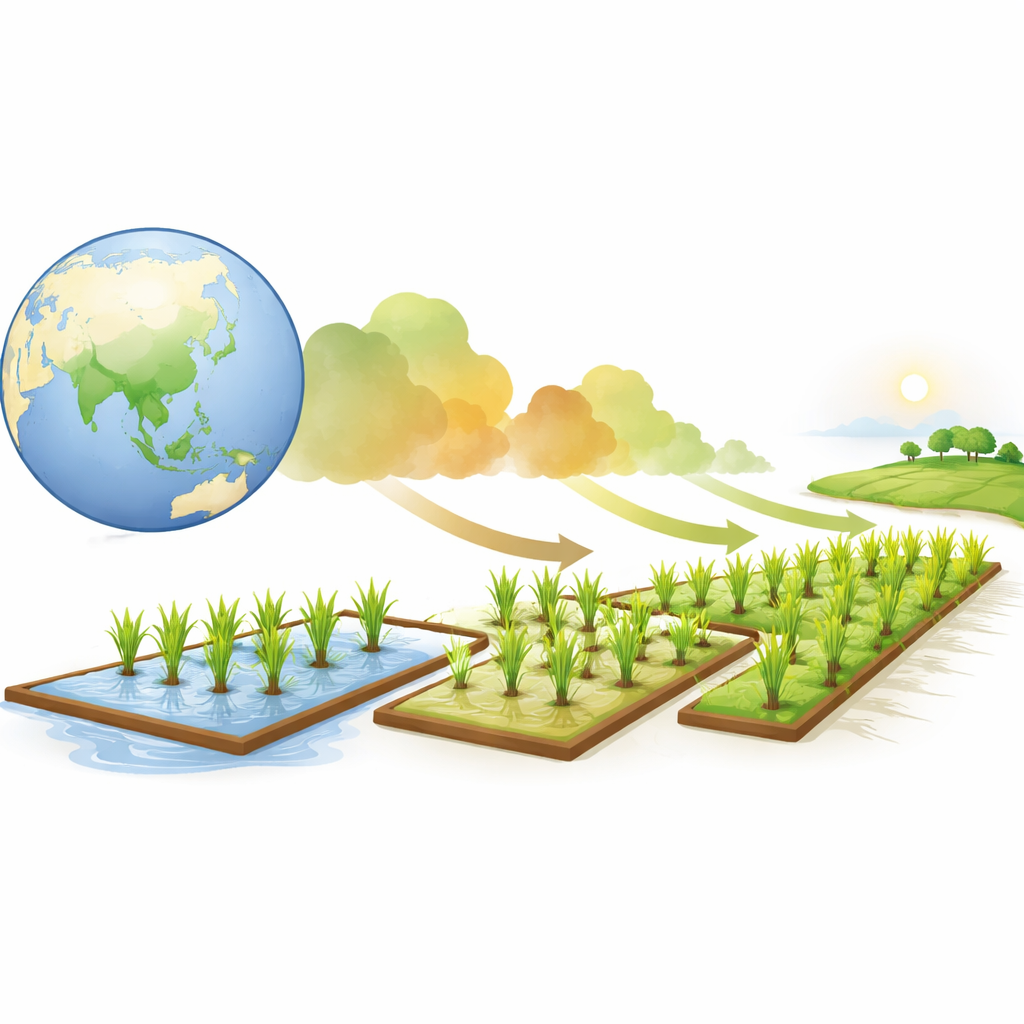
Most rice is grown in flooded fields. The water keeps weeds down and helps plants thrive, but it also blocks oxygen from the soil. In this airless environment, microbes turn decaying plant material into methane, a powerful greenhouse gas, which then escapes into the air through the rice plants. A smaller amount of nitrous oxide, another strong warming gas, is produced when nitrogen fertiliser is added and soils repeatedly shift between wet and dry. The key measure in this study is not just total emissions, but how much gas is released per kilogram of harvested rice, a yardstick called greenhouse gas intensity.
A global scan of rice experiments
To see what really works in farmers’ fields, the researchers combined data from 5,322 experiments reported in 504 peer‑reviewed studies published between 1991 and 2024. These trials tested a wide range of decisions farmers make: crop rotations, rice varieties, tillage, planting methods, water management, fertiliser use, and what is done with leftover straw. Using advanced statistical techniques, the team modelled grain yield and emissions together, while accounting for differences in soil type, climate and season. This allowed them to identify “win‑win” practices that raise or maintain yields while shrinking emissions per unit of rice.
Farming choices that give more rice with less gas
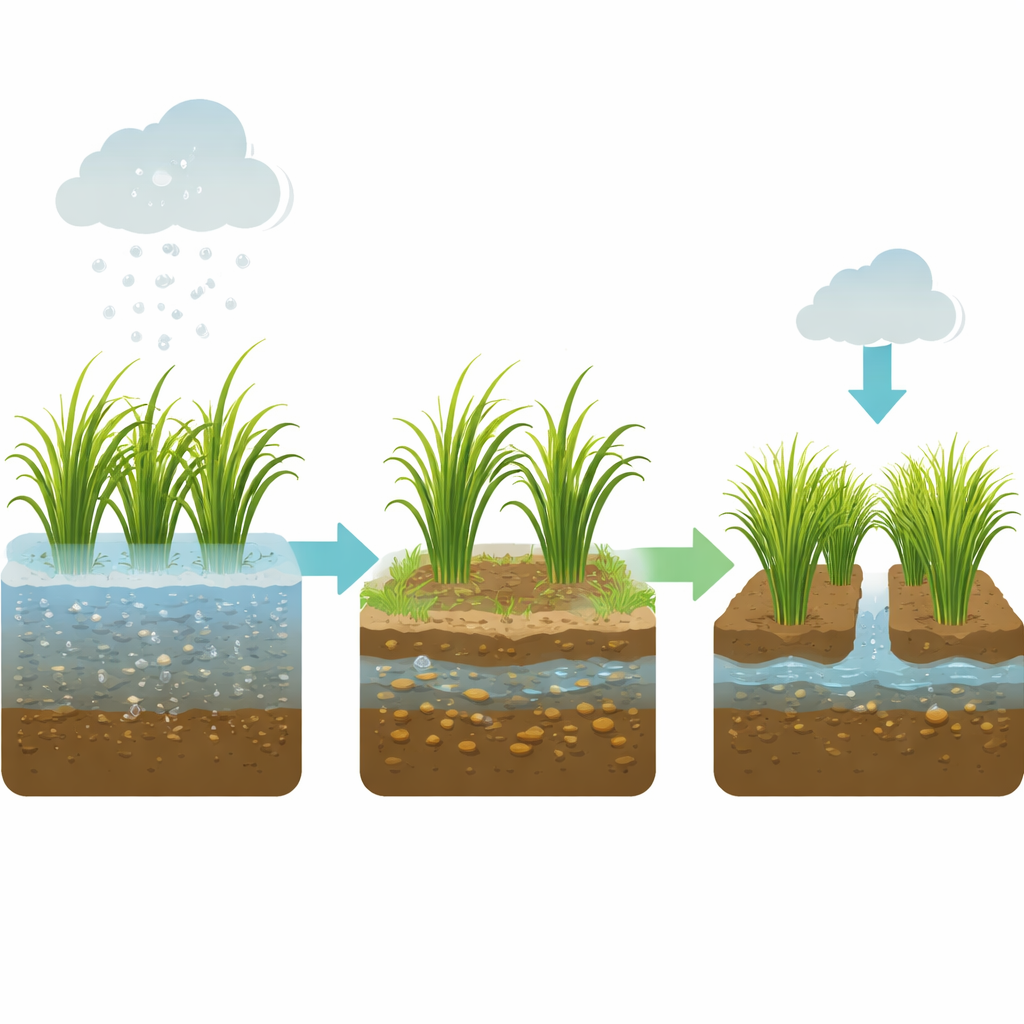
The analysis reveals several clear winners. Dry‑direct‑seeding, where rice is sown into moist but unflooded soil, cuts total emissions by about one‑seventh compared with traditional transplanting, while producing similar or higher yields. Smarter water use, especially alternate‑wetting‑and‑drying, lowers emissions by roughly one‑eighth and even nudges yields upward by around four percent, largely by reducing methane without harming the crop. Improving nitrogen fertiliser management boosts yields by roughly one‑third with only modest increases in emissions, so the climate cost per kilogram of rice actually falls. Managing crop residues carefully—such as removing or partially removing straw rather than ploughing large amounts into flooded fields—can significantly reduce methane while only slightly trimming yields.
Places where context changes everything
The best strategy depends strongly on local conditions. Fields with organic‑rich soils, warm continental climates, or late‑season planting naturally release far more greenhouse gases than cooler, drier or clay‑rich sites, yet they do not produce more rice. In these high‑baseline settings, the same farming change—such as shifting water management or residue handling—can deliver much larger emission cuts than in already efficient systems. By contrast, regions with fine‑textured soils, temperate climates or dry‑season crops already have relatively low emission intensity, so fewer adjustments are needed to keep rice climate‑smart.
Balancing food needs, climate, and practicality
Not every practice is a win‑win. Some methods, like intensive multiple rice crops per year with continuous flooding and heavy straw incorporation, both lower yields and increase emissions, making them “lose‑lose” options. Others trade higher yields for higher emissions, or vice versa, and may still be attractive where food security or carbon cuts are the top priority. The authors sort practices into three adoption pathways: those farmers can use right away with little new equipment (such as better nitrogen use or choosing medium‑duration varieties), those that need new infrastructure like improved water control, and those that demand broader system changes and policy support, such as shifting away from triple‑rice systems. Overall, the study shows that with context‑aware choices and supportive policies, rice farming can move toward a future where feeding people and protecting the climate go hand in hand.
Citation: Thai, V.T., Checco, J., Mitchell, J. et al. Producing more rice with fewer emissions: a global meta-analysis. npj Sustain. Agric. 4, 27 (2026). https://doi.org/10.1038/s44264-026-00136-x
Keywords: rice farming, greenhouse gas emissions, climate-smart agriculture, water management, nitrogen fertiliser