Clear Sky Science · en
Breeding changes water use of winter wheat across Europe
Why this matters for food and water
Across Europe, winter wheat fields stretch for millions of hectares and feed hundreds of millions of people. This study asks a deceptively simple question with big consequences: as breeders have steadily improved wheat yields over the past century, have they also changed how much water these crops pull from the soil and send back to the air? The answer affects not only farmers and food security, but also how we understand water cycles and climate on a continental scale. 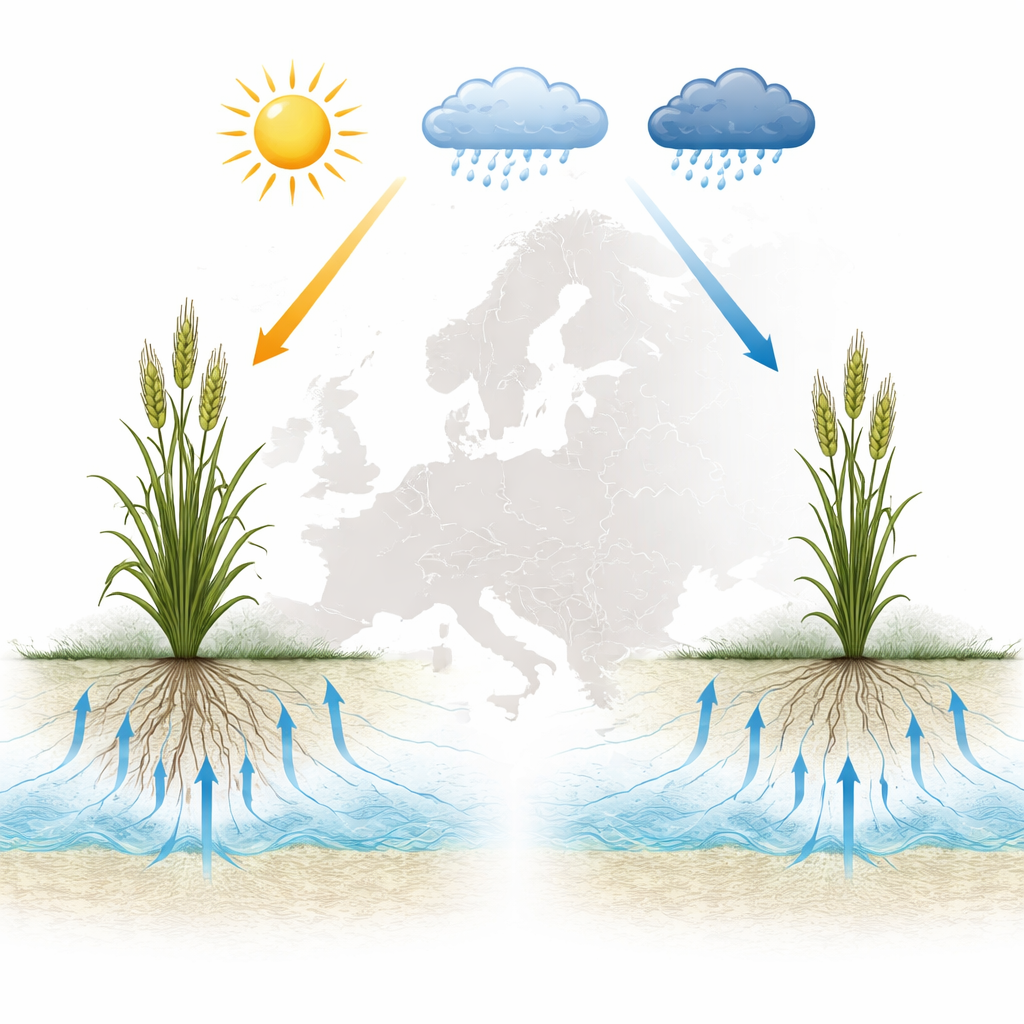
Old wheat, new wheat, and hidden traits
The researchers focused on two German winter wheat varieties that bookend more than 100 years of breeding: an old cultivar released in 1895 and a modern one from 2002, both once widely grown. Earlier work had shown that modern wheat yields more grain thanks to changes in how the plant allocates biomass, how quickly it develops, and how its leaves capture light. Less obvious are the belowground and physiological changes—such as leaf area and root plumbing—that could alter how much water a field of wheat uses over a growing season.
From field plots to a map of Europe
To untangle these effects, the team first calibrated a detailed crop model using data from field experiments near Bonn, Germany. They measured how the two cultivars grew above and below ground, how their leaf area changed over time, and how much water they transpired using sap-flow sensors attached to wheat stems. The model reproduced these measurements well, giving the authors confidence to scale up. They then ran the model across major wheat-growing regions of Europe on a fine grid for 30 years (1990–2020), feeding it with realistic weather and soil data and adjusting the timing of growth stages to match regional conditions.
How breeding reshaped water use
Across all locations and years, the modern wheat cultivar consistently used less water than its historical counterpart—about 17 percent less transpiration over each growing season on average. Yet the modern plants produced similar or slightly higher total aboveground biomass, meaning they converted water into plant material more efficiently. The biggest differences appeared in Mediterranean-type regions with hot, dry summers, especially parts of Spain, southern France, Italy, and Greece. There, the older cultivar’s more vigorous water uptake, combined with low rainfall and limited soil water storage, led to much higher seasonal water use than the modern cultivar. Over the three decades studied, both cultivars showed a trend toward higher transpiration, driven mainly by warmer temperatures and stronger evaporative demand, despite rising carbon dioxide, which tends to reduce leaf-level water loss. 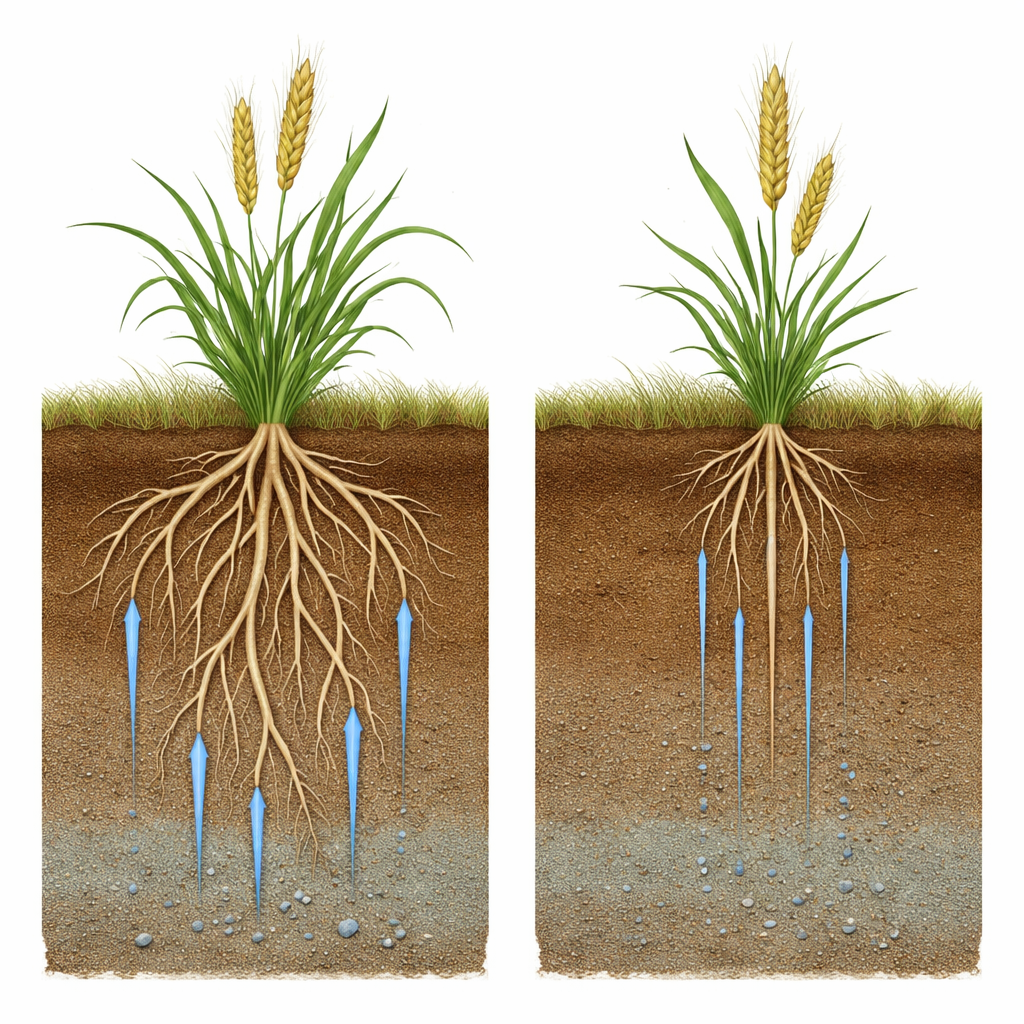
What inside the plant makes the difference
The model allowed the researchers to probe which plant traits best explained the gap in water use. Three stood out: leaf area, root water conductance, and the timing of flowering. The modern cultivar had a noticeably smaller maximum leaf area, reducing the surface from which water could evaporate. Its roots also had much lower hydraulic conductance, meaning water moved less readily from soil into the plant; this effect was especially important in dry, high-demand climates. Phenology—the timing of key stages like flowering—played a smaller but still detectable role, since a longer growing period gives more time for water loss. Together, these traits meant that historical wheat varieties tended to keep transpiring under dry conditions for longer, potentially depleting soil moisture earlier in the season.
What this means for farming and climate
By comparing model scenarios with only the cultivar changed, the authors found that breeding-related physiological shifts in wheat can alter continental water fluxes by an amount comparable to major management decisions such as adding irrigation in models. Because wheat occupies roughly 4 percent of Europe’s land area, a 17 percent drop in its transpiration between old and modern cultivars nudges regional water and energy exchanges in ways climate and hydrology models currently overlook. The study concludes that modern breeding has improved water use efficiency without increasing total water consumption, and that traits like leaf area and root hydraulics deserve more attention in future wheat development. More broadly, it argues that large-scale land and climate models need to represent cultivar-specific traits, not just generic “wheat,” if we want to reliably project how agriculture and the atmosphere will interact in a warming, drying world.
Citation: Behrend, D., Nguyen, T.H., Baca Cabrera, J.C. et al. Breeding changes water use of winter wheat across Europe. npj Sustain. Agric. 4, 29 (2026). https://doi.org/10.1038/s44264-026-00135-y
Keywords: winter wheat, crop breeding, transpiration, water use efficiency, Europe agriculture