Clear Sky Science · en
Non-targeted root exudome profiling reveals genotype-specific strategies for phosphorus use from conventional and recycled sources
Why plant roots matter for future fertilizers
Modern farming depends on phosphorus fertilizer, yet most phosphorus comes from finite rock deposits and much of what we spread on fields is wasted. This study asks a deceptively simple question with big implications: can we choose crop varieties whose roots are naturally better at pulling phosphorus out of both conventional and recycled fertilizers, reducing waste and helping build a more circular, less polluting food system?
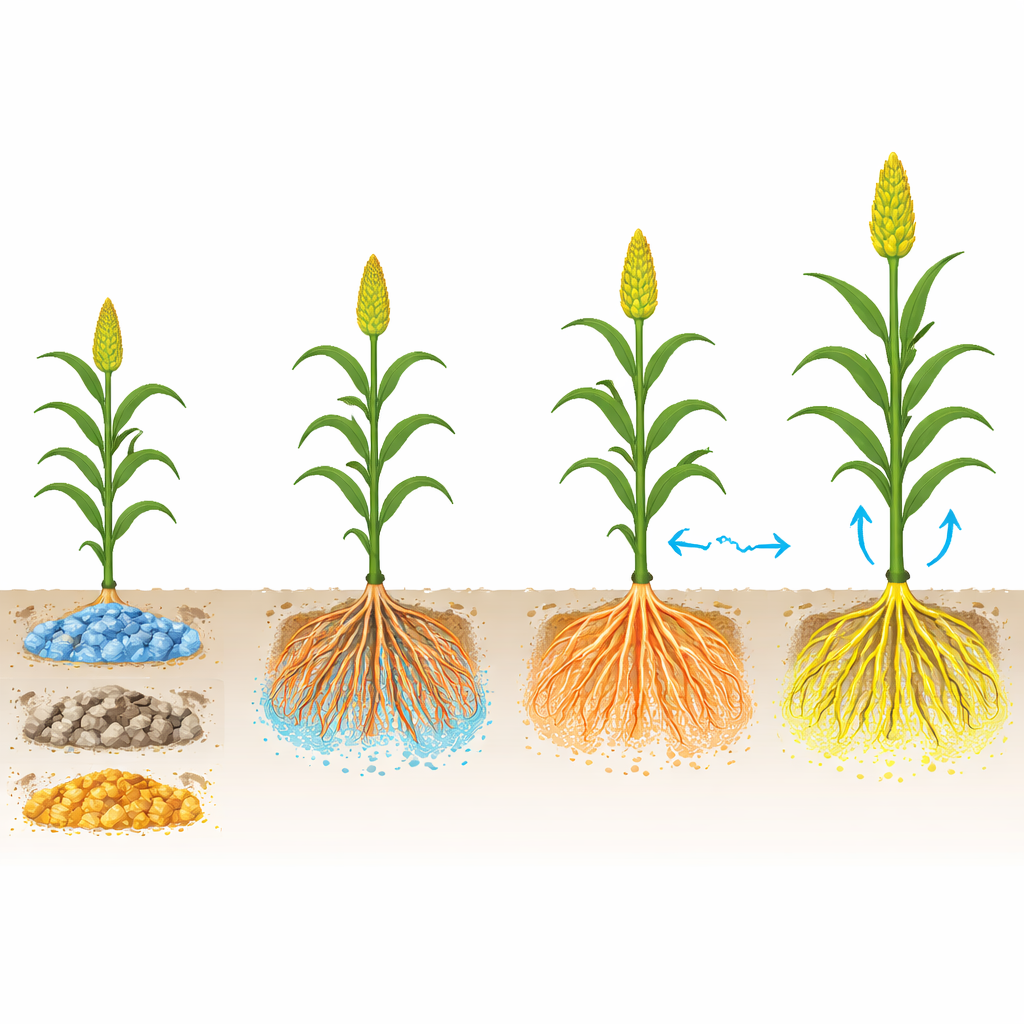
Hidden helpers leaking from roots
Plant roots constantly leak a cocktail of small molecules into the surrounding soil. These “root exudates” can loosen nutrients from soil particles or feed helpful microbes that do the job for them. The authors focused on sorghum, a hardy cereal used for food, feed and bioenergy, and compared two traditional landrace varieties with a modern inbred line that was bred under high fertilizer use. By growing these plants in sterile sand and tightly controlling water and nutrients, they could examine how root exudates alone respond to different forms of phosphorus, without the usual tangle of soil life.
Testing old and new phosphorus sources
The team supplied the plants with four phosphorus sources that ranged from hard-to-dissolve to highly soluble: rock phosphate, a recycled mineral called hazenite, a common fertilizer called single superphosphate, and a very soluble mineral solution. All plants received only modest phosphorus overall to mimic low-input farming. After four weeks, the scientists measured plant growth, phosphorus content, and the length and weight of the roots. They then collected the water draining from each mini-root system and used an ultrahigh-resolution mass spectrometer to scan thousands of different exudate molecules without pre-selecting targets.
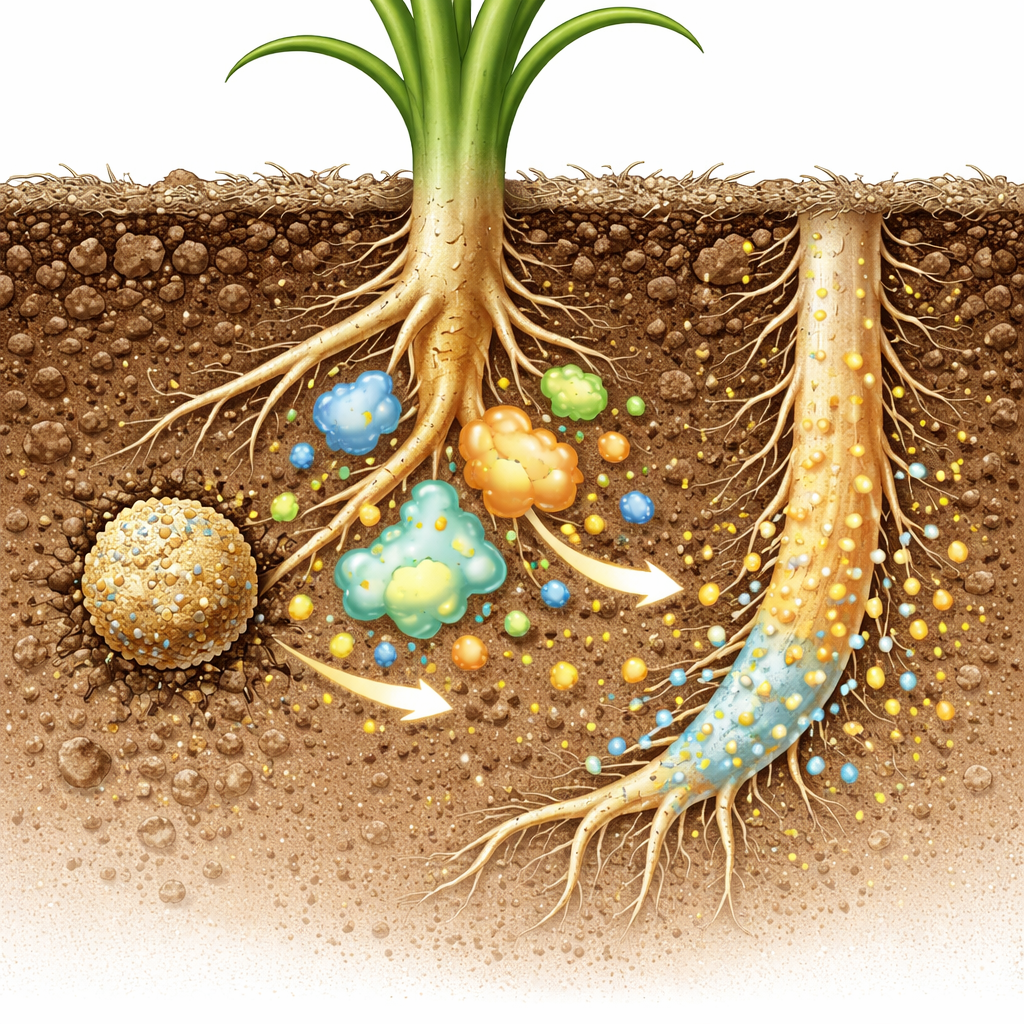
Different roots, different chemical strategies
The three sorghum types behaved differently. One landrace, SC283-14E, built more root biomass than the modern line under several fertilizers and stored the most phosphorus when given the soluble mineral solution, hinting at strong “phosphorus use efficiency.” Its roots released large amounts of a compound related to a common plant hormone breakdown product, as well as mixtures of organic acids and polyphenols that are known from other studies to help mobilize nutrients and influence microbes. The second landrace, SC648-14E, showed a distinct mix rich in flavonoids and polyphenols such as catechin-like and ferulic-acid–like molecules, which in other plants can both chelate nutrients and shape fungal partners. The modern line, BTx623, exuded more nitrogen- and sulfur-rich compounds, including peptide-like and amino acid–like substances that are thought to feed or steer soil microbes rather than directly dissolve phosphorus.
Recycled fertilizer brings out sharp contrasts
The recycled fertilizer hazenite, which contains phosphorus along with potassium and magnesium, produced some of the clearest contrasts among varieties. Under hazenite, SC283-14E secreted heavier, likely dimeric phenolic and tannin-like molecules; SC648-14E released smaller, oxidized phenolic and flavonoid-like compounds; and BTx623 produced an unusually complex mix including sulfur- and nitrogen-containing conjugates. Statistical analyses of the full exudate data showed that treatments with rock phosphate, hazenite and the soluble mineral solution each formed distinct chemical “clouds,” confirming that plants sense not just how much phosphorus they receive, but also which form it comes in, and adjust their root chemistry accordingly.
What this means for crops and the circular economy
To a lay observer, the message is that not all crop varieties are equal when fertilizer is scarce or comes from recycled sources. The landrace sorghums, shaped by generations in low-phosphorus soils, combined stronger root systems with exudate blends that are well suited to freeing up hard-to-access phosphorus, while the modern line seemed geared more toward managing its microbial neighbors. This suggests breeders can use exudate profiles as an extra, currently underused trait when selecting crops for efficient phosphorus use. Pairing the right plant genotypes with next-generation fertilizers such as hazenite could allow farmers to rely less on mined phosphate rock, cut waste and pollution, and still maintain strong yields, advancing a more sustainable, circular phosphorus economy.
Citation: Walsh, M., Schmitt-Kopplin, P., Uhl, J. et al. Non-targeted root exudome profiling reveals genotype-specific strategies for phosphorus use from conventional and recycled sources. npj Sustain. Agric. 4, 28 (2026). https://doi.org/10.1038/s44264-026-00134-z
Keywords: phosphorus use efficiency, root exudates, sorghum, recycled fertilizers, circular agriculture