Clear Sky Science · en
Where regenerative farming practices could increase yields: a global assessment
Why healthier soils matter for our future meals
Feeding a growing, wealthier world without wrecking the planet is one of this century’s defining challenges. Much of the world’s farmland is already worn down, losing fertile topsoil faster than nature can rebuild it. A family’s dinner in 2050 will depend not just on more land or fertilizer, but on how gently and cleverly we farm the land we already use. This study asks a deceptively simple question with global stakes: where could "regenerative" ways of farming actually boost harvests, not just protect the environment?
Farming in trouble, and a different path forward
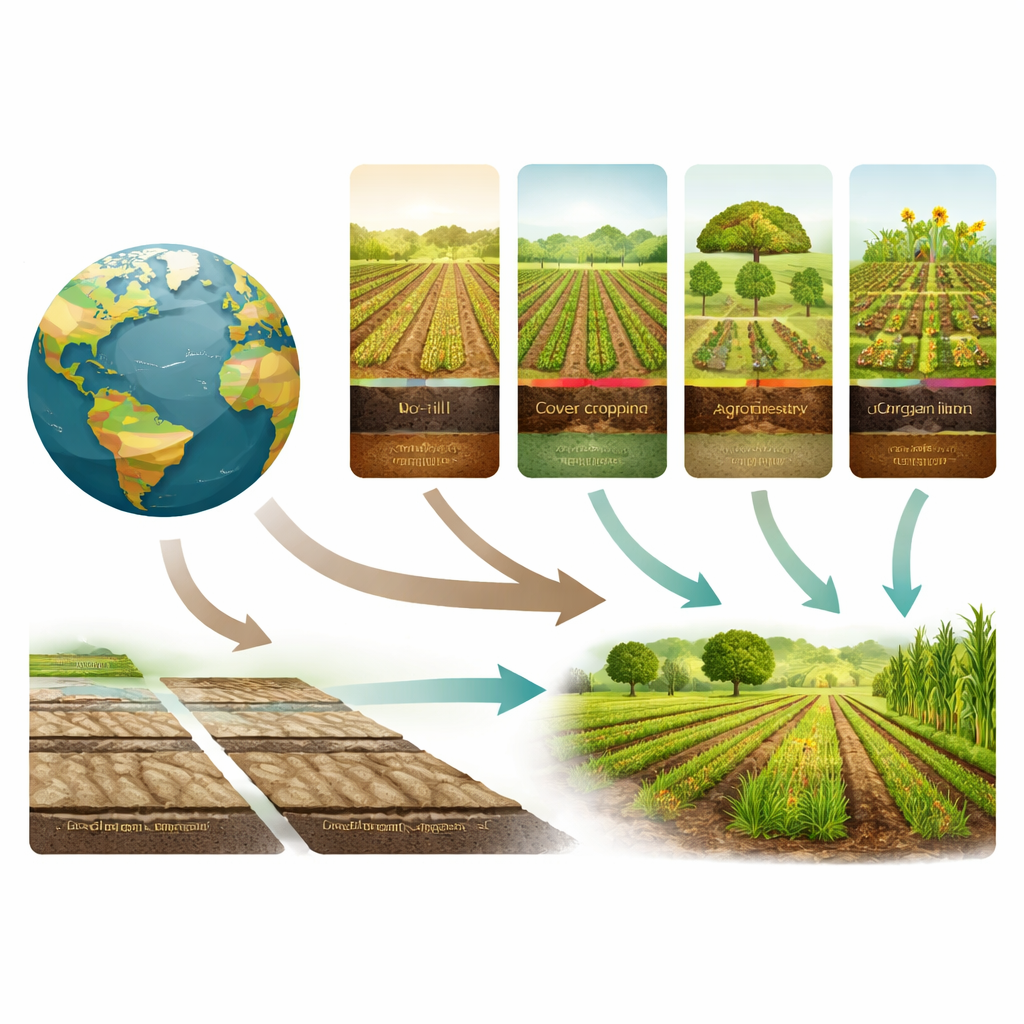
Decades of intensive plowing, heavy machinery, and poorly managed fertilizers have left roughly a third of the world’s soils degraded. At the same time, food demand may grow by up to 100% by mid‑century. Expanding cropland into forests and grasslands would worsen climate change and biodiversity loss, so scientists are searching for ways to grow more on existing fields while healing the land. Regenerative farming focuses on building soil health through practices such as leaving the soil unplowed, growing plants to cover bare ground, mixing trees with crops, and relying more on organic inputs. These methods are praised for storing carbon, reducing erosion, and nurturing biodiversity — but their effects on yields vary widely from place to place.
How the researchers mapped the planet’s regenerative potential
The authors assembled thousands of field experiments from earlier global studies that compared conventional farming with four regenerative practices: no‑tillage, cover crops grown between main crops, agroforestry that integrates trees into fields, and organic farming that replaces synthetic fertilizers and pesticides with organic inputs. For each experiment, they calculated how much yields changed under the regenerative practice. They then combined these yield responses with detailed worldwide maps of climate, rainfall patterns, soil properties, topography, and vegetation, using a machine‑learning method called Random Forest to learn where similar conditions occur across the globe. This allowed them to predict, for every cropland grid cell on Earth, whether each practice would likely raise or lower yields, and how uncertain that prediction would be.
Where different soil‑friendly methods can boost harvests
The results reveal that there is no single "best" regenerative practice everywhere; instead, each one shines under particular combinations of weather and soil. Cover crops stand out as the single most promising option: the study suggests they could increase yields on about 45% of global croplands, especially in parts of Latin America, sub‑Saharan Africa, and East Asia. Agroforestry has similarly large potential, appearing suitable for around 41% of croplands when places with positive yield effects are added up, though predictions there are often more uncertain because most experiments to date are concentrated in a few African countries. No‑tillage could raise yields on roughly 37% of croplands, notably in drier parts of North America, the Middle East, North Africa, and South Asia where conserving soil moisture is crucial. Organic farming shows strong potential in specific niches, like some cereal areas, but overall appears suitable for yield gains on only about 5% of global cropland when judged strictly by short‑term harvests.
Soils, climate, and mixing methods all matter
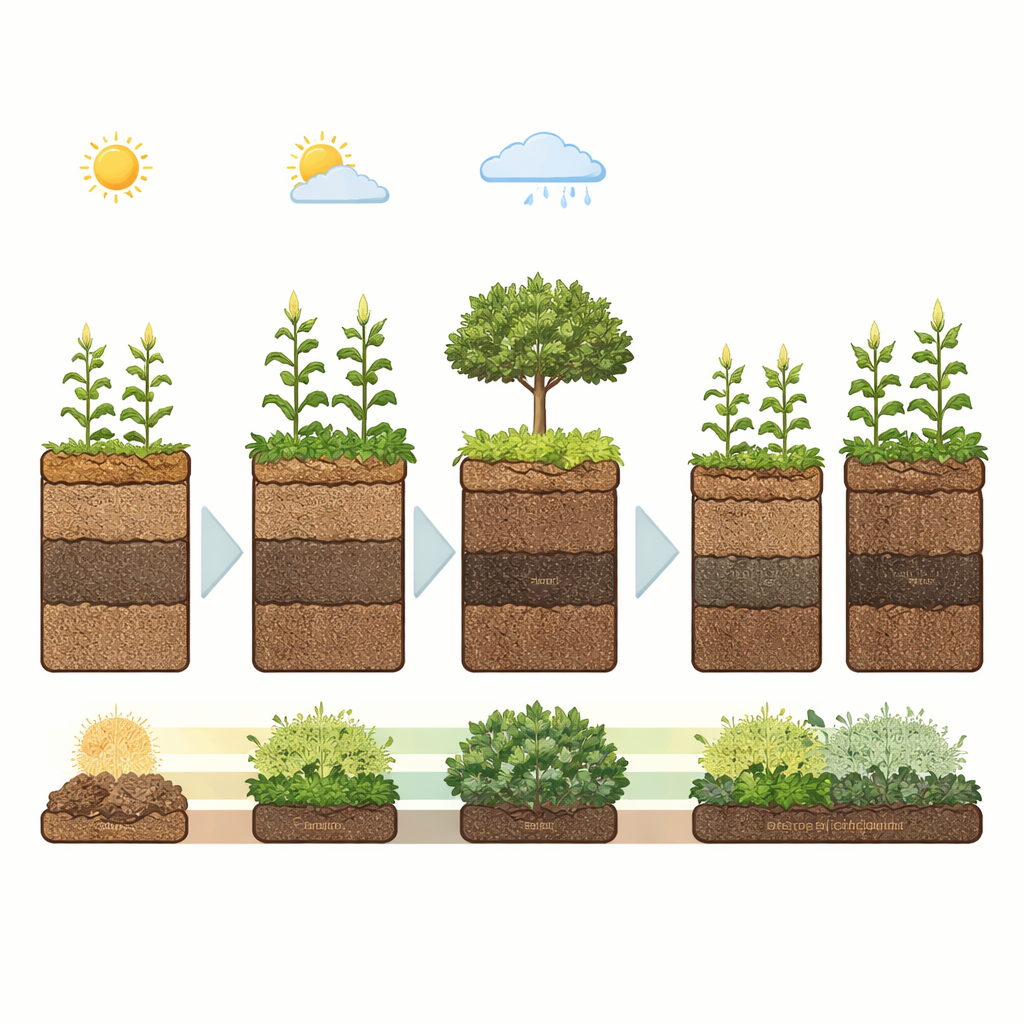
By probing which environmental factors drive their model, the researchers find that broad climate patterns — especially rainfall and solar radiation — set the stage for how these practices perform. Yet local conditions help decide the outcome. For example, soil moisture and the amount of rain in the driest month strongly shape the benefits of agroforestry and cover crops, while surface slope and soil wetness matter for organic systems. In many places, more than one practice could raise yields at the same location. The most common pairing is cover crops with agroforestry, overlapping on about a third of the world’s croplands. These "stacked" opportunities hint at farms that could combine, say, trees, cover crops, and reduced tillage to harvest multiple benefits at once, from weed suppression and erosion control to better water storage and fertility.
Limits, uncertainties, and the bigger picture
The authors stress that their maps are not prescriptions but starting points. The underlying experiments were often conducted under near‑ideal research conditions and are unevenly spread across regions, which means the maps are more reliable in data‑rich areas like North America and Europe than in under‑studied regions. The analysis also focuses on immediate yield responses, not on other advantages of regenerative farming such as carbon storage, flood protection, biodiversity, or long‑term resilience to drought and heat. In real life, farmers face social and economic constraints — from seed availability to labor costs and market incentives — that can matter as much as climate and soil.
What this means for tomorrow’s food and farms
For a lay reader, the takeaway is both hopeful and sobering. This global assessment shows that regenerative practices are not just an environmental luxury; in many places they could actually help grow more food while rebuilding tired soils. Cover crops, trees in fields, and careful tillage emerge as promising tools to boost harvests across large swaths of the planet, especially when thoughtfully combined. But there is no universal recipe: what works on one farm may backfire on another. The study offers a first world map of where soil‑friendly methods can likely pay off in higher yields, helping guide future research, policies, and investments. Turning that potential into reality will require local testing, farmer involvement, and support systems that make it worthwhile to farm with the long‑term health of the land in mind.
Citation: Hounkpatin, K.O.L., De Giorgi, E., Jalava, M. et al. Where regenerative farming practices could increase yields: a global assessment. npj Sustain. Agric. 4, 26 (2026). https://doi.org/10.1038/s44264-026-00131-2
Keywords: regenerative agriculture, soil health, cover crops, agroforestry, sustainable intensification