Clear Sky Science · en
Impacts of climate adaptation on food production and environmental sustainability across metacoupling systems
Why this matters for dinner and the planet
Feeding a growing world without exhausting rivers, soils, and the climate is one of this century’s biggest puzzles. This study looks at China’s Loess Plateau, a region that feeds millions but faces severe erosion and tightening water supplies as the climate warms. By asking how farmers, governments, and trading partners can adapt together, the authors show that smart changes in farming methods, land use, and diets can protect harvests while easing pressure on water, energy, and greenhouse gas emissions.
One region, many pressures
The Loess Plateau is one of China’s main breadbaskets, supplying roughly 7% of the nation’s grain, yet it is also among the world’s most eroded landscapes. Steep slopes, fragile soils, and concentrated rainstorms make farming difficult even before climate change is added to the mix. Modern agriculture here relies heavily on irrigation, machinery, fertilizers, and energy, which in turn draw on limited water and release carbon dioxide. The authors frame these links as a food–water–energy–carbon (FWEC) nexus: water makes crops and electricity possible, energy powers pumps and tractors, and both together shape carbon emissions. Understanding this web is essential for managing not just local fields but also China’s broader food security and environmental goals. 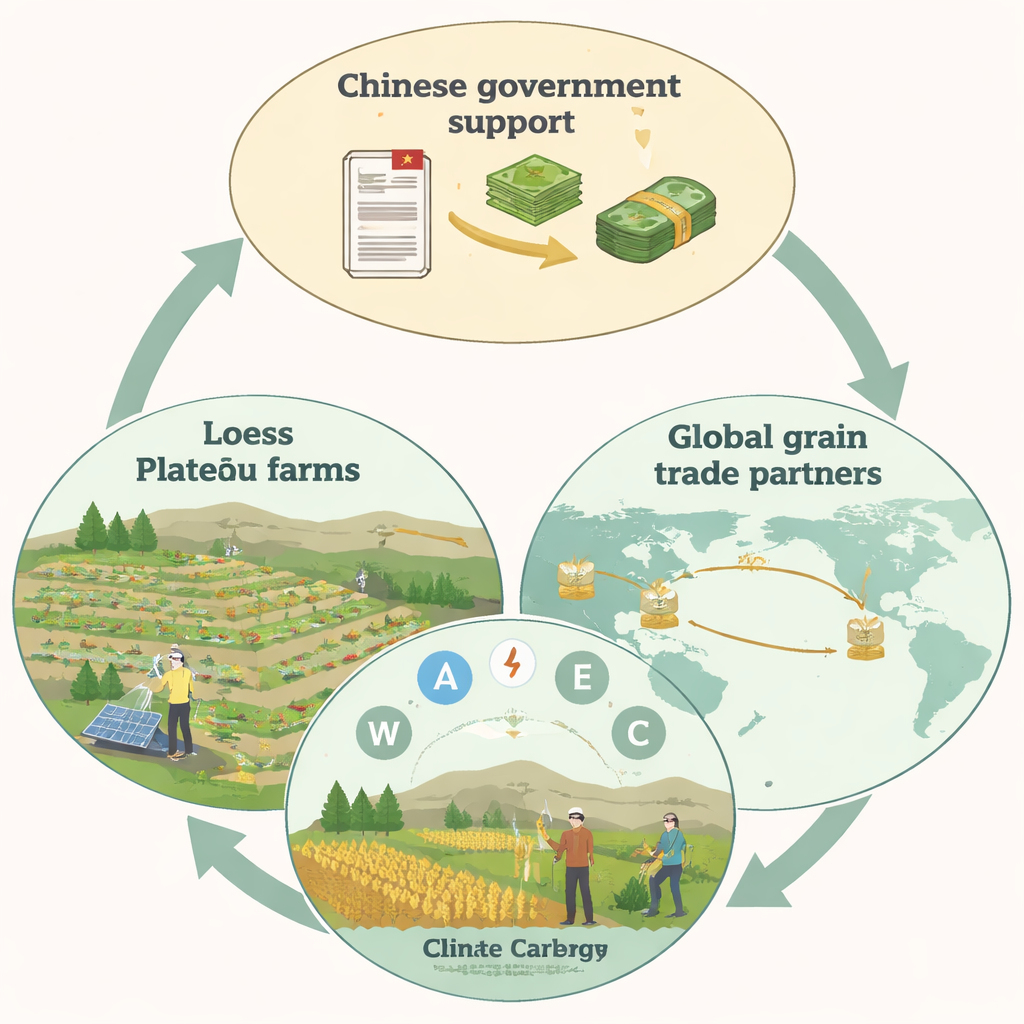
Following grains, water, and carbon through time
To untangle these connections, the study combines crop models, life-cycle accounting, and a “metacoupling” lens that tracks how actions in one place ripple across others. First, the team mapped the 2020 footprints of land, water, energy use, and carbon emissions for wheat, maize, rice, legumes, and tubers across 341 counties. They found that counties along the Yellow River and its main valleys carried the heaviest burdens: they used more irrigation water and energy and produced more emissions per unit of grain. Yet, thanks to recent ecological restoration and better land management, some areas are producing more food without proportionally increasing their resource use, hinting that smarter practices can “decouple” yields from damage.
Climate change shifts the heart of production
Next, the authors asked what happens by 2050 under different greenhouse gas pathways. Using historical weather and harvest data, they projected how yields and cropland area might respond to hotter, drier, and more variable conditions. Under a mid-range scenario, total cultivated area is expected to expand by more than one fifth, but average grain yields drop by around one sixth. In two-thirds of counties, productivity falls, especially in the drier west where heat and water stress intensify. The statistical center of food production shifts dozens of kilometers northwest and climbs tens of meters uphill as farmers and crops follow more favorable conditions. This geographic reshuffling signals higher risk for communities already living near environmental limits. 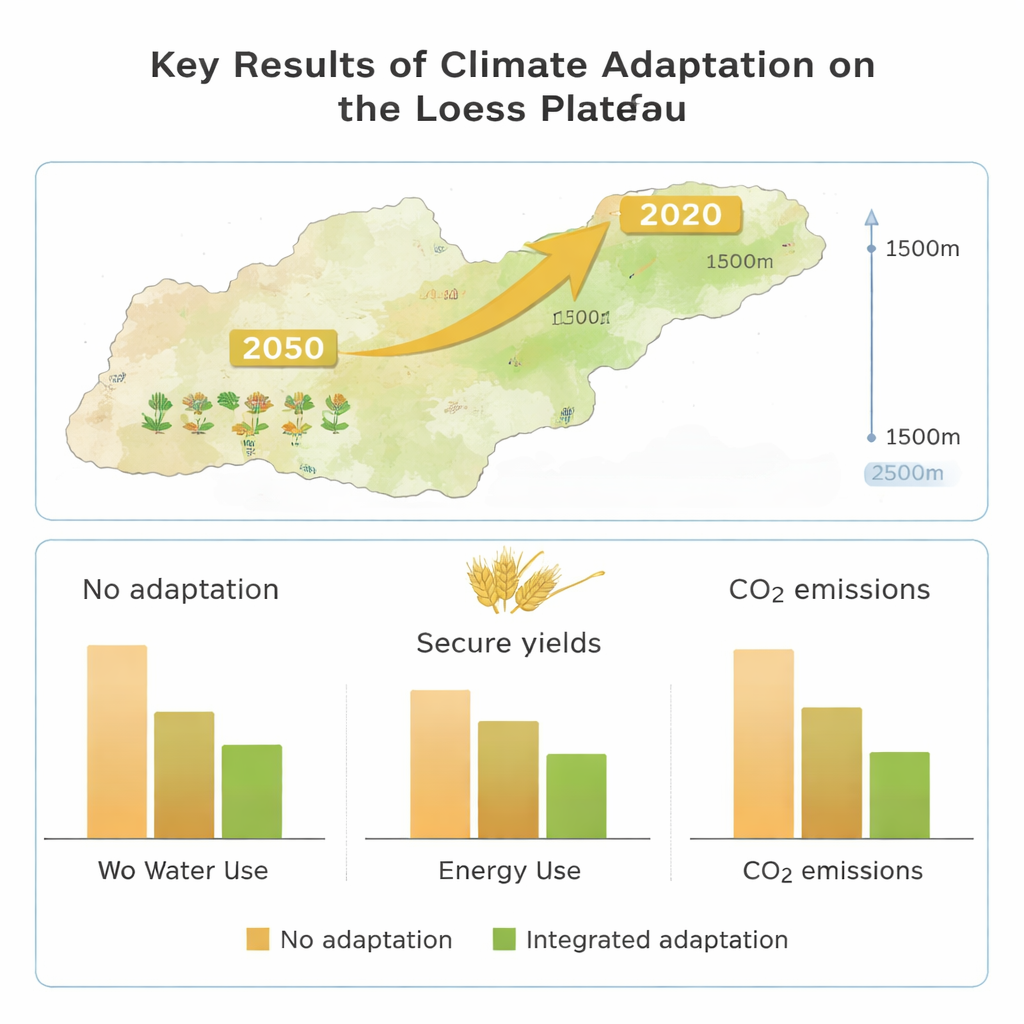
Testing smarter ways to grow and eat
To explore how people might respond, the study builds 13 future scenarios that combine different tools: reducing or upgrading irrigation, adopting conservation tillage, consolidating land to create more efficient plots, and changing diets to require less grain overall. The results reveal clear trade-offs. High-tech drip and sprinkler systems can raise yields and improve food security but often increase energy use and emissions. Simply cutting irrigation saves water but harms harvests. Conservation tillage and land consolidation offer middle paths, trimming footprints while keeping yields relatively stable. The most promising option combines efficient irrigation, better soil and field design, and moderate dietary shifts. This package maintains or improves grain production while lowering water use, energy demand, and carbon emissions, and it also holds up better under hotter, drier weather.
Hidden costs and distant benefits
The study also highlights that adaptation is not free. Building terraces, check dams, and water-saving infrastructure requires huge amounts of materials, fuel, and construction water, creating sizable spikes in water use, energy consumption, and emissions during the building phase. Over time, however, these investments reduce soil loss, stabilize yields, and cut ongoing resource use, so the long-term environmental balance is positive. Because China is a major grain importer, these local changes carry global consequences. If the Loess Plateau boosts its grain self-sufficiency through efficient adaptation, China can trim imports from countries such as Australia, the United States, and Canada. That, in turn, reduces water use, energy demand, and carbon emissions embedded in international grain trade, effectively exporting environmental relief instead of environmental strain.
What this means in everyday terms
For non-specialists, the message is straightforward: how and where we grow food matters as much as how much we grow. On the Loess Plateau, climate change alone pushes farmers toward more land and lower yields, straining rivers and raising emissions. Thoughtful adaptation—better irrigation, smarter soil care, carefully planned land reshaping, and healthier, less grain-heavy diets—can reverse much of this trend. While such measures require upfront investment and create short-term impacts, they can secure reliable harvests, safeguard scarce water, and lower the region’s climate footprint, all while easing pressure on ecosystems and farmers in distant countries that currently help feed China.
Citation: Qu, L., Zhang, Y., Liu, X. et al. Impacts of climate adaptation on food production and environmental sustainability across metacoupling systems. npj Sustain. Agric. 4, 20 (2026). https://doi.org/10.1038/s44264-026-00129-w
Keywords: climate adaptation, food security, water-energy-food nexus, Loess Plateau, sustainable agriculture