Clear Sky Science · en
Multiobjective spatial optimization of fertilizer rates enables sustainable crop production in southwest China
Feeding people without harming the land
As the world’s population grows, farmers are under pressure to grow more food, but using ever more chemical fertilizer is polluting rivers, warming the climate, and wasting money. This study looks at a major grain-producing region in southwest China and asks a crucial question: can we rearrange how and where fertilizers are used so that farmers harvest plenty of rice, maize, and wheat while cutting pollution and unnecessary costs?
Why fertilizer can be too much of a good thing
Chemical fertilizers—mainly nitrogen, phosphorus, and potassium—have helped fuel the boom in global crop production. But in many places, especially in China, they are now used in excess. Extra nitrogen runs off into rivers, seeps into groundwater, and escapes to the air as greenhouse gases. Phosphorus buildup can trigger algal blooms that suffocate fish, while shortages of potassium silently limit plant growth. The Sichuan Basin, a fertile “rice bowl” ringed by mountains, is a vivid example: farmers there apply more than 300 kilograms of fertilizer per hectare, far above global averages, putting the upper Yangtze River and local ecosystems under stress.
Using data and algorithms to map what fields really need
To move beyond one-size-fits-all fertilizer advice, the researchers assembled a decade’s worth of detailed information: tens of thousands of soil samples, farmer fertilizer surveys, and more than 2,000 controlled field trials where plots received precise combinations of nitrogen, phosphorus, and potassium. They combined these with satellite images and weather records and then trained a machine-learning method called a random forest to predict crop yields with and without fertilizer at a fine spatial scale across the region. This allowed them to estimate how much of each crop’s harvest was due to the inherent quality of the soil and climate, and how much came from added fertilizer. 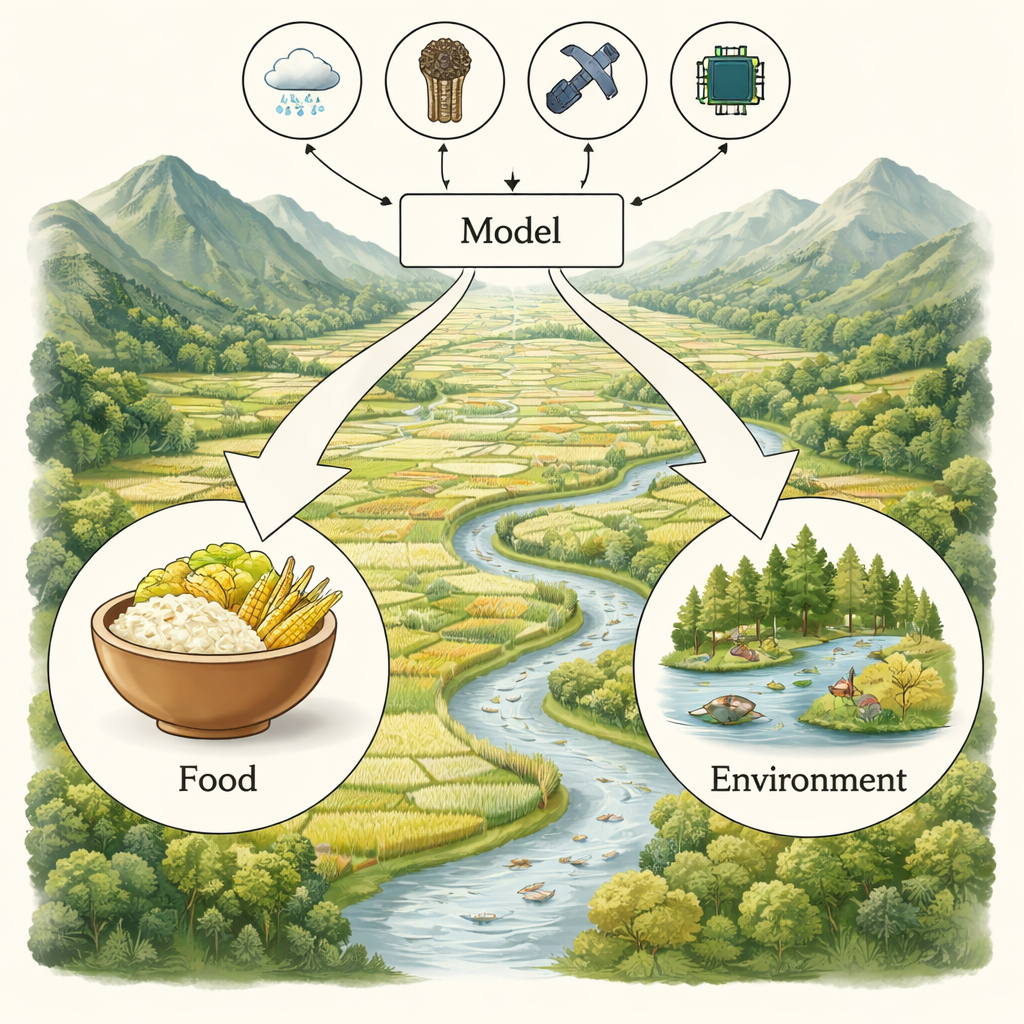
Uneven and unbalanced: where nutrients are in surplus or short supply
The maps revealed a striking pattern. From 2009 to 2019, average yields of rice, maize, and wheat rose slightly, even though fertilizer use fell, suggesting that soil health improved and earlier overuse of fertilizer was reined in. Yet fertilizer’s contribution to yield actually declined by 1–3 percent, especially for rice and maize in rich lowland plains, meaning extra fertilizer there was delivering diminishing returns. At the same time, nutrient balances were badly skewed. Nitrogen was generally excessive, particularly on plains and along major rivers where some rice fields received up to ten times the calculated need. Phosphorus and potassium told the opposite story: they were often deficient, especially for maize and wheat in central and northeastern hills, contradicting the common belief that Chinese croplands are uniformly phosphorus-rich.
Finding the sweet spot between yields and pollution
To turn these diagnostics into action, the team used a multiobjective optimization algorithm—essentially a search tool that juggles trade-offs—to explore thousands of possible adjustments to fertilizer rates. The algorithm sought combinations that would keep or raise total grain production while cutting overall fertilizer, especially nitrogen. The optimal solution suggested that nitrogen use across the basin could fall by about 18 percent, with far larger cuts for rice on the fertile western plains, while phosphorus and potassium would increase modestly where they are currently lacking. Under this plan, total grain output would edge slightly higher than in 2019, and the overall nutrient mix would shift from a nitrogen-heavy ratio of 1:0.38:0.33 (N:P:K) to a more balanced 1:0.51:0.42, closer to national recommendations for sustainable farming. 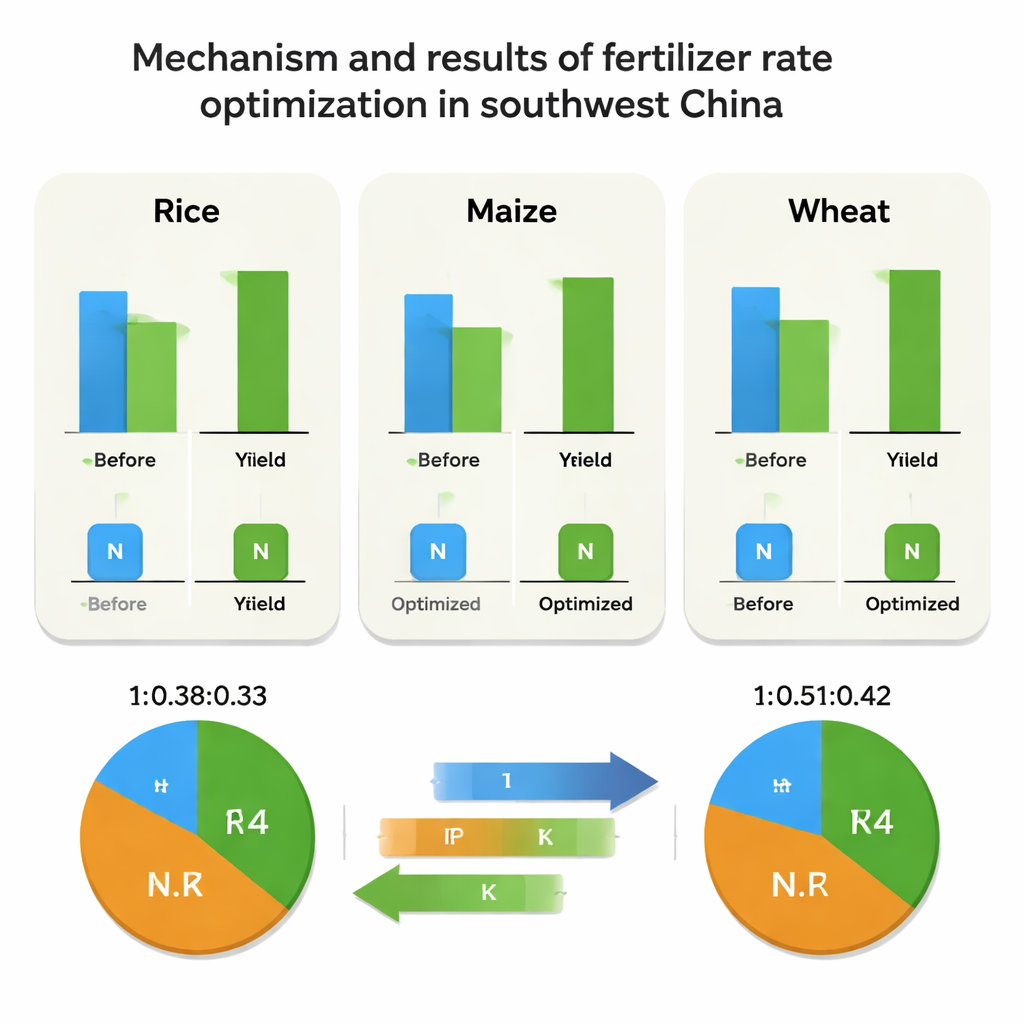
What this means for farmers and the environment
For non-specialists, the message is straightforward: smarter use of fertilizer, guided by data and modern algorithms, can help farmers grow just as much—or even more—food while cutting back on wasteful and polluting inputs. Instead of simply telling farmers to use more or less fertilizer overall, this approach shows where to reduce nitrogen sharply, where to add phosphorus or potassium, and how to do so field by field. Applied widely, similar methods could help many regions feed their populations, save farmers money, and keep waterways cleaner, all without expanding farmland or sacrificing harvests.
Citation: Liao, G., Qian, J., He, P. et al. Multiobjective spatial optimization of fertilizer rates enables sustainable crop production in southwest China. npj Sustain. Agric. 4, 22 (2026). https://doi.org/10.1038/s44264-026-00127-y
Keywords: fertilizer optimization, sustainable agriculture, nutrient balance, machine learning in farming, Sichuan Basin crops