Clear Sky Science · en
On the nature of human performance in competitive endeavors
Why some people soar in tough contests
In many high‑stakes arenas—war, science, and elite sports—a tiny fraction of people collect a striking share of victories, grants, or medals. It is tempting to see this as proof that the game is rigged or that a few stars are simply untouchable. This paper asks a more subtle question: when we see very unequal outcomes, does it always mean runaway dominance or blind luck, or can such patterns also arise in competitions that are tough yet still give skill room to grow?
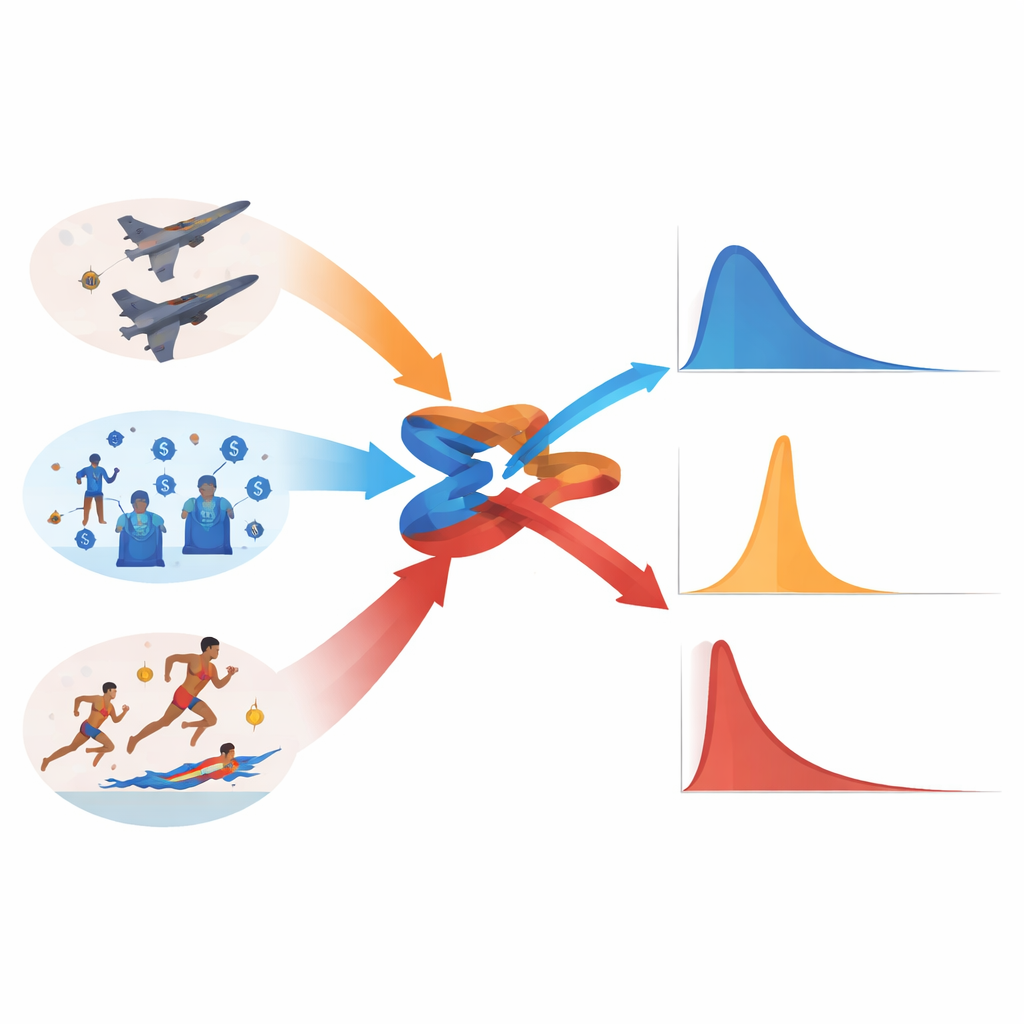
Three kinds of winning worlds
The authors propose that competitive systems tend to fall into three broad “worlds.” In the first, early success snowballs into overwhelming advantage: a few players end up with almost everything, like a handful of firms owning most of a market. In the second, opportunities are so broad and loosely selective that results are closer to a lottery: each new win is largely independent of past performance. Between these extremes lies a third world the authors call “Relative‑Fairness.” Here, entry is already filtered—fighter pilots, grant‑winning scientists, Olympic athletes—but once inside, participants face many rounds of demanding contests under reasonably stable rules. Skill matters, luck matters, and neither completely smothers the other.
Reading the shape of success
To tell these worlds apart, the study looks not at individual stories but at the overall shape of success distributions—the way counts of victories, grants, or medals fan out across people. Very heavy, power‑law‑like tails signal runaway dominance, while thin, geometric‑like tails resemble repeated coin flips. In between sits a lognormal shape, produced when gains multiply over many rounds without becoming infinite. The authors treat this intermediate, “heavy but not extreme” pattern as the signature of Relative‑Fairness, where highly capable competitors repeatedly test themselves and skill has a real chance to accumulate.
What war, science, and sport reveal
The team assembled detailed records from three very different arenas: German fighter pilots in World War II, U.S. biology and computer‑science faculty vying for major research grants, and Olympic swimmers and fencers from the United States, Great Britain, and France. They also added men’s professional tennis as a controlled sports example. Across these systems, they repeatedly sliced the data: whole histories, specific entry cohorts, and distinct eras marked by changes in funding, training, or global politics. In almost every case where rules were stable and contenders had many chances to compete, the upper tail of success followed a lognormal pattern. Runaway, power‑law‑like dominance and thin, lottery‑like tails rarely fit the data best.
When the game really does tilt
Crucially, the exceptions make sense in historical context. Early‑war German pilots, trained longer and facing less prepared opponents, produced a more dominance‑like pattern. In modern swimming, a few once‑in‑a‑generation stars concentrated medals enough to briefly mimic runaway behavior. At the other end of the spectrum, when the U.S. National Institutes of Health temporarily doubled its budget around 2000, grants became easier to obtain; the tail of biology funding thinned toward a geometric form, consistent with a more chance‑like, broad‑access regime. When the budget boom ended and competition tightened, the pattern drifted back toward the lognormal shape of Relative‑Fairness.

What this means for judging fairness
In plain terms, the study suggests that very unequal outcomes do not, by themselves, prove that a system is broken. In highly selective fields where people face many rounds of serious competition, we should expect a heavy but not extreme spread: most careers look modest, some are excellent, and a few become extraordinary. The precise curvature of that spread is informative. When it thins toward a lottery‑like pattern, repeated opportunities are failing to distinguish skill from chance; when it thickens into a near‑winner‑take‑all pattern, structural advantages or overwhelming stars are crowding out the rest. By reading the shape of the tail, institutions can get a compact, testable signal of whether their contests are giving talent a “fighting chance” to shine—or sliding toward luck or lock‑in.
Citation: Zhukov, V., Tsiamyrtzis, P. & Pavlidis, I. On the nature of human performance in competitive endeavors. npj Complex 3, 14 (2026). https://doi.org/10.1038/s44260-026-00078-y
Keywords: human competition, performance inequality, fairness in contests, elite sports and science, heavy-tailed outcomes