Clear Sky Science · en
Rethinking self-replication: detecting distributed selfhood in the outlier cellular automaton
Why copying patterns matter for understanding life
When we ask what makes something “alive,” self-replication – the ability to make copies of oneself – usually tops the list. We know how this works in biology, from DNA to dividing cells, but researchers also explore much simpler, digital worlds to probe the basic rules of life. This article looks at a minimalist virtual universe, a grid of black and white squares called a cellular automaton, and shows that surprisingly lifelike self-replication can arise on its own, without any design or intervention. Even more surprisingly, these digital “selves” are spread out across space in pieces rather than being neat, single objects. 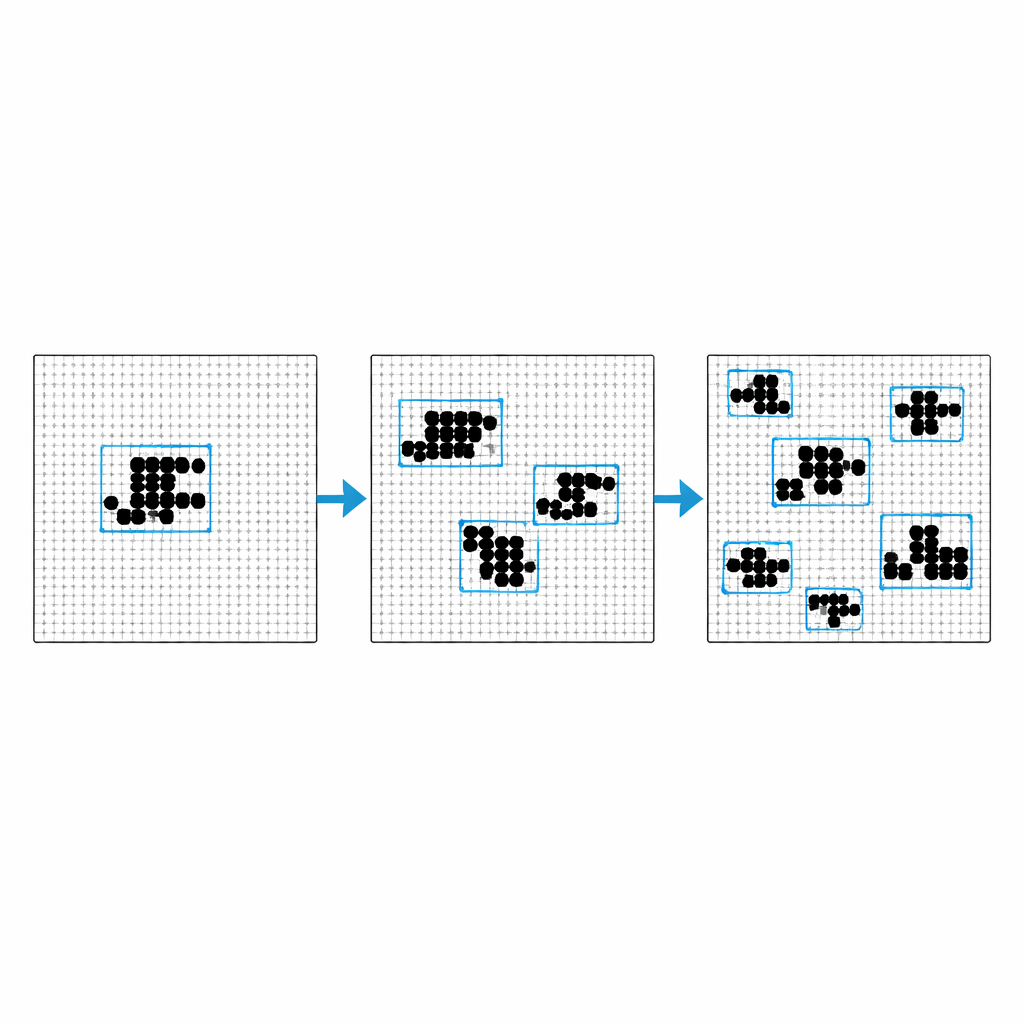
Toy universes where simple rules create surprises
Cellular automata are grid-based systems where each cell flips between “on” and “off” according to fixed rules that look only at nearby neighbors. Despite their simplicity, they can produce gliders that move, oscillators that pulse, and “guns” that fire endless streams of patterns, as seen in the famous Game of Life. For decades, scientists have used such systems as clean, controllable laboratories to ask, “What is life?” and “How complex can simple rules become?” Early self-replicating designs in these worlds, like John von Neumann’s machine or Christopher Langton’s loop, were carefully engineered, intricate contraptions: single, connected shapes that deliberately build copies of themselves.
From engineered machines to spontaneous digital offspring
The new work focuses on a particular rule set called the Outlier cellular automaton. Unlike classic rules that were hand-crafted, Outlier was discovered by a computer search that rewarded unusual, rich behavior. Starting from a very simple initial pattern, the authors let the system evolve on a huge grid for tens of thousands of time steps. Instead of just eyeballing repeating shapes, they built a data-driven “family tree” of every pattern of connected live cells, tracking when and where each appears and which earlier patterns caused it. This lets them apply a strict, causal definition of self-replication: a structure must produce multiple offspring that can each be traced back to a common parent, and those offspring must themselves give rise to further generations.
Distributed selves made of scattered pieces
Using this exhaustive causal tracing, the researchers show that Outlier produces genuine self-replicators spontaneously, without any special starting arrangement. Some patterns make only a few copies before dying out, but others, such as a particular cluster they call c2, generate long branching lineages that grow roughly exponentially until they run out of space. Crucially, the copying process does not pass through a single, solid “organism” that buds off children. Instead, replication unfolds through multiple, separate clusters that split, wander, collide and sometimes rejoin. These scattered pieces, taken together, carry and recreate the information needed for future copies. Over time, different paths to replication appear: the same type of cluster can re-create itself through many distinct developmental sequences that take different numbers of steps and grow in different directions.
New replicators from debris and crowding
When the researchers extend their simulations into effectively unlimited space, the picture grows richer. New clusters continue to appear following broad statistical patterns, and the maximum size of newly discovered shapes keeps increasing. As the grid fills up, replicators bump into one another and into stray patterns, breaking apart and leaving debris. Out of this clutter, the study finds new self-replicating versions of the same key cluster that cannot be traced back to the original ancestor. They arise from recombinations of fragments produced by earlier replication events, then go on to spawn their own lineages. The authors argue that this resembles, in stylized form, how early life might have combined both faithful copying and the generation of novel reproducers through interaction. 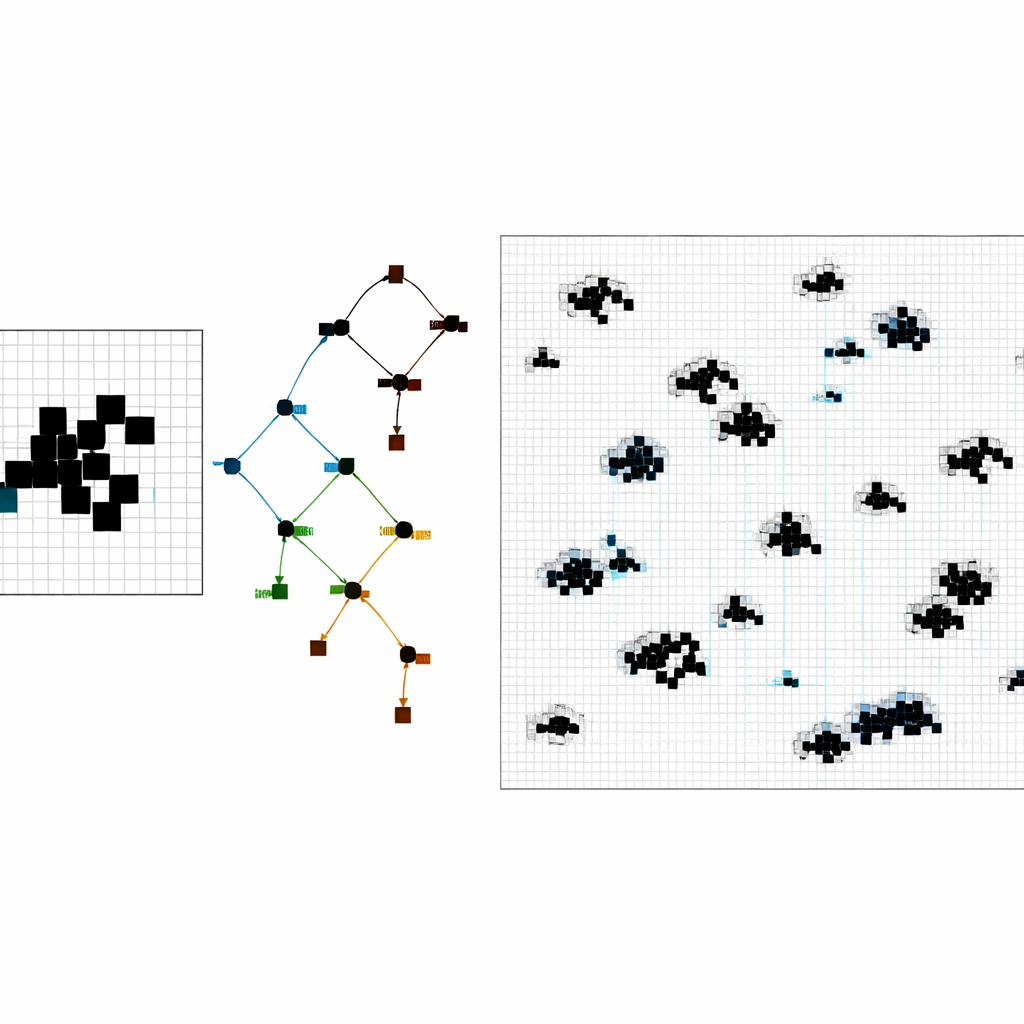
Rethinking what it means to be an individual
For a general reader, the most striking message is that in this simple digital universe, “individuals” are not tidy, self-contained objects. Instead, selfhood is distributed: multiple, disconnected clusters of cells can together act as a single replicating unit, and what really persists is not a particular shape but a causal process that keeps re-creating that shape. The study offers the first complete, formal description of such a non-engineered, multi-part self-replicator in this kind of system. It suggests that evolution and life-like replication can emerge as natural consequences of deterministic rules, and that our everyday picture of organisms as compact, bounded things may be too narrow. In some worlds – and perhaps in our own at certain scales – the “self” is better understood as a network of cooperating pieces and the ongoing process that links generations across time.
Citation: Hintze, A., Bohm, C. Rethinking self-replication: detecting distributed selfhood in the outlier cellular automaton. npj Complex 3, 11 (2026). https://doi.org/10.1038/s44260-026-00074-2
Keywords: cellular automata, self-replication, artificial life, complex systems, emergence