Clear Sky Science · en
Symmetry breaking in collective decision-making through higher-order interactions
Why group choices can get stuck
From honeybee swarms picking a new home to robot teams searching for survivors, many groups must choose between equally good options. Yet, when no choice is clearly better, groups can get stuck in endless hesitation. This paper explores how the way we interact—not just one-on-one, but also in small groups—can help break such deadlocks and push a community, animal group, or swarm of robots toward a shared decision.
From simple contacts to real-world conversations
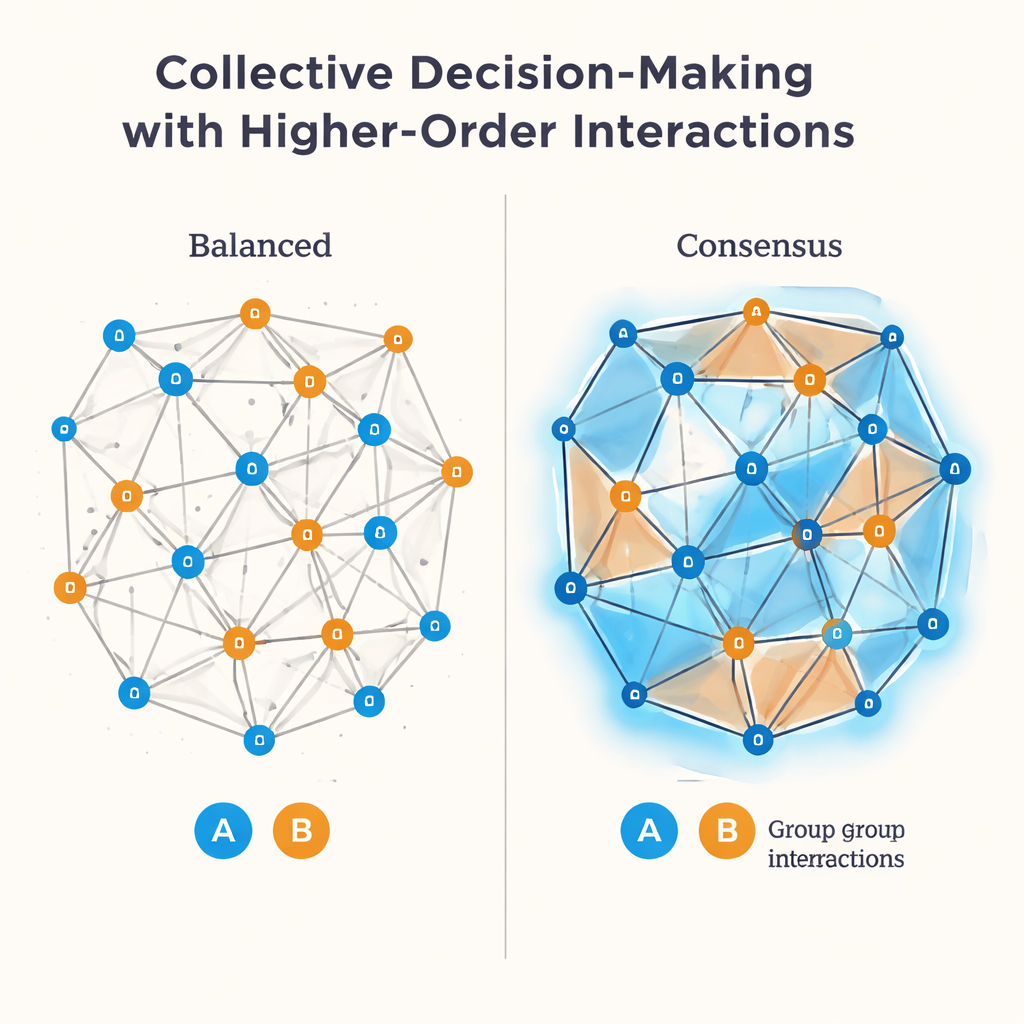
Most mathematical models of how opinions or behaviors spread treat social contact as a series of pairwise encounters: you talk to one friend, who then talks to another, and so on. That picture works well for simple disease spread but falls short for richer social situations, where people more often discuss, argue, and decide in small groups. The authors build on newer tools that represent these higher-order interactions using structures called simplicial complexes, which can capture not just links between pairs, but also group meetings among three or more individuals.
Agents that explore, commit, and change their minds
The study introduces a model inspired by honeybees choosing nest sites. Each agent can be uncommitted or committed to one of several options. Uncommitted agents may discover an option on their own, mimicking independent exploration, or they can be recruited through social contact. Recruitment happens in two ways: through pairwise conversations between one committed and one uncommitted agent, and through group interactions where several committed agents together persuade an undecided one. Committed agents can also abandon their choice and return to an uncommitted state, capturing the idea that individuals sometimes reconsider their stance.
How group interactions break the tie
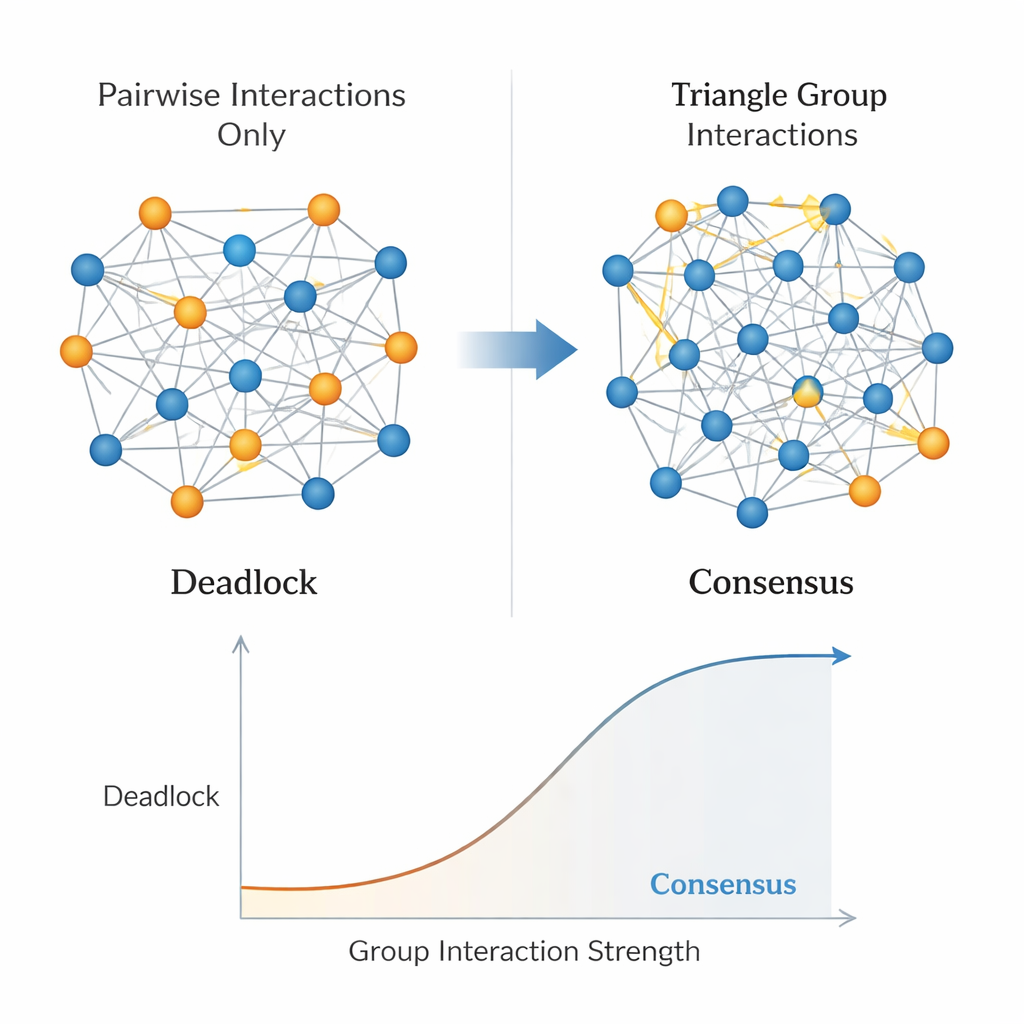
The core question is what happens when there are two equally good options. Using mathematical analysis and computer simulations, the authors show that if decisions spread only through pairwise contacts, the system tends to fall into a deadlock: in the long run, neither option gains a clear majority. In contrast, when group interactions are added—such as triangles representing three agents interacting together—the picture changes. Above certain thresholds in group recruitment strength, the system undergoes a symmetry-breaking transition: a small initial imbalance gets amplified, one option becomes widely preferred, and the population reaches consensus.
Noise, real data, and robustness of the effect
The model also includes spontaneous adoption, representing agents who independently pick an option without being persuaded. This randomness acts like noise: it makes full consensus harder but can also help the system escape stalemates. The authors map out different regimes, from inactive (no sustained commitment) to deadlock, to regions where multiple stable outcomes coexist, including strong consensus states. They then test their theory on computer-generated group networks and on structures built from real face-to-face contact data in schools and workplaces. Across these different settings, the same pattern appears: adding genuine group interactions consistently helps the system move from indecision to a clear collective choice.
What this means for swarms, crowds, and beyond
In plain terms, the study shows that small-group conversations are not just a detail; they can fundamentally change how a community chooses between equally good alternatives. One-on-one persuasion alone often leaves groups stuck, but when clusters of like-minded individuals jointly influence undecided members, a clear winner can emerge without needing extra negative signals or complex rules. This insight has implications for understanding social animals, human organizations, and the design of robot swarms: if we want reliable, fast group decisions, we should design and encourage structured group interactions, not just pairwise links.
Citation: March-Pons, D., Pastor-Satorras, R. & Miguel, M.C. Symmetry breaking in collective decision-making through higher-order interactions. npj Complex 3, 7 (2026). https://doi.org/10.1038/s44260-026-00071-5
Keywords: collective decision-making, social contagion, higher-order interactions, consensus dynamics, robot swarms