Clear Sky Science · en
Uneven distribution of knowledge seeking for female researchers
Why online questions from scientists matter
When scientists have a puzzle they cannot solve alone, many now turn to the internet rather than knocking on a colleague’s door. On academic question‑and‑answer sites, they ask for help with experiments, data, or theory—and their queries quietly reveal who needs what kind of knowledge to keep their work moving. This study looks under the hood of one major platform, ResearchGate, to see how gender and geography shape these digital cries for help, and what that means for fairness and progress in science.
Different regions, different needs
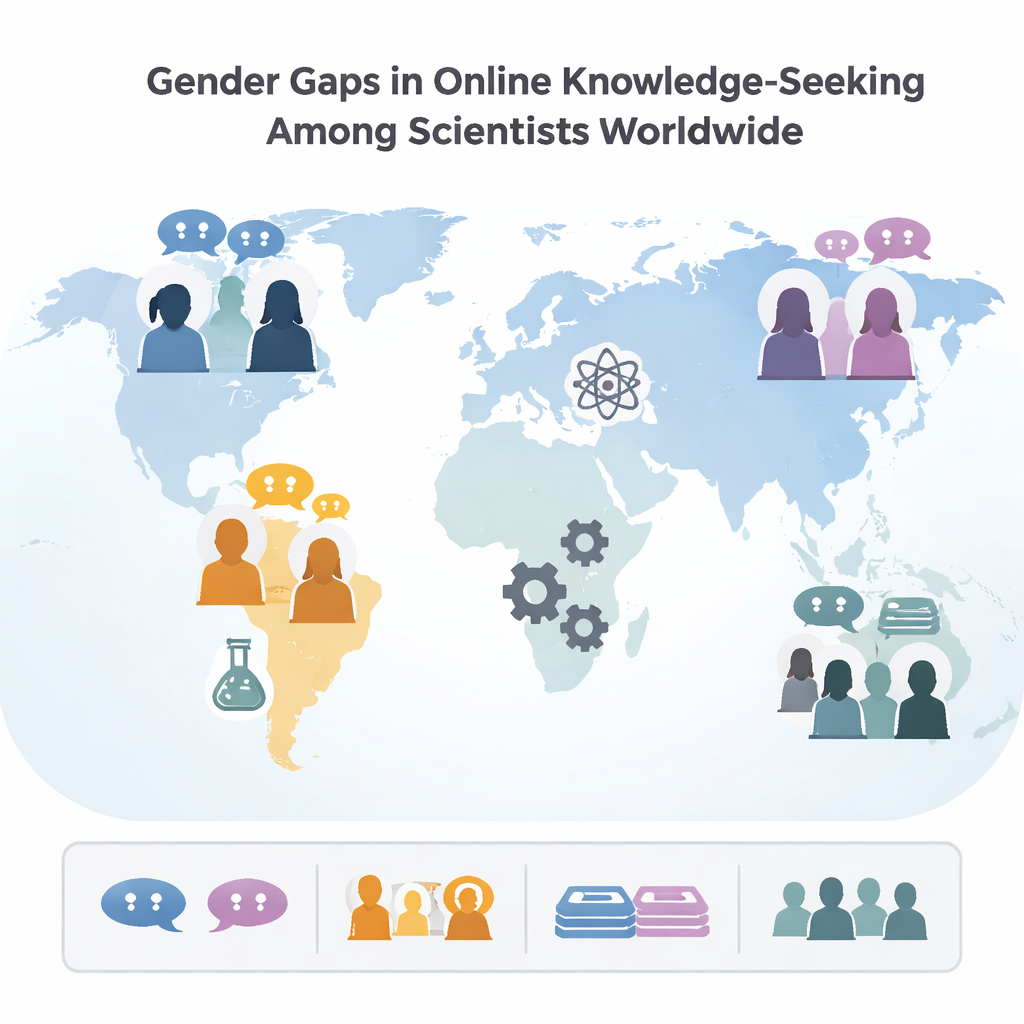
Using data from more than half a million questions posted between 2008 and 2023, the authors measured how intensely researchers seek help in five broad areas: arts and humanities, life sciences and biomedicine, physical sciences, social sciences, and technology. They compared men and women across seven world regions, accounting for how active each group is overall. The picture that emerges is uneven. In fast‑developing regions—such as East Asia and the Pacific, South Asia, and the Middle East and North Africa—women ask more questions than average, often clustering in a few fields. In highly developed regions like North America and Europe, women’s questions are spread more evenly across disciplines, and overall demand for help is lower. These patterns mirror broader differences in economic development and scientific investment.
Women focus on hands‑on know‑how
The researchers then zoomed in on the life sciences and biomedicine, the largest field on the platform and one with many women participants. Here they distinguished between questions about general topics—such as COVID‑19 or broad data analysis—and questions about specific laboratory techniques, such as staining cells, running ELISA tests, performing Western blots, or using flow cytometry. Across nearly all regions, women were more likely than men to ask about these hands‑on procedures, even though these topics attracted fewer people overall. General, widely discussed themes were more often driven by men. To understand why, the authors linked the question‑askers to publication records from large bibliographic databases. They found that women are slightly more involved in experimental work on papers, supporting the idea that they carry much of the lab‑bench labor and therefore need more technical guidance to get experiments right.
Who asks and who answers
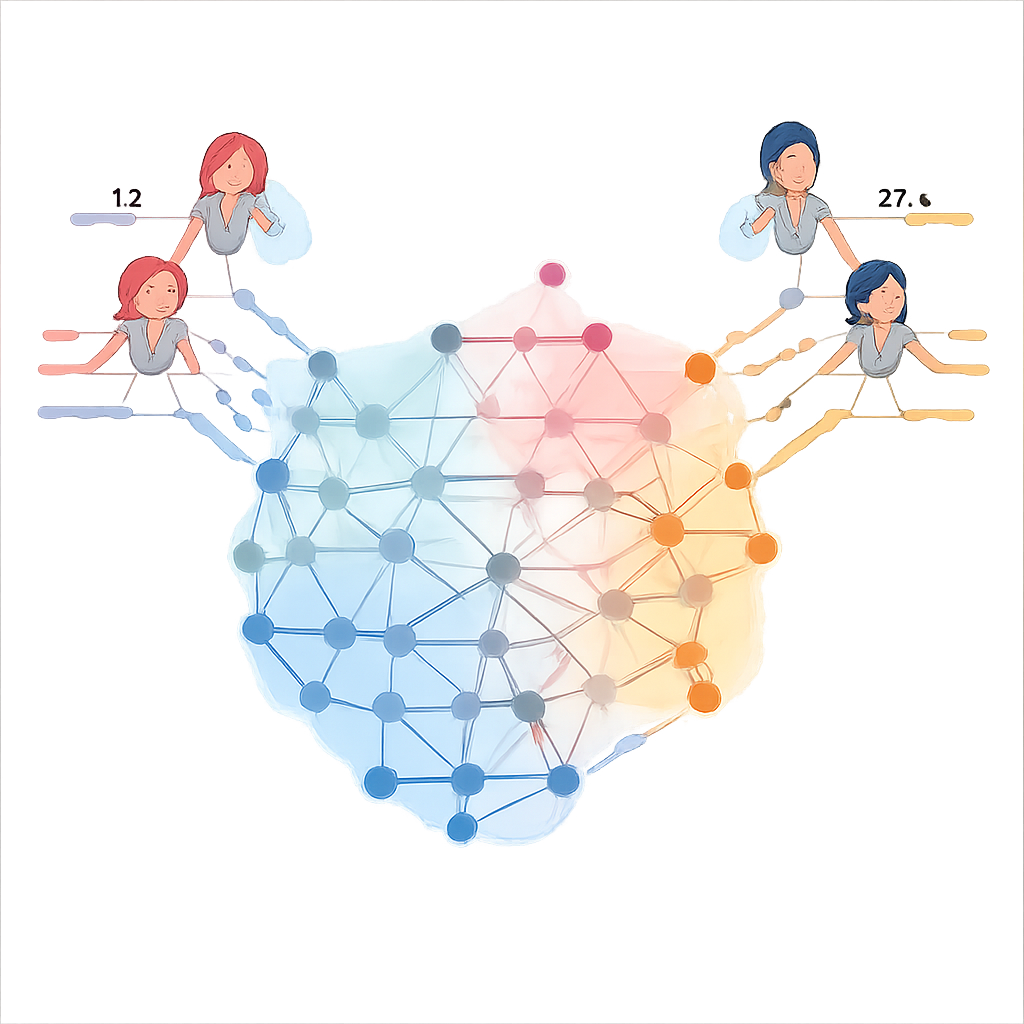
Questions are only half the story; answers show who holds recognized expertise. By turning the questions and replies into a network—where each researcher is a dot and each answer is an arrow pointing from helper to asker—the authors compared how men and women participate in knowledge exchange. They found that women have, on average, more incoming links than outgoing ones: they are more often in the role of seekers. Men show the opposite pattern: they more often provide answers to others. This held both in the overall network and in focused snapshots of a technical topic (staining) and a broad, headline topic (COVID‑19). In the technical network, women asked especially many questions but did not answer as frequently, suggesting that their need for help in specialized methods is not fully met by the community.
Hidden walls in digital communities
The structure of these online networks reveals subtle barriers. Researchers tended to interact with others of the same gender and from the same region, forming clusters rather than a single, well‑mixed conversation. This “like‑talks‑to‑like” tendency makes it harder for knowledge to cross boundaries, particularly when senior, highly visible experts are disproportionately male. Over time, the authors argue, this can create feedback loops: men, by answering more questions, become more central and more visible, while women remain more peripheral as question‑askers whose problems are not always fully solved. Because online platforms are increasingly where informal scientific help is sought, such patterns risk reinforcing long‑standing inequalities in training, recognition, and access to cutting‑edge methods.
What this means for fairer science
To a non‑specialist, the main message is straightforward: women scientists are not only present in online communities, they are especially active in asking for help with the hands‑on parts of research—but they receive relatively less support and answer fewer questions themselves. This imbalance reflects deeper divides in who does what kind of work, who is seen as an expert, and which regions have broad scientific strength. The authors suggest that universities, funders, and platform designers can help by investing in technical training where women cluster, encouraging diverse mentorship, and tweaking algorithms so that questions from under‑served groups more often reach well‑placed experts. In short, by paying attention to who is asking which questions online—and who is answering—we can redesign digital spaces to share expertise more fairly and help close gender gaps in science.
Citation: Tang, S., Wang, D., Bu, Y. et al. Uneven distribution of knowledge seeking for female researchers. npj Complex 3, 12 (2026). https://doi.org/10.1038/s44260-025-00067-7
Keywords: gender disparities in science, online academic Q&A, female researchers, researchgate, scientific knowledge exchange