Clear Sky Science · en
Five-decade global expansion of Staphylococcus argenteus ST2250 shapes antimicrobial resistance dynamics
Why a little-known germ matters
Most people have heard of “MRSA,” the drug-resistant Staphylococcus aureus that haunts hospitals and news headlines. Far fewer know its close cousin, Staphylococcus argenteus. This study shows that one particular family of S. argenteus, called ST2250, has quietly spread around the world over the last 50 years while collecting a toolkit of antibiotic-resistance genes. Understanding how this has happened helps doctors and public health officials prepare for the next wave of hard-to-treat infections.
A new troublemaker in the staph family
S. argenteus was only recognized as its own species in 2015, after years of being mistaken for S. aureus in the laboratory. Yet it can cause many of the same problems: food poisoning, skin and soft tissue infections, bloodstream infections, bone and joint disease, and infections in animals and food products. Because routine tests often mislabel it as S. aureus, its true impact has likely been underestimated. The authors gathered 379 high-quality genomes of S. argenteus from 28 countries across six continents, mostly from human patients but also from food, animals, and the environment, to take a global look at how this species is evolving.
A dominant clone circles the globe
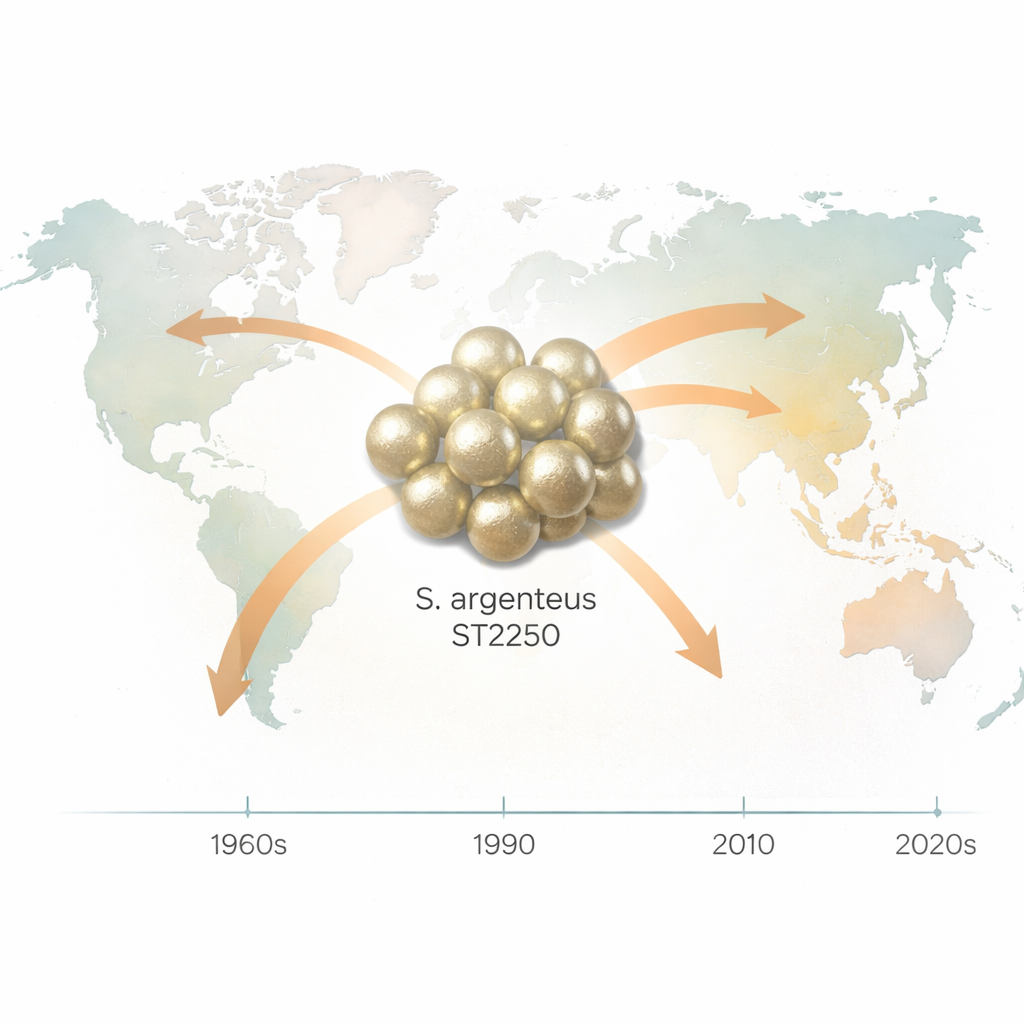
When the team compared the DNA of all these isolates, they found that S. argenteus is made up of several distinct lineages, each corresponding to a specific genetic “sequence type.” One, ST2250, dominated the dataset, accounting for more than half of all genomes. ST2250 was found on multiple continents and in many kinds of samples, from hospitalized patients to food. Using a time-calibrated evolutionary tree, the researchers estimated that the common ancestor of today’s ST2250 strains emerged around 1967. Since then, its effective population size—an indicator of how many successful infections and transmissions occur—soared for decades, peaking around 2012 before showing signs of a recent decline.
Loaded with resistance and virulence tools
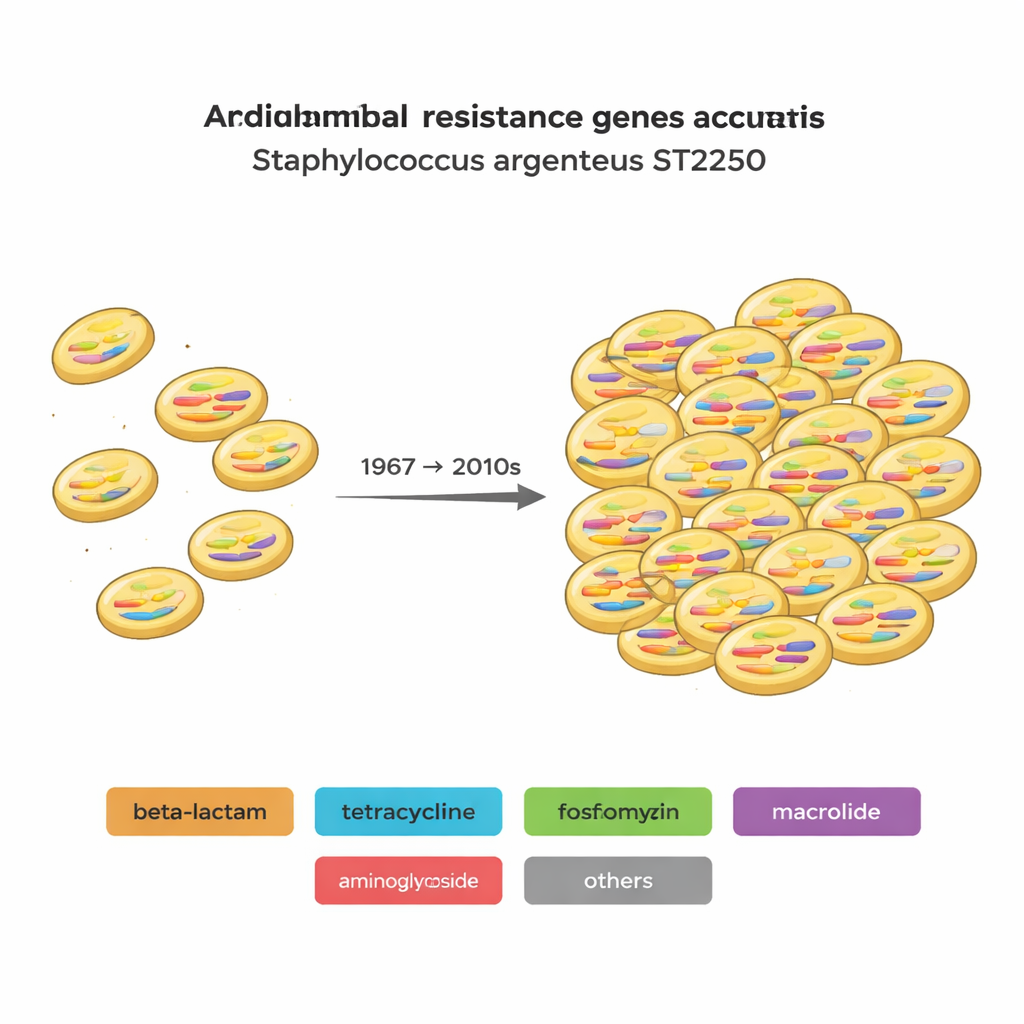
The study cataloged genes that help S. argenteus cause disease (virulence genes) and resist antibiotics (antimicrobial resistance, or AMR, genes). Each genome carried dozens of virulence genes, and ST2250 strains had only slightly fewer of these than other lineages, suggesting similar potential to make people sick. The bigger difference lay in resistance. Across all genomes, the authors found 29 distinct AMR genes covering 12 classes of antibiotics and disinfectants. ST2250 strains typically carried more resistance genes than other types and often shared the same combinations. Many ST2250 strains also carried fosB, a gene that protects against fosfomycin, an “old” antibiotic that has seen renewed use against difficult staph infections. The close relative ST1850 also carried fosB, hinting that this gene may have been present in their common ancestor.
How resistance traits travel together
The researchers looked for resistance genes that tend to appear together in the same strain more often than chance would predict. They found strong pairings such as genes for tetracycline resistance (tetL) with aminoglycoside resistance (aph(3')-IIIa), and trimethoprim resistance (dfrG) with methicillin resistance (mecA). These clusters likely reflect past events where several genes were picked up at once on mobile DNA elements like plasmids, then passed down as the bacterial lineages spread. Indeed, the team detected dozens of plasmid “replicon” types and showed that some plasmids strongly co-occur with specific resistance genes. Within ST2250, two major sublineages appeared: one in Asia and one in Europe, each marked by its own characteristic resistance package and, in Europe, by the methicillin-resistance cassette known as SCCmec.
What this means for the future
For non-specialists, the key message is that S. argenteus is not a harmless curiosity but a rising member of the drug-resistant staph family. Over roughly five decades, a single successful lineage, ST2250, has spread widely and accumulated a rich mix of resistance genes, creating conditions where multidrug-resistant strains can readily emerge. Although there are early hints that ST2250’s growth may be slowing, other lineages with their own resistance traits are waiting in the wings. The authors argue that more precise detection of S. argenteus, broader sampling beyond hospitals, and close genetic surveillance will be essential to prevent this quiet pathogen from becoming the next major staph threat.
Citation: Costa, L.R.M., Marmion, M., Buiatte, A.B.G. et al. Five-decade global expansion of Staphylococcus argenteus ST2250 shapes antimicrobial resistance dynamics. npj Antimicrob Resist 4, 14 (2026). https://doi.org/10.1038/s44259-026-00188-6
Keywords: Staphylococcus argenteus, antimicrobial resistance, genomic epidemiology, ST2250 clone, drug-resistant bacteria