Clear Sky Science · en
The relationship between social adversity, micro-RNA expression and post-traumatic stress in a prospective, community-based cohort
Hidden Scars of Stress
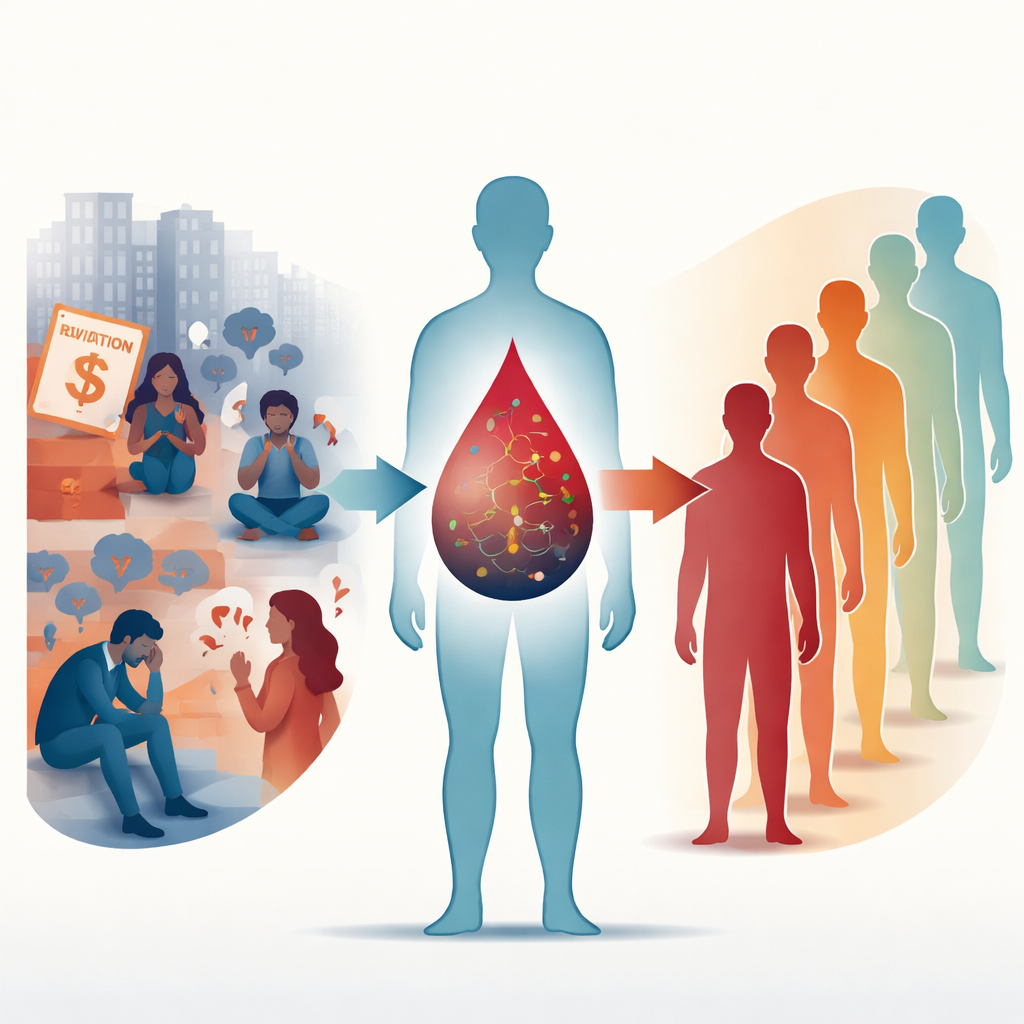
Why do some people emerge from hardship deeply shaken while others, who have lived through equally harsh experiences, manage to cope better? This study looks inside the body’s biology to explore that puzzle, focusing on people in Detroit who have faced discrimination, financial strain and violence. By examining tiny molecules in the blood that help control how genes behave, the researchers uncover clues about how social adversity can become biologically embedded and shape vulnerability to post-traumatic stress symptoms over time.
Life Challenges and Lasting Stress
The work centers on post-traumatic stress symptoms, which can include nightmares, flashbacks, and constant feelings of threat after frightening events. Unlike many mental health conditions, post-traumatic stress requires exposure to trauma, such as assault or witnessing violence. But trauma does not affect everyone the same way. People’s daily environments—like chronic money problems, feeling unwelcome or targeted, or repeated losses—can build up, increasing the chance that trauma leaves a lasting mark. In Detroit, a long-running community study has tracked hundreds of adults, most of whom are African American, asking about their experiences of discrimination, loneliness, financial difficulties, emotional mistreatment, and traumatic events, alongside detailed mental health surveys.
Tiny RNA Switches in the Blood
Beyond life circumstances, the team focused on microRNAs, tiny pieces of genetic material that do not make proteins themselves but help turn other genes up or down. These molecules act like dimmer switches for the body’s gene activity, and they can change in response to environmental pressures. Researchers collected blood samples from 483 participants at two time points several years apart and used high-throughput sequencing to capture the activity of hundreds of different microRNAs. They then linked these molecular snapshots to people’s histories of social adversity and to their later levels of post-traumatic stress symptoms, treating symptom severity as a continuous scale rather than an all-or-nothing diagnosis.
How Adversity, Biology and Symptoms Interact
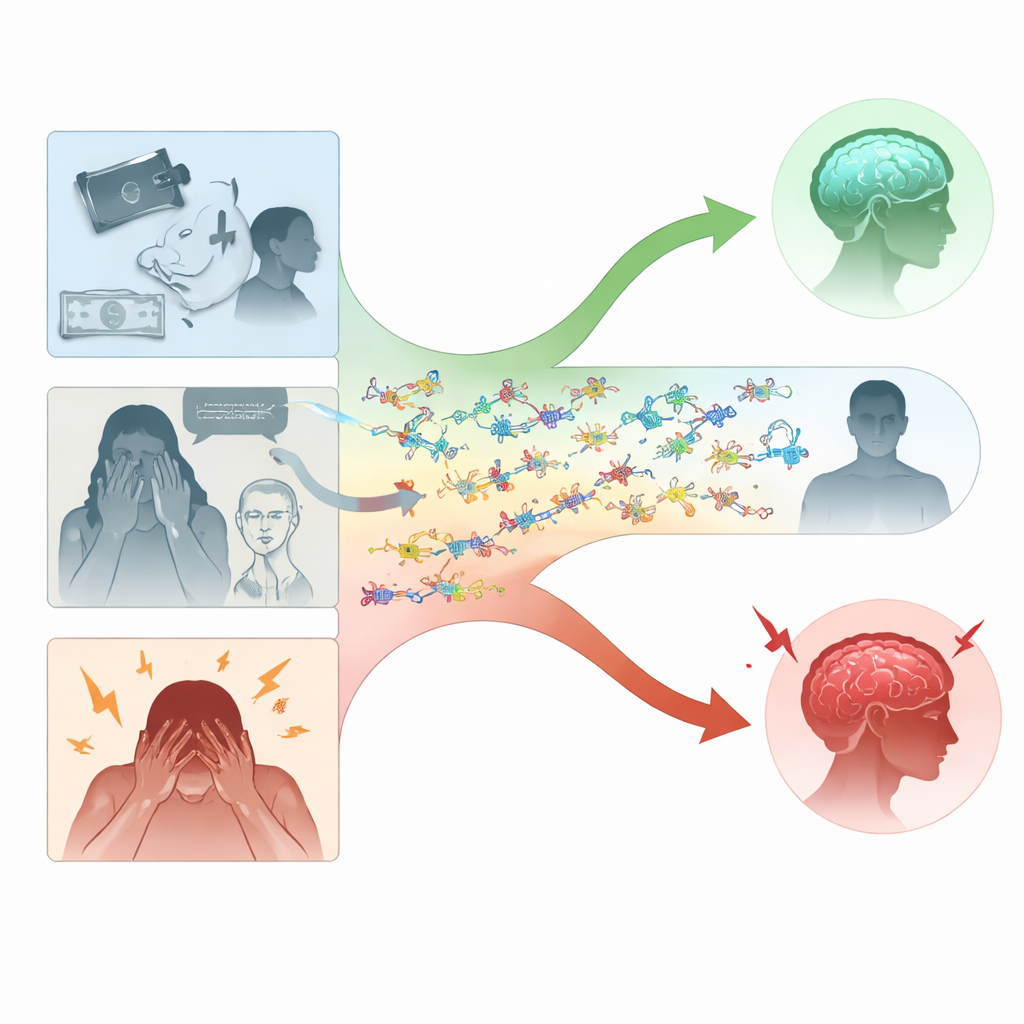
Using statistical models suited for skewed, count-like symptom data, the authors first confirmed that the overall pattern of someone’s lifetime social adversity was strongly related to how severe their later symptoms became. Interestingly, adding genetic risk scores or estimates of blood cell types did little to improve prediction beyond these social measures. The key advance came from testing whether individual microRNAs changed the strength of the link between adversity and symptoms. The team identified 86 microRNAs that were either directly associated with symptom severity or altered how particular hardships translated into distress. For example, dozens of microRNAs appeared to reshape the impact of perceived discrimination, some amplifying its effect on symptoms and others dampening it. In certain cases, higher levels of a given microRNA were linked to a weaker connection between money problems or accumulated trauma and later stress symptoms, hinting at a possible protective role.
Biological Pathways Behind Coping and Risk
To understand what these microRNAs might be doing, the researchers examined the genes they are predicted to regulate and the biological pathways those genes occupy. The targets clustered in systems already suspected to matter for trauma-related conditions: immune responses, cell growth and renewal, and networks involved in brain signaling and learning. Pathways that help shape how nerve cells communicate, change with experience, and respond to hormones and stress signals appeared prominently. Many of the microRNAs highlighted here have also been linked in earlier work to traumatic brain injury or stress response, suggesting that the same molecular tools may be reused across different kinds of trauma and adversity.
What This Means for Real Lives
For a lay reader, the message is that long-term social pressures—such as discrimination, loneliness, and financial hardship—do not just weigh on the mind; they also leave traces in the body’s gene-control machinery. The study does not prove cause and effect, and it cannot yet tell us whether changing microRNA levels would change a person’s fate. But it offers a detailed map of specific molecular switches that seem to shape how strongly social adversity leads to post-traumatic stress. In the future, these microRNAs might help identify people at higher risk, clarify why some communities bear a disproportionate burden of trauma-related illness, and perhaps point toward new strategies to buffer the psychological harm of chronic social disadvantage.
Citation: Wang, C., Uddin, M., Wani, A. et al. The relationship between social adversity, micro-RNA expression and post-traumatic stress in a prospective, community-based cohort. Nat. Mental Health 4, 416–426 (2026). https://doi.org/10.1038/s44220-025-00581-6
Keywords: post-traumatic stress, social adversity, microRNA, epigenetics, mental health disparities