Clear Sky Science · en
Oceanographic connectivity strongly restricts future range expansions of critical marine forest species
Why ocean forests matter to us
Hidden beneath coastal waves, vast underwater forests of seagrass and brown seaweeds protect shorelines, feed fisheries, store carbon, and shelter marine life. As the climate warms, these habitats are shifting, shrinking in some places and appearing in others. This study asks a deceptively simple question with big consequences: even if new cool-water refuges appear in a warming world, can these vital marine forests actually get there, or will ocean currents strand them in place?
Shifting homes in a warming sea
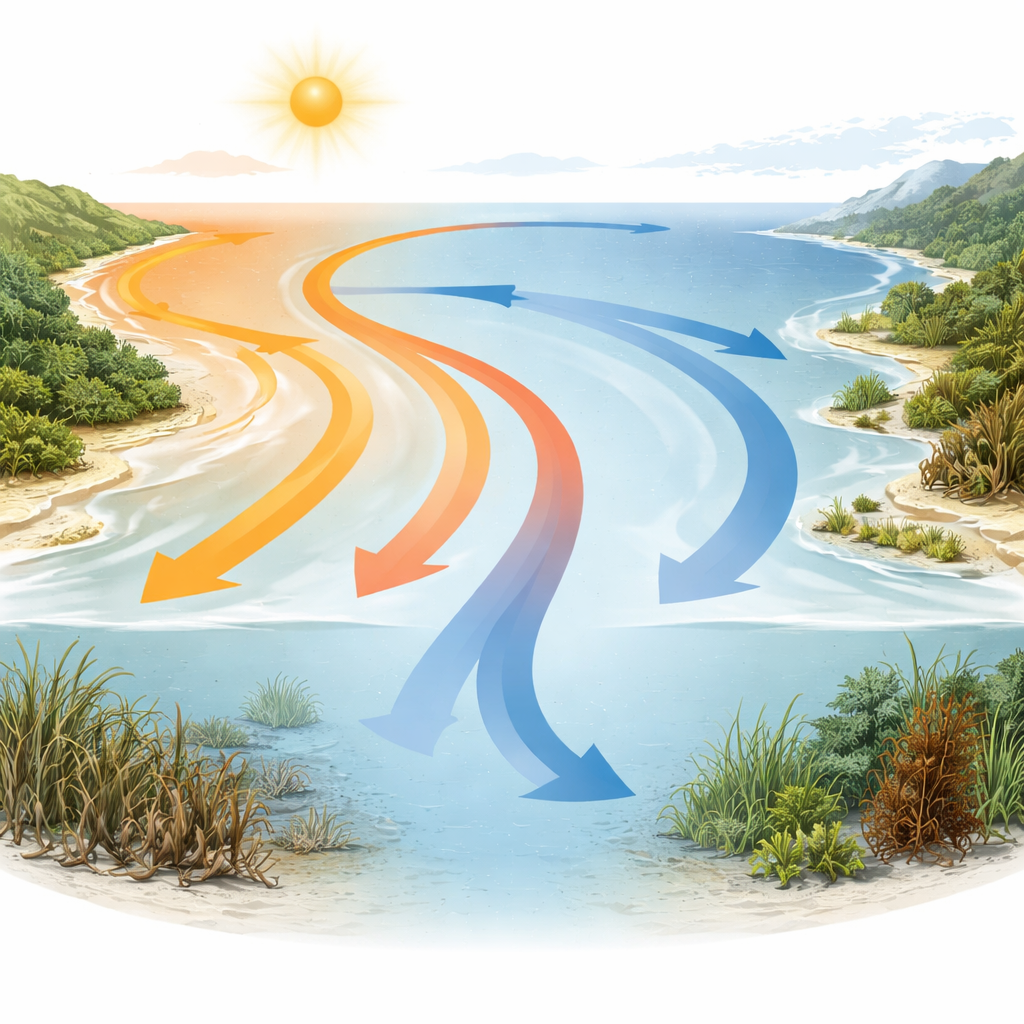
Climate change is already pushing many marine species toward the poles, where waters remain cooler. For seagrasses and brown macroalgae, computer models predict large losses of suitable habitat, especially under higher greenhouse gas emissions. In the most pessimistic scenario, seagrasses are projected to lose roughly half of their current habitat, and brown seaweeds close to three-fifths. While some new areas farther from the equator become suitable, especially in higher latitudes, the basic picture is one of contraction rather than simple relocation.
The invisible highways of the ocean
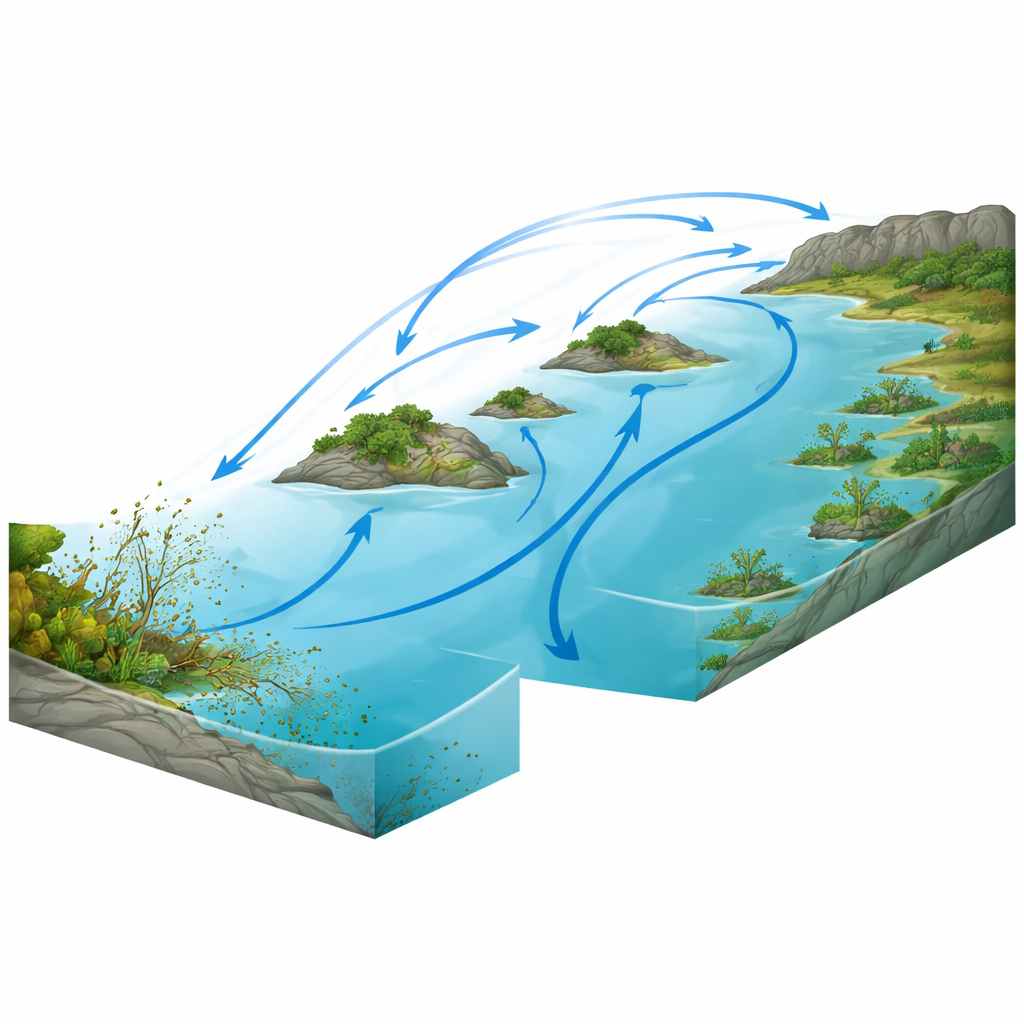
Whether these underwater forests can move into their new potential homes depends on a crucial but often overlooked factor: the paths followed by their drifting seeds, spores, and fragments. These microscopic or floating “propagules” travel mainly by riding ocean currents. The researchers combined detailed maps of present and future suitable habitat with a global model of ocean circulation that simulates how propagules move over days to months. They examined 467 species and explored different assumptions about how long propagules can survive and stay afloat before settling.
Currents as bridges—and as walls
When the team assumed that species could disperse freely to any suitable area, models suggested modest gains at higher latitudes that partly offset the losses in today’s warm regions. But once real oceanographic connectivity was added, these hopeful expansions shrank dramatically. Depending on the group and dispersal scenario, range expansions in area were cut by up to about half, and the distances species were able to shift shrank by roughly two-thirds. Under more conservative assumptions—where propagules survive for shorter periods—expansions were even more restricted, and many colonization routes required long chains of “stepping-stone” sites across multiple generations that rarely materialized in the model.
Hotspots at risk and refuges out of reach
The study maps where today’s marine forests are richest and where they are most vulnerable. Present hotspots for seagrasses cluster in the Indo-Pacific, West Africa, and Australia, while brown seaweed diversity peaks in the Indo-Pacific, around Australia, the Northeast Pacific, the western Mediterranean and nearby Atlantic, and the British Isles. These same regions, especially parts of the Indo-Pacific like the East China, Philippine, and Java seas, are projected to suffer severe losses of species. At the same time, several cooler regions—such as the Okhotsk Sea, New Zealand, southern Australia, southern Angola, and parts of the Arctic and North Pacific—look highly suitable in future climate scenarios. Yet the ocean current simulations show strong dispersal barriers into many of these prospective refuges, meaning they may remain largely empty of marine forests even if the climate there becomes favorable.
Rethinking how we protect ocean life
For non-specialists, the central message is that it is not enough to ask where the climate will be right for marine life; we must also ask whether ocean currents will actually deliver the organisms there. This work shows that, for seagrasses and brown seaweeds, currents often act like walls rather than highways, sharply limiting their ability to follow shifting climate zones. As a result, more species are likely to end up with net habitat losses than climate-only models suggest. For conservation and coastal planning, this means that protecting underwater forests cannot rely solely on “climate-smart” maps of future suitable areas. Instead, strategies such as well-placed marine protected areas, restoration projects, and even assisted movement of species need to be designed with oceanographic connectivity in mind, so that these critical habitats—and the benefits they provide to people—have a fighting chance in a rapidly changing ocean.
Citation: Assis, J., Fragkopoulou, E., Serrão, E.A. et al. Oceanographic connectivity strongly restricts future range expansions of critical marine forest species. npj biodivers 5, 10 (2026). https://doi.org/10.1038/s44185-026-00123-y
Keywords: marine forests, ocean currents, climate change, seagrass, kelp