Clear Sky Science · en
A systematic review of higher education-based interventions to support the mental health and wellbeing of neurodivergent students
Why this matters for students and families
More and more students who think and learn differently—such as those with autism, ADHD, or dyslexia—are enrolling in colleges and universities. Yet the support they receive often centers on exam accommodations rather than how they feel, cope, and thrive day to day. This article reviews what universities around the world are actually doing to support the mental health and wellbeing of these neurodivergent students, and asks whether current efforts build on students’ strengths or focus mainly on their perceived weaknesses. 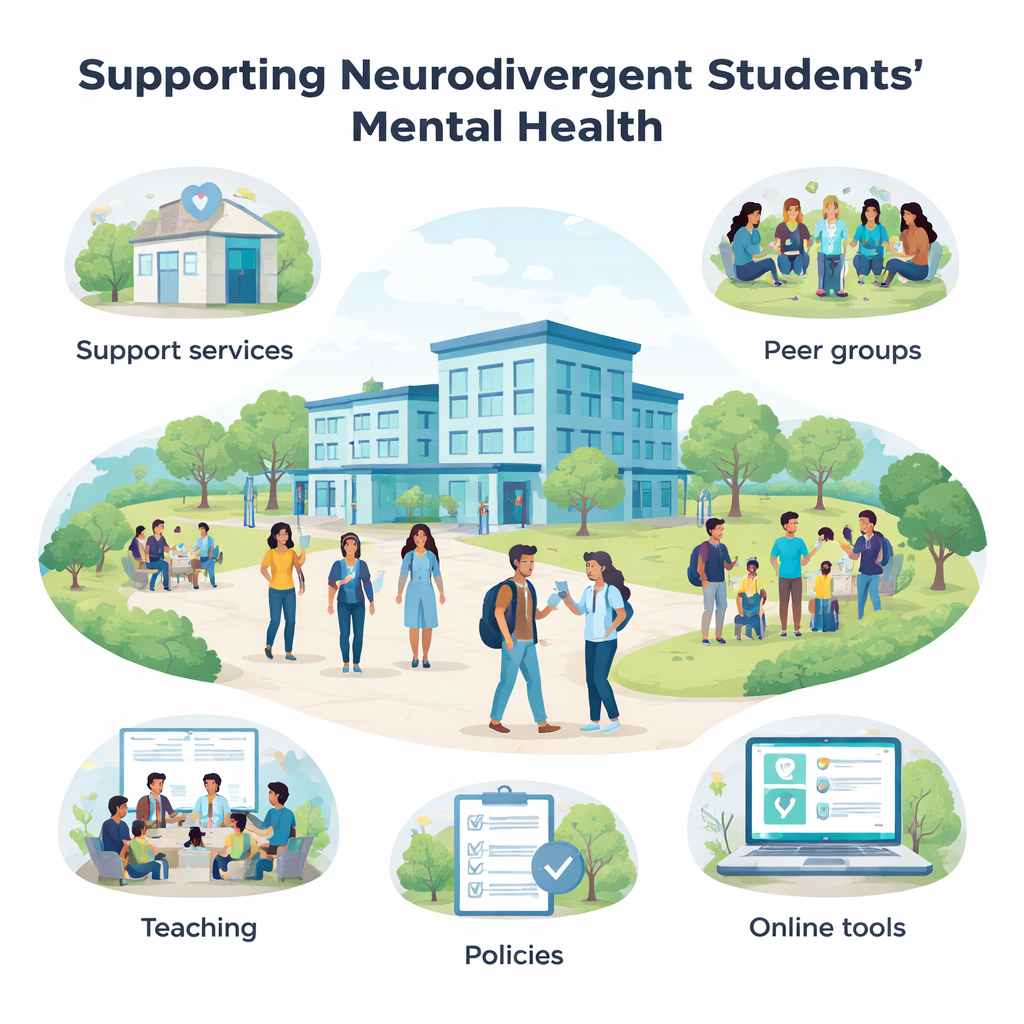
Who is being studied and what counts as support
The authors searched major research databases for studies of adults in higher education who were described as neurodivergent—covering autism, ADHD, dyslexia, dyspraxia and related conditions. To be included, a study had to test some form of support that aimed either to improve mental health directly (for example, reducing anxiety or depression) or to improve the student experience in ways likely to affect wellbeing, such as easing the transition into university. They found 37 studies from seven countries, most of them carried out in the United States. Nearly all focused on students with ADHD or autism; there was very little work on other forms of neurodivergence, and almost none on students with more than one diagnosis, even though this is very common.
What kinds of help universities are trying
The review uncovered a wide variety of interventions. Some were forms of talking therapy, including cognitive behavioural therapy (CBT), group therapy and general counselling. Others used coaching to build study habits and time-management skills, or mentoring and peer-support schemes to reduce loneliness and boost confidence. A smaller number tested mindfulness courses, biofeedback, structured transition programs that introduce autistic students to campus life in advance, or practical classes such as cooking to support independent living. These programmes varied widely in length—from just a few weeks to more than a semester—and were led by everyone from trainee psychologists and specialist clinicians to student peers and academic staff. 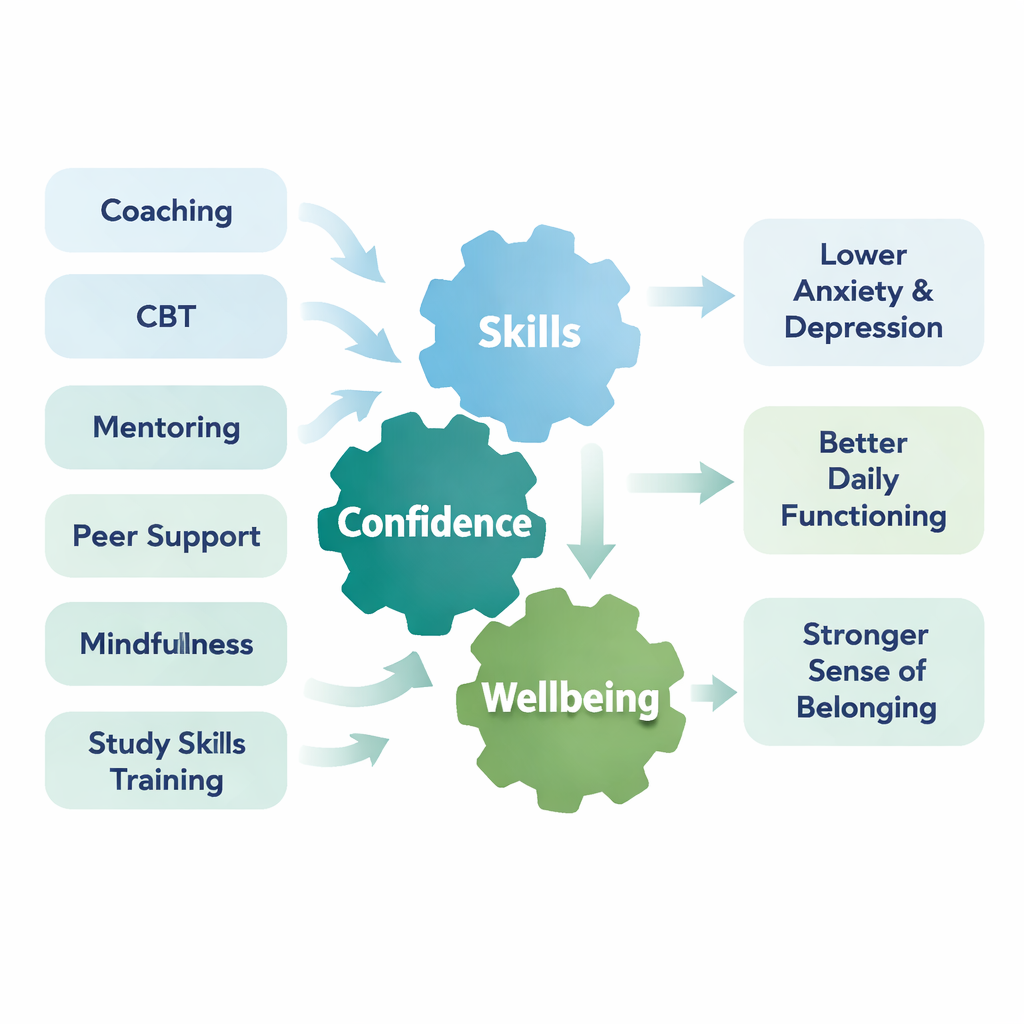
What seems to work—and for whom
Across studies, many interventions showed at least some positive effects. Students often reported less anxiety and depression, improved attention and organisation, and greater self-esteem or academic confidence after taking part. For example, several CBT and coaching programmes helped students with ADHD feel better able to manage their studies and daily routines. Support groups and specialist mentoring for autistic students reduced loneliness and boosted feelings of connection on campus. However, most studies were small, and the research methods and outcome measures differed so much that the authors could not combine results into a single overall estimate of effectiveness. Quality checks suggested that many studies had limitations, such as unclear sampling or incomplete information about how the programmes were delivered.
Strengths versus deficits in how support is framed
A central question in the review was whether universities are helping neurodivergent students by building on what they are good at, or mainly trying to “fix” what is seen as wrong. Here the findings were striking. Only two studies clearly described strength-based approaches, such as mentoring that focused on students’ abilities and potential, or coaching that helped them understand and use their neurodivergent traits as assets. Most interventions instead aimed to reduce symptoms or “correct” behaviours—for example, by targeting inattention, social differences, or emotional reactions—often without acknowledging that these traits may also be linked to creativity, deep focus, or different but valid communication styles. Very few projects involved neurodivergent students in designing the support they received, despite growing evidence that co-created programmes are more relevant and respectful.
What is missing and where we go next
The review highlights who is being left out. Research has focused heavily on White students in the United States with either ADHD or autism. There was almost no evidence on students with dyscalculia, dyspraxia, OCD, Tourette’s, or multiple overlapping conditions, and little attention to how race, gender, or culture shape people’s experiences. Because most interventions are time-intensive and delivered by professionals, they may also be expensive or difficult for universities to scale up. The authors argue that future work should involve neurodivergent students as partners from the start, aim to recognise and build on their strengths, and consider whole-campus changes—such as more flexible teaching and genuinely inclusive policies—rather than relying mainly on one-to-one, deficit-focused services.
What this means in everyday terms
For a lay reader, the message is clear: universities are starting to experiment with ways to support neurodivergent students’ mental health, and many of these efforts can help. But most current programmes still treat neurodivergence as a problem to be fixed rather than a different way of being that comes with both challenges and strengths. There is an urgent need for more inclusive, co-designed, and strength-based approaches that recognise neurodivergent students as experts in their own lives and reshape university environments so that a wider range of minds can flourish.
Citation: Ross, F., Dommett, E.J. & Byrom, N. A systematic review of higher education-based interventions to support the mental health and wellbeing of neurodivergent students. npj Mental Health Res 5, 14 (2026). https://doi.org/10.1038/s44184-026-00196-4
Keywords: neurodivergent students, university mental health, strength-based support, ADHD and autism in higher education, inclusive campus interventions