Clear Sky Science · en
Joint models targeting U.S. Army soldiers at high-risk of post-separation unemployment, homelessness, and suicide-related behaviors
Why this matters to life after military service
Every year, nearly 200,000 Americans leave the armed forces and step into civilian life. For many, this transition is bumpy: finding steady work, keeping a roof overhead, and staying mentally healthy can be real challenges. This study asks a practical question with life-or-death consequences: can we use information gathered before a soldier leaves the Army to spot who is most likely to face homelessness or suicidal behavior afterward, so that scarce support services can be focused where they are needed most?
Following soldiers beyond the uniform
The researchers drew on a large, long-running project that has followed tens of thousands of U.S. Army soldiers from active duty into civilian life. From this broader effort, they focused on 7,188 former Regular Army soldiers who had completed detailed surveys about their background, military career, health, and life experiences. These survey answers were linked to follow-up information on what happened to them in the first three years after they left active duty: whether they were unemployed, experienced homelessness, made a nonfatal suicide attempt, or died by suicide. For suicide deaths, the team relied on an earlier model built from administrative records on nearly a million former soldiers.
Turning survey answers into risk signals
To turn these data into usable warnings, the team used modern prediction tools borrowed from computer science. Rather than rely on a single statistical formula, they combined several methods into an “ensemble” that looks for complex patterns linking pre-separation information to later outcomes. They tested models for three outcomes over the first three years after separation: unemployment at the time of survey; homelessness at any point; and nonfatal suicide attempt. For each outcome, the model produced a predicted probability, essentially a personalized risk estimate based solely on information that could in principle be collected during standard transition programs.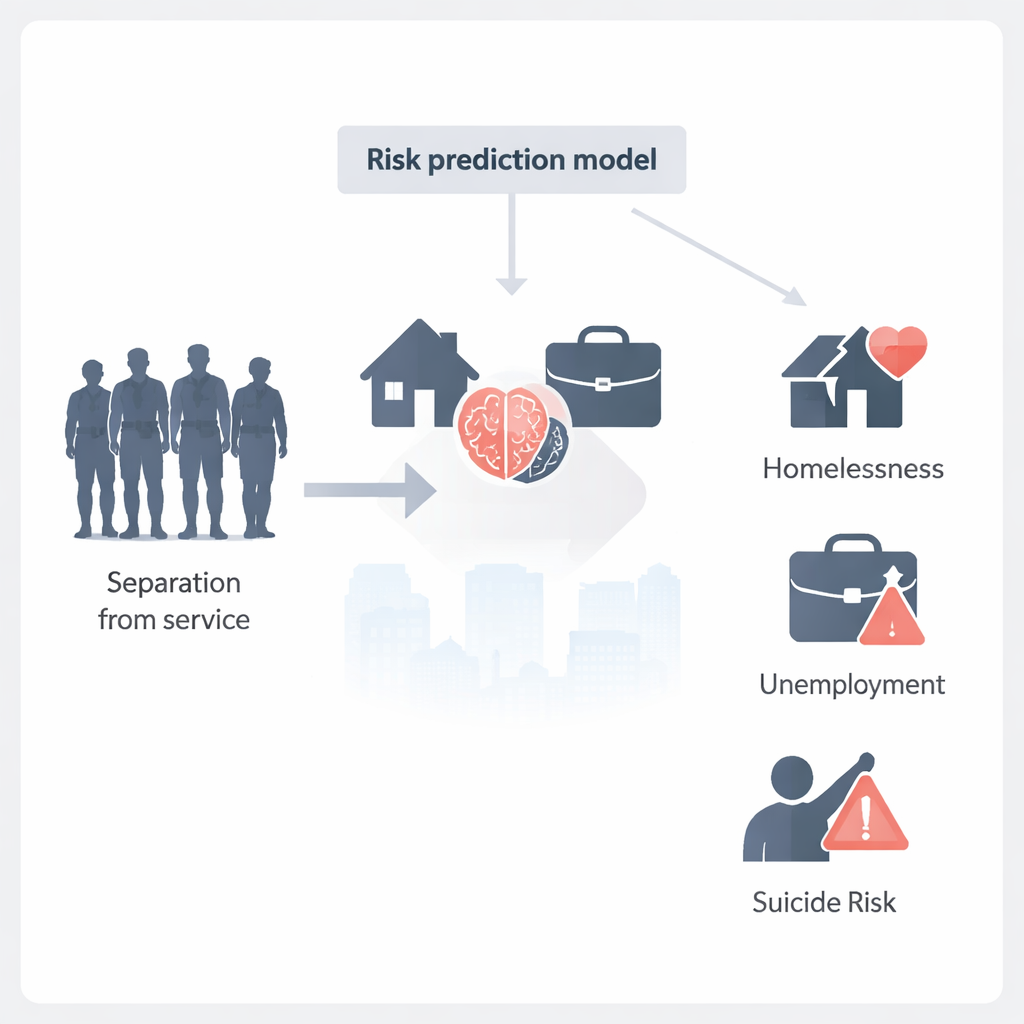
What the models could and could not predict
The models performed unevenly across outcomes. The homelessness model reached a moderate level of accuracy, and the suicide-attempt model performed even better. When the researchers ranked former soldiers by predicted risk and looked at the top slices of the distribution, they found meaningful “concentration of risk.” The 10% of soldiers with the highest predicted risk of homelessness accounted for about 27% of those who actually became homeless, and roughly 1 in 12 people in this high-risk group experienced homelessness within a year. For suicide attempts, the top 20% of predicted risk captured about 61% of all post-separation attempts, with roughly 1 in 30 attempting suicide in a year. By contrast, the unemployment model was only slightly better than chance and was not considered useful for targeting support.
Overlapping dangers, different needs
Because the same person might be at risk for more than one bad outcome, the researchers next asked how these risks overlap. Using the homelessness and suicide-attempt models plus the earlier suicide-death model, they labeled each person as “high risk” or not for each outcome and cross-classified the results. Just over 28% of former soldiers fell into a high-risk group for at least one outcome: 18% were high risk for only one problem, while about 10% were high risk for two or all three. Those with multiple risks showed especially high concentrations of actual homelessness and suicide attempts, suggesting that they might need more intensive, wraparound services. At the same time, many individuals flagged as high risk for one outcome were not high risk for the others, implying that programs focused on a single issue may miss important vulnerabilities elsewhere.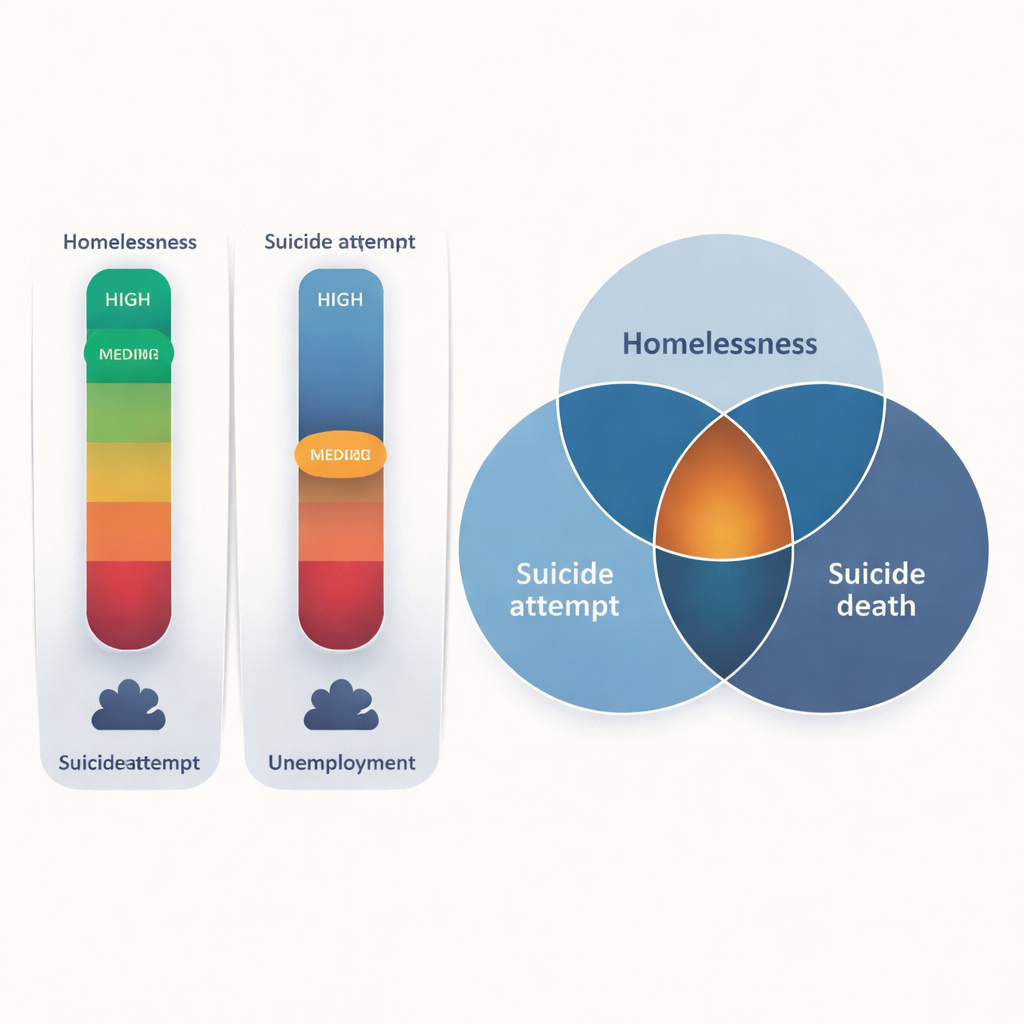
What shapes these risks
The team also examined, in broad strokes, which kinds of factors most strongly influenced the predictions. Measures of mental health and prior self-injury were generally the most powerful class of predictors, especially for suicide attempts. Army career features—such as leaving service at a younger age, having a lower rank, fewer months on active duty, or receiving a less-than-honorable discharge—were strongly linked to homelessness risk. Life stressors and socioeconomic factors contributed as well. Importantly, the researchers stress that these are not simple cause-and-effect findings, but patterns that help sharpen the models’ ability to flag who might need extra support.
From prediction to better support
For a layperson, the main takeaway is that carefully analyzing information collected before soldiers leave active duty can meaningfully improve our ability to identify who is most likely to struggle with homelessness or suicidal behavior in the years that follow. Unemployment, at least as measured in this study, proved harder to forecast. The authors argue that, once effective interventions are clearly defined and tested, such risk tools could help move beyond one-size-fits-all transition programs. Instead, resources could be tailored—lighter-touch services for those at low risk, focused housing help for those flagged mainly for homelessness, suicide-focused care for those at risk of self-harm, and more intensive, coordinated support for the smaller group facing multiple serious risks.
Citation: Borowski, S., Edwards, E.R., Geraci, J.C. et al. Joint models targeting U.S. Army soldiers at high-risk of post-separation unemployment, homelessness, and suicide-related behaviors. npj Mental Health Res 5, 10 (2026). https://doi.org/10.1038/s44184-026-00192-8
Keywords: military transition, homelessness, suicide prevention, veterans, machine learning