Clear Sky Science · en
Longitudinal associations of dispositional forgivingness with multidimensional well-being: a two-wave outcome-wide analysis in the Global Flourishing Study
Why Letting Go Matters
Most people have been hurt by someone else and know how hard it can be to forgive. This study asks a simple but important question: when people are more inclined to forgive those who wrong them, does their life actually go better over time? Using massive survey data from around the globe, the researchers look at whether a forgiving mindset today is linked with better mental health, relationships, and overall quality of life about a year later.
A Global Look at Forgiveness
The research draws on the Global Flourishing Study, an ambitious project that follows nationally representative samples of adults from 23 countries, together covering roughly two-thirds of the world’s population. More than 200,000 people answered questions about how often they forgive those who hurt them and reported on many aspects of their lives, from happiness and health to relationships and finances. About a year later, many of the same people were surveyed again. This allowed the team to see whether people who more often said they “often” or “always” forgave others tended to fare better later on than those who “rarely” or “never” forgave.
Forgiveness and Everyday Well-Being
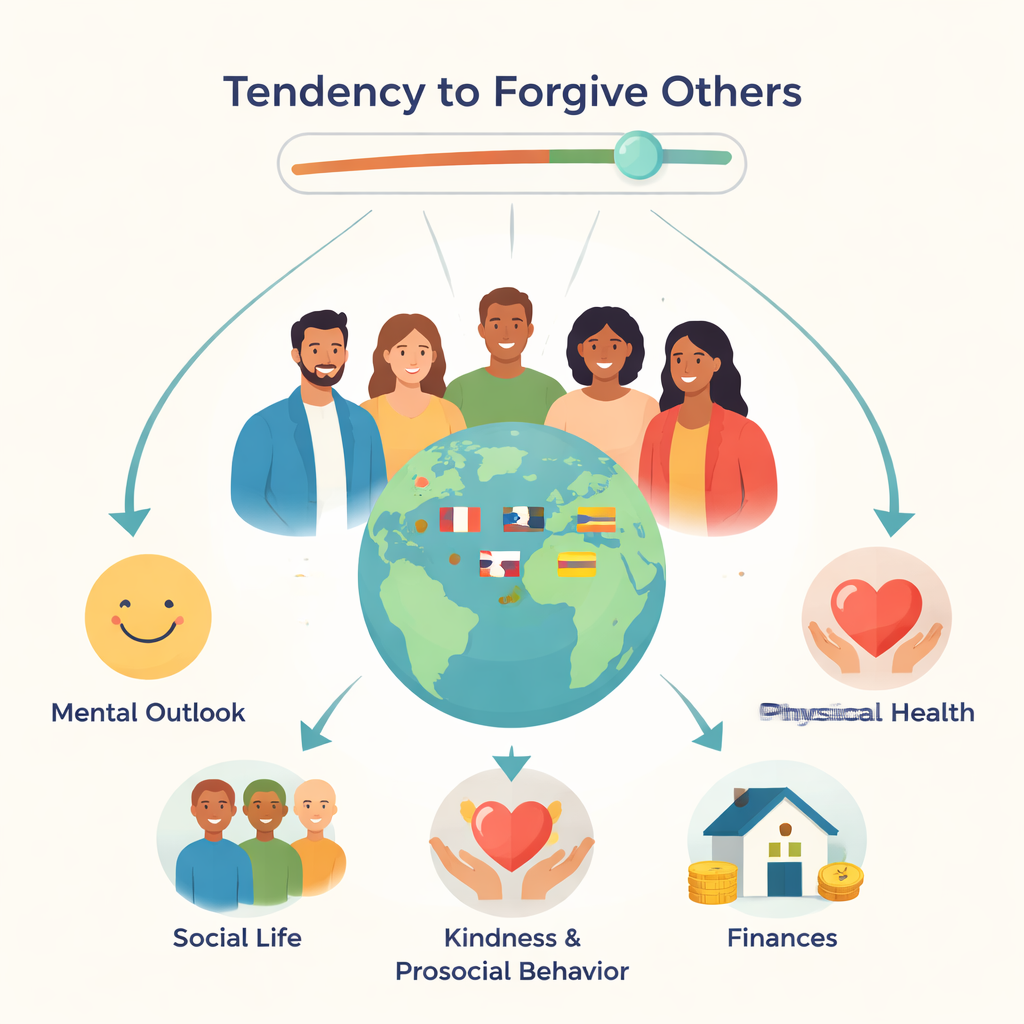
To make sense of such a large dataset, the researchers used an “outcome-wide” approach. Instead of focusing on just one result, they examined 56 different outcomes spanning mental and emotional life, social connections, physical health and habits, character and kindness, and material security. They ran similar statistical models separately in each country, carefully adjusting for people’s background (such as age, gender, education, work status, and childhood experiences) so that differences in forgivingness would be less likely to simply mirror those factors. They then combined the country-level results using meta-analysis, a technique that pools evidence to see the overall pattern.
Benefits That Are Small but Broad
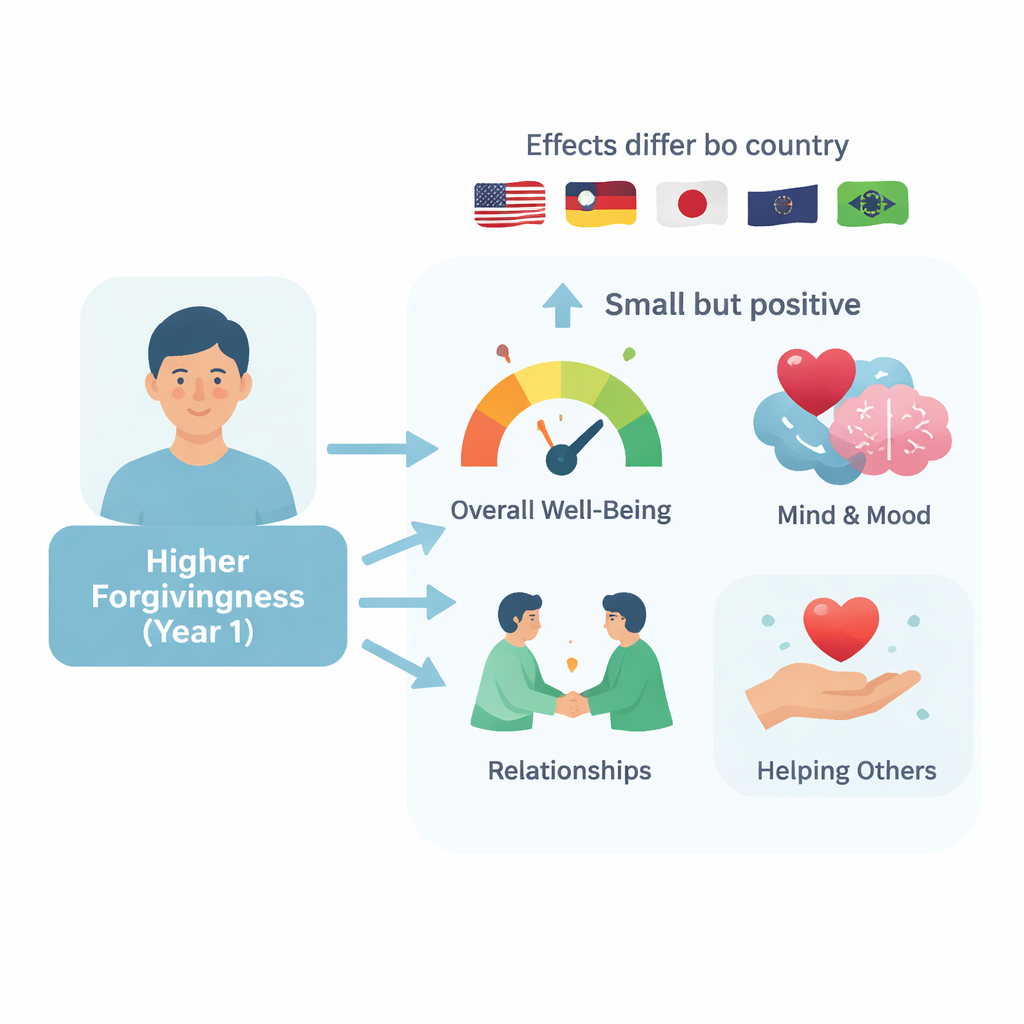
Across countries, people who tended to forgive more often showed slightly higher scores on broad measures of “flourishing,” which capture overall well-being across multiple areas of life. They also reported modestly better psychological well-being—more optimism, a clearer sense of purpose, feeling that their activities are meaningful, and better self-rated mental health. Socially, higher forgivingness was linked with greater satisfaction in close relationships, stronger social support, and a stronger sense of belonging in one’s country. People who forgave more also tended to describe themselves as more oriented toward doing good, more hopeful and grateful, and more likely to show love and care to others. The size of these associations was generally small, but they appeared consistently across many of the measures.
Where Forgiveness Helps Less
The links between forgivingness and other parts of life were weaker or more mixed. Associations with physical health and health behaviors—such as self-rated physical health, pain, smoking, drinking, and exercise—were small and sometimes barely detectable. Forgivingness was also only faintly related to material outcomes like income, education level, and job status. When the researchers used more conservative models that controlled for even more potential influences, many of the associations shrank further. This suggests that while forgivingness may play a role, it is one small piece in a much larger puzzle of life circumstances and personal traits.
Differences Across Countries
The impact of forgivingness was not identical everywhere. In some places, like the United States, Japan, Sweden, Brazil, Germany, and the United Kingdom, forgivingness was linked with better scores on many of the well-being outcomes studied. In other settings—including South Africa, Hong Kong, Indonesia, Nigeria, Turkey, and Egypt—the pattern was weaker, with few outcomes showing clear benefits. The authors note that broader social and economic conditions, cultural norms around forgiveness, and how common forgiveness already is in a society may all shape how strongly a forgiving disposition translates into better day-to-day life.
What This Means for Everyday Life
To a layperson, the message is straightforward: people who more often let go of grudges and forgive those who hurt them tend, on average, to report slightly better mental outlook, relationships, and sense of overall flourishing a year later, though the improvements are modest and vary by country. Forgiveness is not a magic cure, nor is it always safe or appropriate, especially in situations of ongoing harm. But as one part of a broader approach to coping with life’s hurts, cultivating a forgiving mindset may gently tilt the odds toward a richer, more connected, and more hopeful life.
Citation: Cowden, R.G., Worthington, E.L., Padgett, R.N. et al. Longitudinal associations of dispositional forgivingness with multidimensional well-being: a two-wave outcome-wide analysis in the Global Flourishing Study. npj Mental Health Res 5, 3 (2026). https://doi.org/10.1038/s44184-026-00187-5
Keywords: forgiveness, well-being, mental health, human flourishing, global survey