Clear Sky Science · en
Transmissive metasurface with 3.5-μm-thick liquid crystals for subterahertz-wave dynamic beamforming
Turning Windows into Smart Wave Guides
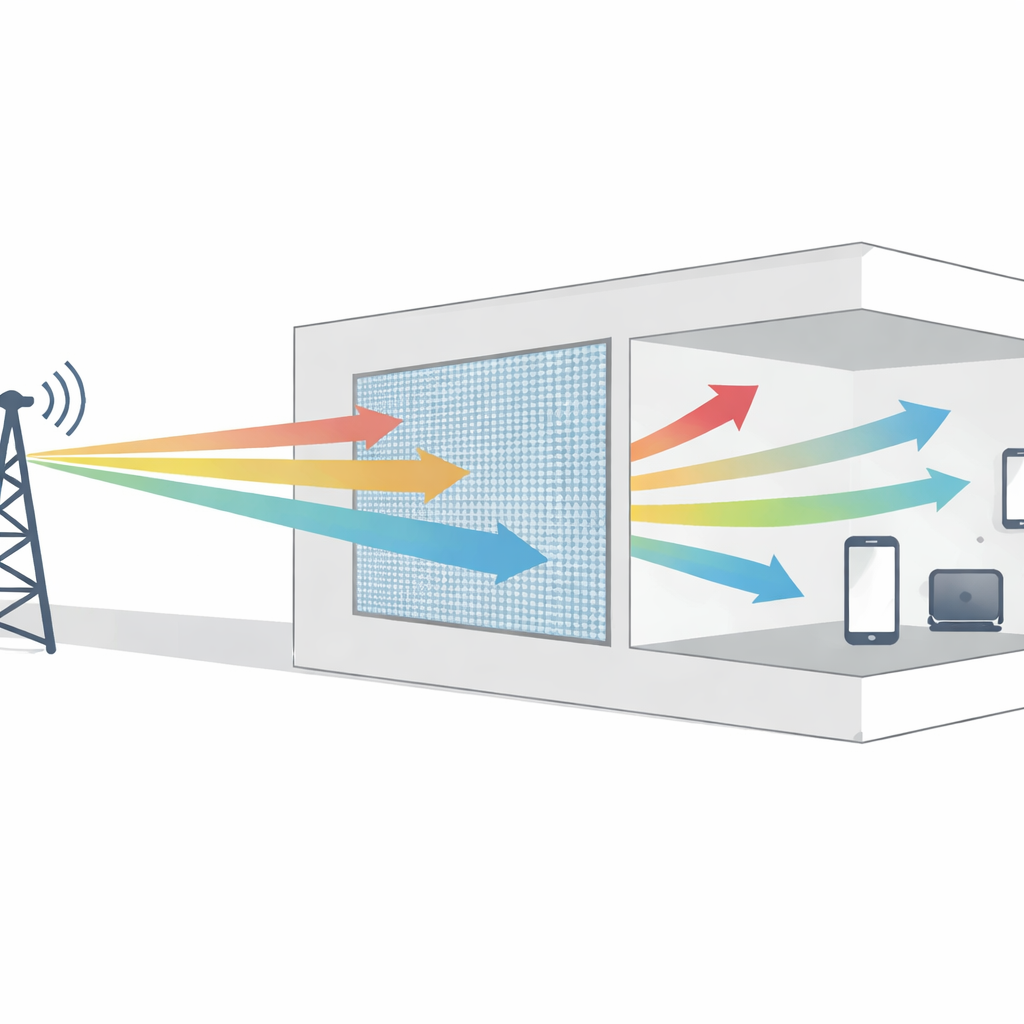
Future wireless networks will need far more data capacity than today’s systems can provide. One promising approach is to use extremely high radio frequencies, in the so‑called sub‑terahertz range, which can carry huge amounts of information but do not naturally bend well around walls or into shadowed corners. This study explores how ordinary‑looking windows coated with an ultra‑thin, LCD‑like layer can actively reshape these high‑frequency waves, steering them toward users and focusing them where coverage is needed most.
Why High‑Frequency Signals Need Help
As more devices compete for wireless bandwidth, engineers are eyeing frequencies around and above 100 gigahertz, where there is still plenty of unused spectrum. At these frequencies, however, radio waves travel almost like narrow beams of light: they prefer clear line‑of‑sight paths and struggle to reach receivers hidden behind obstacles or deep indoors. Simply turning up the power is not practical. Instead, researchers want to redesign the environment itself, using thin engineered surfaces on walls or windows that can redirect and shape the beams, forming new paths into hard‑to‑reach spaces.
A Wall of Tiny Adjustable Elements
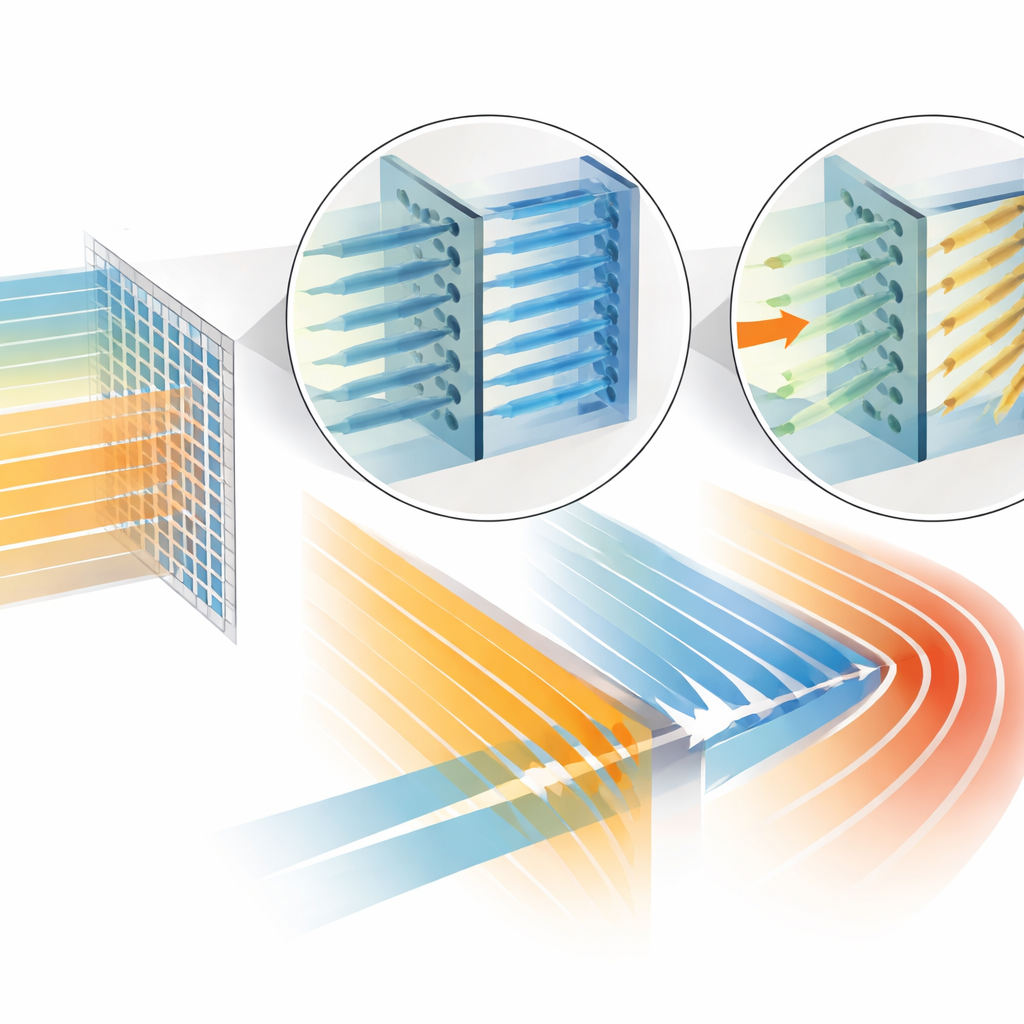
The device introduced in this work is a "metasurface"—a flat panel made from tens of thousands of tiny repeating cells, each smaller than one‑eighth of the wavelength of the radio waves it controls. At the heart of each cell is a layer of liquid crystal, the same class of material used in flat‑panel displays. The liquid crystal layer here is only 3.5 micrometers thick, similar to commercial display technology. By applying small voltages across patterned metal structures around this layer, the orientation of the liquid crystal molecules can be switched, slightly changing how each cell transmits the incoming radio wave. Putting many such cells together allows the panel to sculpt the overall outgoing beam.
A New Cell Design for Fast, Thin Control
Designing cells that work well with such a thin liquid crystal layer is not straightforward. Earlier approaches either required much thicker layers—slowing down the response and complicating manufacturing—or could not handle the linear polarizations used in real communication systems. The authors solve this with a special "stepped split‑ring" pattern of metal on either side of the liquid crystal. This pattern channels the electric field into the thin layer without relying on strong magnetic effects that would be too sensitive to thickness. The same basic geometry can be scaled to operate over a wide range of frequencies, from around 10 gigahertz up to the sub‑terahertz band, all while keeping the liquid crystal thickness compatible with display‑style fabrication.
Steering and Focusing Beams Through a Window
The researchers fabricated a 70‑millimeter‑wide panel containing 47,524 cells and tested it around 115 gigahertz. Using a simple on/off control of the cells—much like turning individual pixels dark or bright—they were able to shape the intensity of the transmitted wavefront. With only 218 control channels arranged in crossing rows and columns, the panel steered a beam by up to 30 degrees in two dimensions and focused energy to a chosen point in front of the surface. The device maintained reasonable performance across about 10 percent of its operating band and worked for both vertical and horizontal polarizations, a key requirement for practical wireless links.
Steps Toward Practical Smart Surfaces
From a lay perspective, this work shows that we can turn something as ordinary as a window into a smart, nearly transparent lens for high‑frequency radio waves, using technology closely related to mass‑produced LCDs. The ultra‑thin liquid crystal layer allows fast response times and makes large‑area panels feasible, while the new cell design provides enough control to steer and focus beams without bulky hardware. As networks evolve toward so‑called 6G systems that rely on sub‑terahertz bands, such metasurfaces could quietly sit on building facades, dynamically redirecting signals to fill coverage gaps and deliver high‑speed connections where they are needed.
Citation: Kitayama, D., Kagami, H., Pander, A. et al. Transmissive metasurface with 3.5-μm-thick liquid crystals for subterahertz-wave dynamic beamforming. Commun Eng 5, 56 (2026). https://doi.org/10.1038/s44172-026-00635-2
Keywords: reconfigurable intelligent surface, liquid crystal metasurface, subterahertz wireless, beam steering, 6G communications