Clear Sky Science · en
A Metal Hydride Compressor Concept using Hydrogen as a Heat Transfer Fluid
A New Way to Squeeze Hydrogen
Hydrogen is often hailed as a clean fuel of the future, but getting it into tanks at high pressure still costs a lot of energy and money. Today’s hydrogen refueling stations rely on large mechanical compressors that are noisy, wear out over time, and waste significant electricity. This paper explores a different kind of compressor that has no pistons and almost no moving parts. Instead, it uses special metal powders that soak up and release hydrogen, and—crucially—uses hydrogen gas itself to move heat around inside the system. The result is a concept that could compress hydrogen more quietly, with less electricity, and by tapping into waste heat that many industries already throw away.
Why Hydrogen Needs a Better Boost
Hydrogen gas at room conditions has a very low energy content per liter, which makes storing and moving it a challenge. To fill car tanks or supply industry, hydrogen must be compressed to very high pressures, typically hundreds of bar. Standard mechanical compressors can do this, but they consume 2–4 kilowatt-hours of electricity for every kilogram of hydrogen they compress and demand regular maintenance. They can also contaminate hydrogen with oils and create noise and vibration. Metal hydride compressors offer an alternative: they use alloys that reversibly absorb hydrogen when cooled and release it when heated, acting as a kind of thermal “sponge pump.” However, existing designs struggle to move heat efficiently through thick metal beds via slow heat conduction across heavy walls and heat exchangers, which limits how fast they can operate.
Turning Hydrogen into Its Own Cooling and Heating Agent
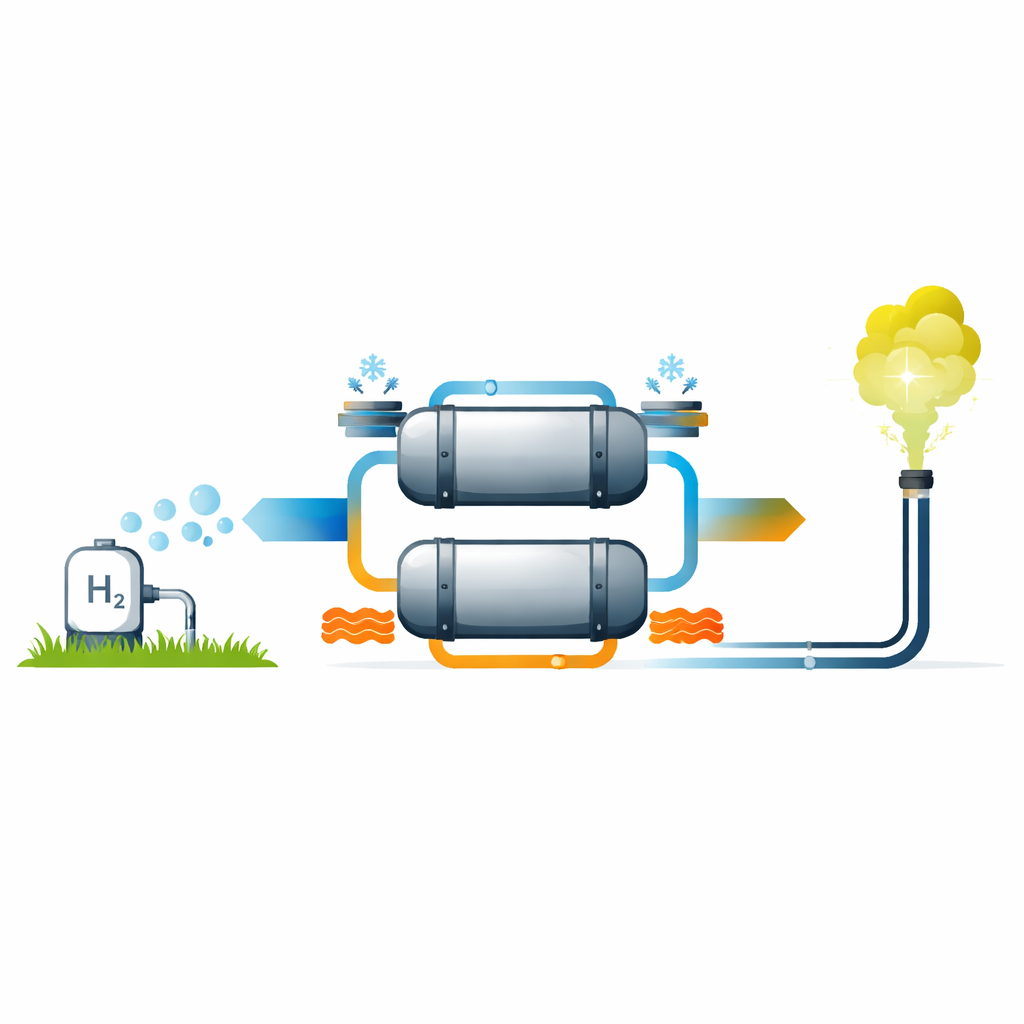
The authors propose a new compressor design called the “Hydrogen Loop,” in which hydrogen is both the gas being compressed and the fluid that transports heat. Two tanks packed with metal hydride powder are connected in a closed gas circuit with a blower and heat exchanger. Cool hydrogen is circulated directly through one tank, carrying away the heat released as the metal absorbs hydrogen. At the same time, hot hydrogen is circulated through the other tank, delivering heat needed to drive hydrogen back out of the metal. External gas–liquid heat exchangers add or remove heat from these two loops, but no bulky internal metal heat exchangers are needed inside the pressure vessels. After one tank has filled with hydrogen and the other has emptied, the pressures are briefly equalized, valves switch the hot and cold loops to the opposite tanks, and the cycle repeats—continuously taking in hydrogen at a lower pressure and delivering it at a higher one.
Testing the Idea in Detailed Computer Models
To see whether this concept could work in practice, the team built a dynamic computer model of the full system using commercial simulation software. They modeled the complex processes inside the metal powder beds—hydrogen flow, heat transfer, and chemical reaction—using a one-dimensional representation that they verified against more detailed three-dimensional simulations. The design used two tanks containing a total of 100 kilograms of metal hydride made from robust intermetallic alloys already known to withstand thousands of cycles. By running case studies over a range of inlet and outlet pressures, and assuming realistic heating and cooling between 10 °C and 90 °C, they examined how much hydrogen the compressor could process per hour and how much electrical power the blower would consume. A performance metric called the coefficient of performance compared the ideal work of compressing hydrogen to the actual electrical input.
How Fast and How Efficient Can It Be?
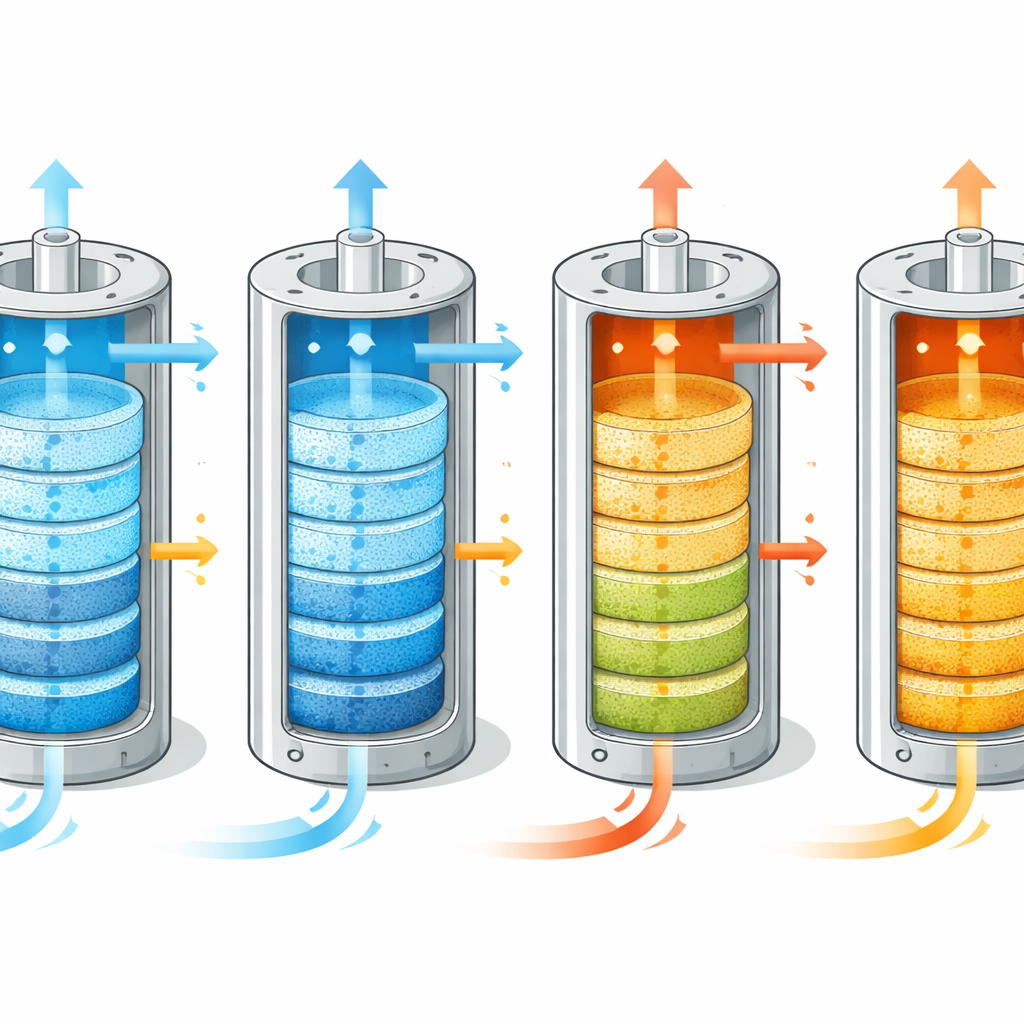
The simulations show that circulating hydrogen directly through the metal beds can dramatically improve heat transfer, allowing specific productivities of roughly 200–300 standard liters of hydrogen per hour for each kilogram of metal hydride. In some operating windows, the electrical efficiency of the Hydrogen Loop, measured as isothermal efficiency, surpassed the typical value of about 75 percent achieved by modern mechanical piston compressors. A sensitivity study revealed that the most important design factors are how easily hydrogen can flow through the powder bed—controlled by particle size and porosity—rather than the solid material’s thermal conductivity or the added volume of pipes and components. Interestingly, even the blower’s efficiency had only a moderate impact compared with these flow properties, because dense hydrogen at higher pressure naturally enhances heat transfer and reaction rates.
What This Could Mean for Future Hydrogen Systems
From an engineering standpoint, nearly all parts of the proposed compressor—tanks, valves, plate heat exchangers, and piping—are already available or can be built using standard pressure-rated hardware. The main missing piece is a blower designed to handle hydrogen at the required pressures. If developed, such a system could run largely on waste heat from industrial processes, drastically reducing the extra electricity needed for compression while avoiding oil contamination and moving mechanical parts. In simple terms, this study suggests that by letting hydrogen cool and heat itself as it shuttles through smartly arranged metal powders, we may be able to build quieter, more efficient, and more durable compressors that help make a hydrogen-based energy system more practical.
Citation: Fleming, L., Passing, M., Puszkiel, J. et al. A Metal Hydride Compressor Concept using Hydrogen as a Heat Transfer Fluid. Commun Eng 5, 49 (2026). https://doi.org/10.1038/s44172-026-00615-6
Keywords: hydrogen compression, metal hydride, waste heat utilization, hydrogen storage, clean energy infrastructure